
Summer rainfall declines ‘primary driver’ of surge in US wildfires
Sea of flames
California is currently facing its largest wildfires on record. Across the state, more than 332,000 hectares (820,000 acres) of forest have already been scorched – more than twice the area burnt during the same time last year. Out of the 15 largest wildfires ever recorded in California, 10 have occured since 2000. Across the western US, forest fires have become fives times more frequent and six times larger, on average, since the 1970s, research shows. As Carbon Brief recently explained in a detailed factcheck, the chances of a wildfire spreading and becoming large are affected by myriad factors. However, research shows that there is a correlation between rising spring and summer temperatures and the amount of land burned by forest fires in the western US in recent decades. When temperatures are warmer, rates of evaporation increase – meaning more moisture is drawn out from the land, leaving it dry. A parched land surface creates tinderbox conditions – allowing wildfires to spread more quickly. The new research, published in the Proceedings of the National Academy of Sciences, pinpoints a second important driver of wildfires – recent declines in summer rainfall. The findings suggest that such declines could be the main cause of increases in the severity of the wildfire season in recent years, says lead author Dr Zachary Holden, an ecologist from the US Forest Service in Missoula, Montana. He tells Carbon Brief:“We found that across large areas of the west, there have been significant declines in precipitation during the western fire season. We also found that the length of dry windows – consecutive days without any rain – are becoming longer.”
Declines in rainfall could be affecting the severity of wildfires in two main ways, he says. First, less rainfall leads to the drying out of vegetation – which can then act as tinder for a spreading fire. Second, long spells without rain cause more sunlight to be converted to heat at the Earth’s surface – leading to further drying at the land’s surface. Holden says:“Overall, we found that reduced precipitation has had a larger impact on historical trends in western wildfire activity than the effects of winter snowpack or air temperatures.”
Drying up
For the study, the researchers compared temperature and rainfall data taken from weather stations across the western US to forest fire data captured by satellites. The charts below show forest cover (left) and forest wildfire area burnt per year from 1984-2015 (right) in the western US.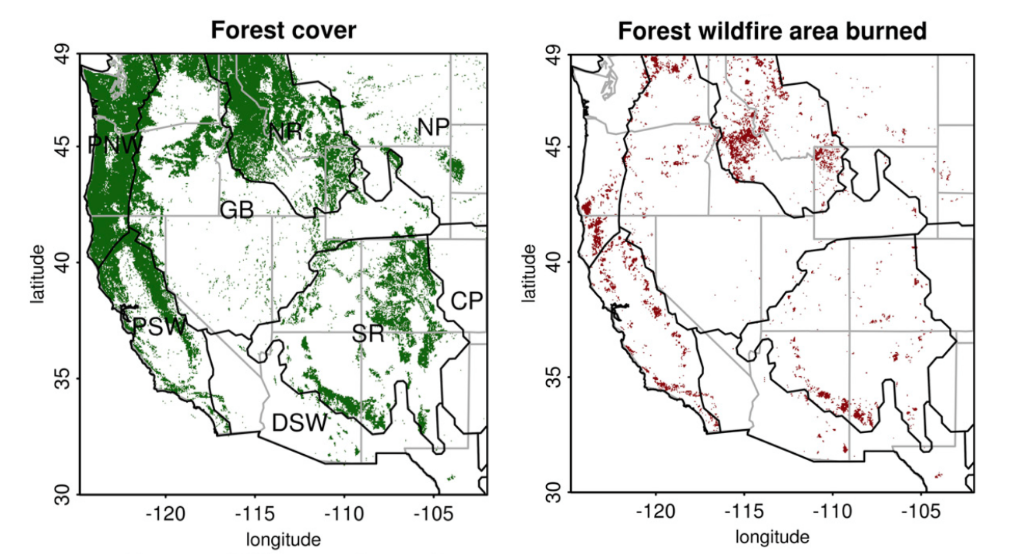
Rainy days
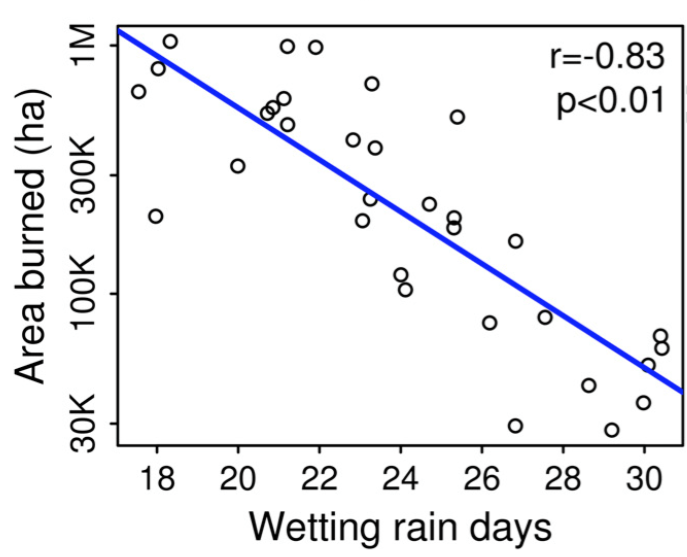
The researchers also looked at changes in the number of summer “wetting rain days” – days when rainfall exceeded 2.5mm. They found, on average, forests experienced one less wetting rain day per decade, while the worst affected forests experienced six fewer days per decade In addition, the researchers found that the average length of dry spells increased in many parts of the western US from one decade to the next. The maps below show changes to summer rainfall (left), number of rain days (middle) and the average length of time without rain (right) in the western US. The top and middle columns show the results from the two different datasets called “GRIDMET” and “DAYMET”, while the bottom column shows the results from individual weather stations (shown as dots). For the first two columns, red shows decreases while green shows increases. For the last column, green shows decreases while red shows increases.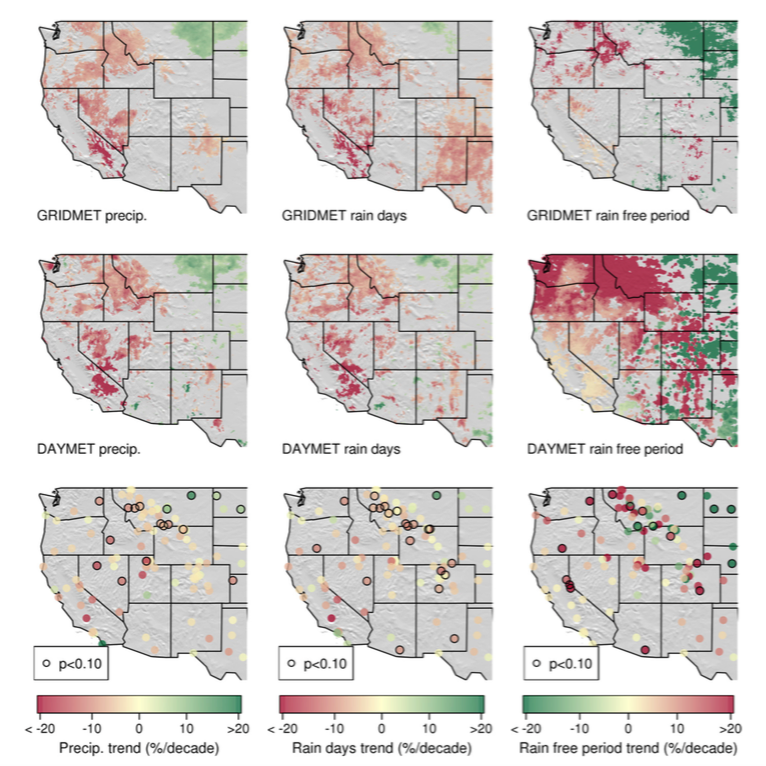
“We don’t know whether long rain-free periods in the west are likely to continue, or increase. Here in western Montana, we’ve just broken the historical record for the longest continuous number of days with no rain. If we see continued summer drying, we expect fire seasons to be as or more severe in the future.”
Link to sea ice?
The study did not aim to separate out the extent to which climate change and natural climate variability are behind the observed summer rainfall declines, Holden says. However, recent research suggests that the decline in Arctic sea ice extent – in part, caused by climate change – could be contributing to longer summer dry periods, he says. This is because declines in Arctic sea ice extent could be causing the winds that carry weather systems into the western US to weaken. The slowing of winds allows patterns of weather – such as a dry spell – to persist for longer over one area Holden says:“It’s likely a combination of both climate change – through sea ice changes – and natural variability – through ocean temperature variations – and further study is needed to better describe the drivers of these changes.”
The research “adds evidence” to what is known about how climatic factors influence the severity of wildfires in the western US, says Prof John Abatzoglou, a wildfire researcher from the University of Idaho, who was not involved in the study. He tells Carbon Brief:“Precipitation during the fire season is certainly an important factor as it helps raise fuel moisture and can aid in suppression efforts on active fires. The effect to which anthropogenic climate change is behind declines in summer precipitation in the west is unknown.”
However, the researchers may have overestimated the relative importance of rainfall in comparison to other drivers, such as “atmospheric aridity” – the general dryness of the air, says Prof Park Williams, a researcher in climate and ecology from Columbia University, who was also not involved in the study. He tells Carbon Brief:“The authors’ method seems to assume that all of the co-variability shared between precipitation and atmospheric aridity is due to precipitation. This undoubtedly leads to precipitation taking a little more credit than it should for year-to-year variations in burned area, and to atmospheric aridity consequently taking less than it should.”
Article information
Holden, Z. A. et al. (2018) Decreasing fire season precipitation increased recent western US forest wildfire activity, Proceedings of the National Academy of Sciences, doi/10.1073/pnas.1802316115