
Guest post: Credible tracking of land-use emissions under the Paris Agreement
Stocktake
The Paris Agreement calls for global warming to be limited to “well below 2C” and for GHG “neutrality” by the second half of this century. GHG neutrality requires that human-caused emissions must be balanced by GHG removals from the atmosphere. Achieving this balance requires two things to happen simultaneously – a dramatic reduction of fossil-fuel and land-based GHG emissions and creating “net CO2 sinks” (“negative emissions” that remove CO2 from the atmosphere). There is now a high expectation that a significant proportion of the required reduction in GHG emissions will come from changing the way we use land. This is evident in both the national pledges under Paris, where land use is assumed to provide up to a quarter of planned emission reductions by 2030, and in the model studies of pathways to achieve 2C. This potential includes reducing emissions from deforestation, as well as enhancing the current capacity of CO2 “sinks”. Globally, terrestrial ecosystems (mainly forests) absorb nearly one third of the total CO2 emissions caused by human activities. While new technologies to remove CO2 from the atmosphere will be eventually needed, forests are, at present, the most important CO2 sink that humans can manage. Unlike emissions from fossil fuel use and industry, emissions and sinks from land-based activities are notoriously difficult to measure and verify. In fact, a large discrepancy has already been identified between countries’ GHG inventories and independent global modelling studies. The Paris Agreement includes a periodic “global stocktake” every five years from 2023 to assess collective progress towards the long-term temperature goal in light of the “best available science”. To facilitate this assessment, historical human-caused emissions and future mitigation pledges (known as nationally determined contributions, or NDCs) will need to be compared with independent science benchmarks of both historical emissions and trajectories of what is necessary to meet the “well-below 2C” target. This approach requires that country GHG inventories and independent scientific estimates are consistent and comparable (as in the upper panel of the figure below). If country estimates are not consistent with science benchmarks (as in the lower panel), then the need for further action could be under or over estimated.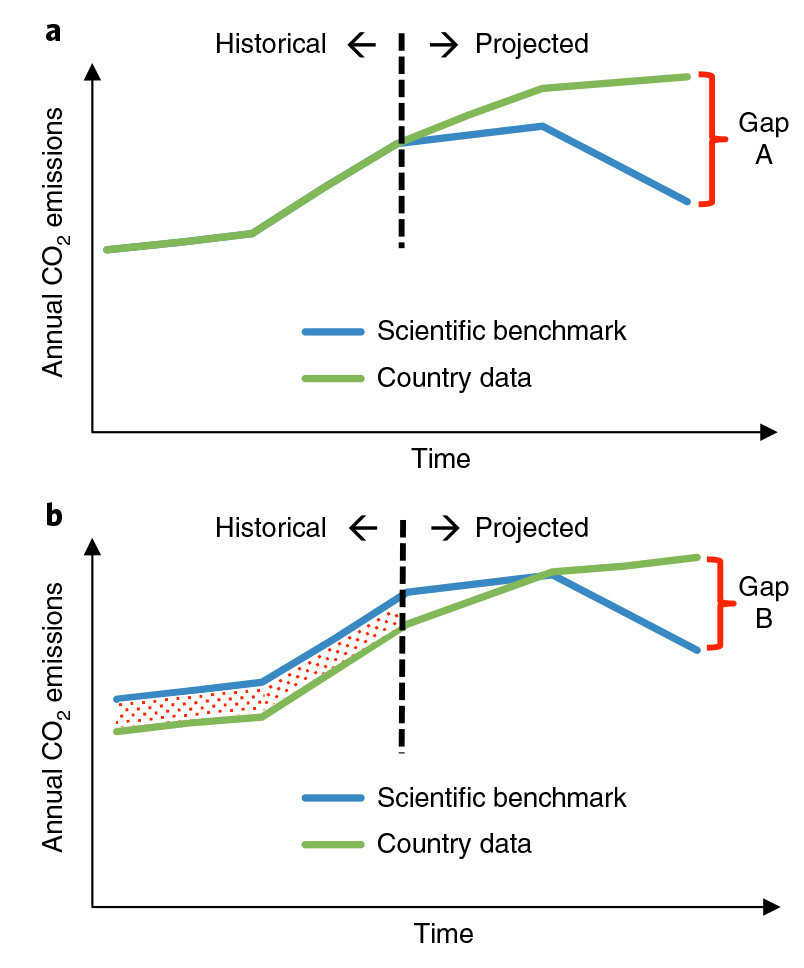
Conceptual gap
In our new study, we highlight a discrepancy of four gigatonnes of CO2 per year (GtCO2/y) in global land-related CO2 net emissions (for the period 2005-2014) between estimates based on countries’ GHG inventories reported to UNFCCC and independent scientific estimates from the global modelling community (as detailed by the Global Carbon Project and assessed in the Intergovernmental Panel on Climate Change’s, IPCC, fifth assessment report). This discrepancy is equivalent to 10% of total human-caused CO2 emissions over this period. To understand the reasons of this discrepancy, we have explored the impact of differences in estimating what part of a forest CO2 sink is “anthropogenic”, or human caused. Due to differences in purpose and scope, the scientific modelling community supporting the IPCC assessment reports and the IPCC guidelines for national GHG inventories (used by countries for their emission reporting) have developed different approaches to identify what “anthropogenic” means in relation to GHG sources and sinks from land. The main conceptual differences in defining the anthropogenic land CO2 flux between the IPCC AR5 and countries’ GHG inventories can be seen in the figure below. This chart shows the kind of effects influencing land CO2 fluxes (left), where these effects occur (centre), and how these effects are captured in the IPCC AR5 and in countries’ GHG inventories (right).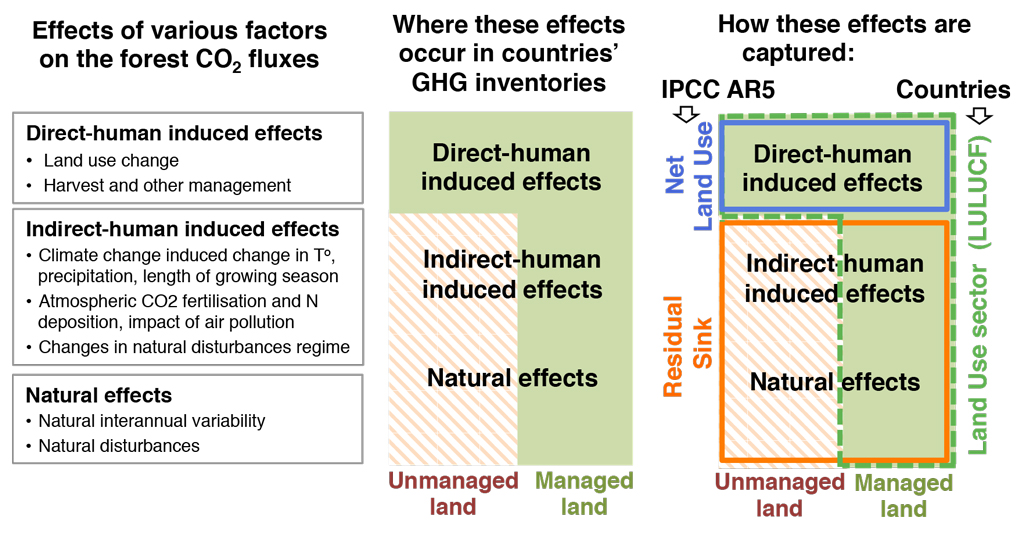
Speak the same language
In our paper, we have explored whether a different disaggregation and combination of global model results – through post-processing of existing estimates – may help reconcile the conceptual differences described above. Our framework adds up the modelled estimates associated with direct effects (blue box in earlier figure) with those associated with indirect and natural effects on areas that could be considered “managed forest” (i.e. the right part of orange box in the earlier figure). This sum is then compared with the anthropogenic forest fluxes from GHG inventories (dashed green box in the earlier figure). Our results shows that the large discrepancy (4 GtCO2/y globally) in land-related fluxes between GHG inventories (green column in figure below) and IPCC AR5 modelling studies (blue column) is associated mostly (80%) with differences in managed forest sink estimates. This gap can be largely reconciled when the impact of environmental change (indirect effects) on managed lands (orange columns) is added to the direct effects (blue column) from IPCC AR5 (total grey columns). An even greater reconciliation occurs when differences in managed land area between GHG inventories and global models are taken into account.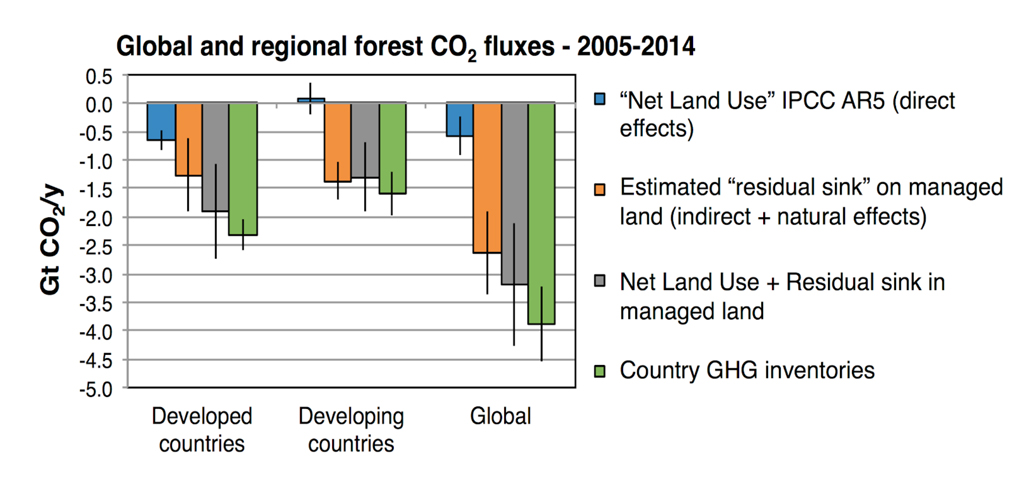
Recommendations
Our study shows a pragmatic way to reconcile the large discrepancy in the global net “anthropogenic” land CO2 flux estimates between countries GHG inventories and emissions trajectories assessed in IPCC assessment reports and provide concrete recommendations. For example, countries could provide more transparent and complete information on what is included in their GHG inventories. The global carbon modelling community could design model experiments and outputs to enable the results to be separated out in a way that is more comparable with countries’ inventories and, thus, more policy relevant.
Glossary
Integrated Assessment Models: IAMs are computer models that analyse a broad range of data – e.g. physical, economic and social – to produce information that can be used to help decision-making. For climate research, specifically,… Read More
Article information
Grassi, G., et al. (2018) Reconciling global model estimates and country reporting of anthropogenic forest CO2 sinks, Nature Climate Change, doi:10.1038/s41558-018-0283-x