
World must act quickly to govern solar geoengineering, report says

Heating up
From releasing aerosols into the atmosphere to sending a giant mirror to space, the proposed ideas for solar geoengineering – also known as solar radiation management (SRM) – vary widely in form. However, they all have the same aim of reflecting incoming sunlight back into space – which could, in theory, slow global temperature rise. This could protect the world from many of the impacts of global warming. However, it would not protect from rising CO2 levels – which is likely causing oceans to become more acidic and crops to become less nutritious, among other problems.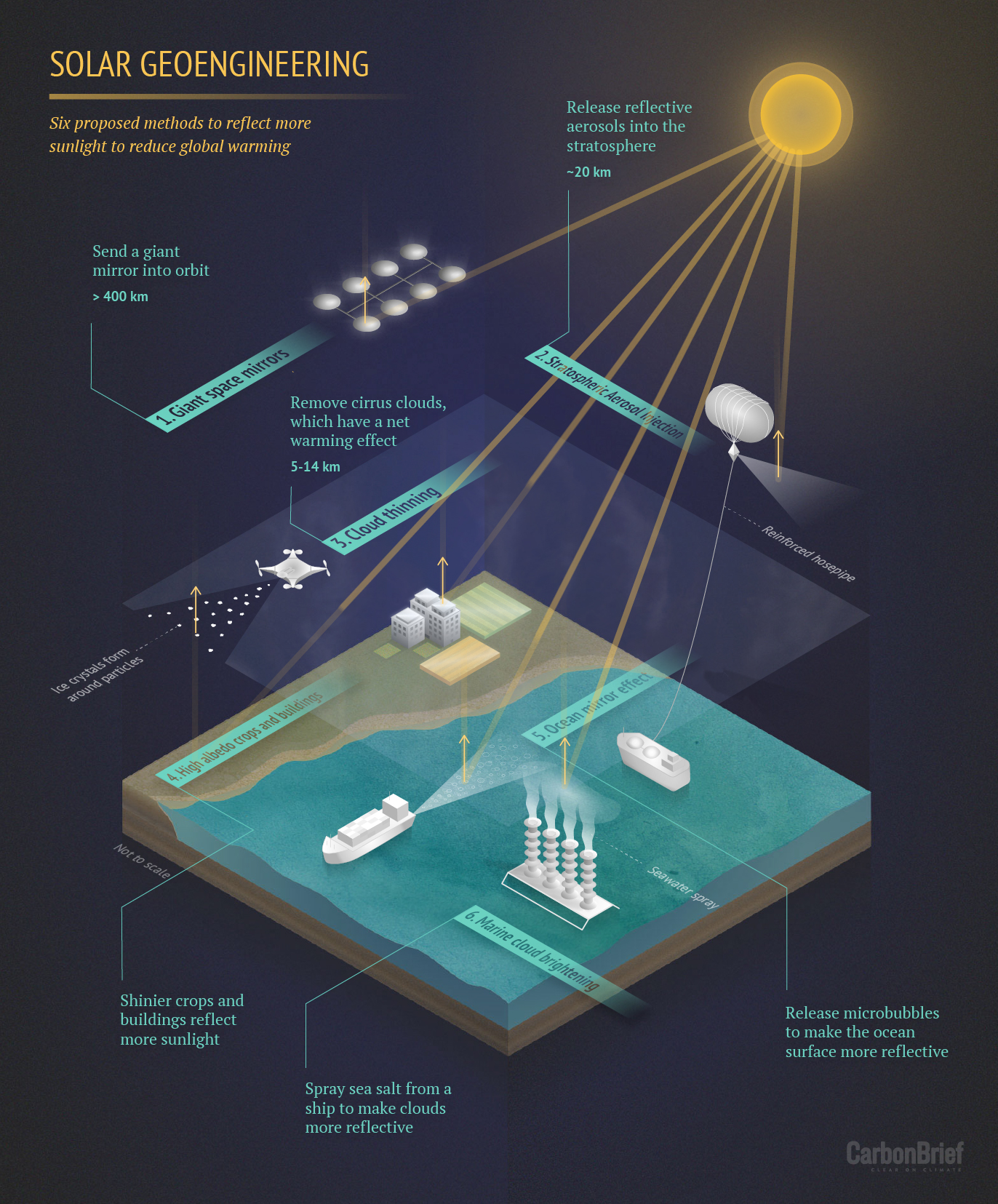
“Without governance, you really run the risk that whatever research is done could end up serving ends that are not related to the public interest – that could be disastrous.”
However, it is “not a given” that research in solar geoengineering will accelerate, she adds:“I don’t think the right way to look at this report is that we’re in imminent danger and research is running away from our ability to govern it. It’s very possible that 10 years from now, we’ll look back and who’ll remember SRM?”
Taking action
McKinnon is one of 14 governance experts who was asked to contribute to the report. Rather than technical expertise in solar geoengineering, the report authors instead hold experience in areas such as the social sciences, humanities, law and politics. Such authors were chosen to get “fresh eyes” on the topic, McKinnon says. One of the goals of the report was to provide a series of steps that the world could take to ensure solar geoengineering is subject to some kind of governance by 2025. The first of these is to establish a “World Commission on SRM”, which would debate “first-order questions about whether and to what end SRM should be researched and developed, and how it fits within a broader climate response landscape”, the report says. The commission would be established by the United Nations General Assembly, with members appointed by the UN secretary-general, the report says. The report also advocates establishing a separate “global forum” which would “allow deliberation by stakeholders who might otherwise be marginalised from international deliberations”. At present, most research into SRM is concentrated in the US and western Europe. In April, researchers from the global south published a letter in Nature calling for developing nations to take the lead on SRM research. The group argued that, since the impacts of climate change are likely to be most pronounced in developing nations, they should play a chief role in if and how technologies should be used to tackle it. The map below – which is taken from the new report – shows where research into SRM is currently taking place. On the map, dark blue indicates a relatively high level of research while grey indicates no research.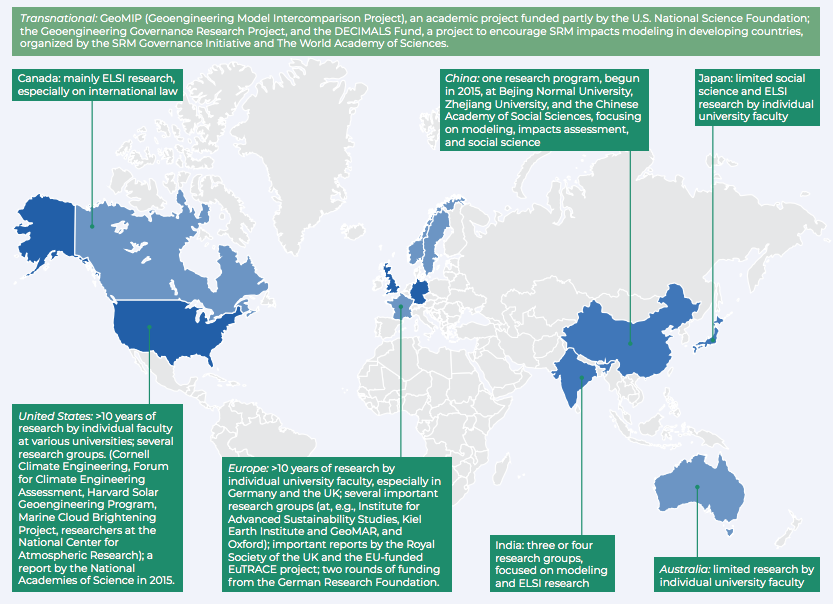
“A lot of the steps are very procedural and we don’t specify the mechanics of who should fit the bill. The UN is the obvious place to look for it.”
The other proposed steps are summarised in the table below. These include making better use of existing organisations – via the continuation of SRM research assessment by the Intergovernmental Panel on Climate Change (IPCC) and the development of “foresight tools” by the UN, which could be used to govern SRM research and possible deployment. Other steps aim to make SRM research “transparent and accountable”. This could be achieved by making any funding for SRM a matter of public record and by establishing of “codes of conduct” in countries where SRM research is currently underway, the authors say.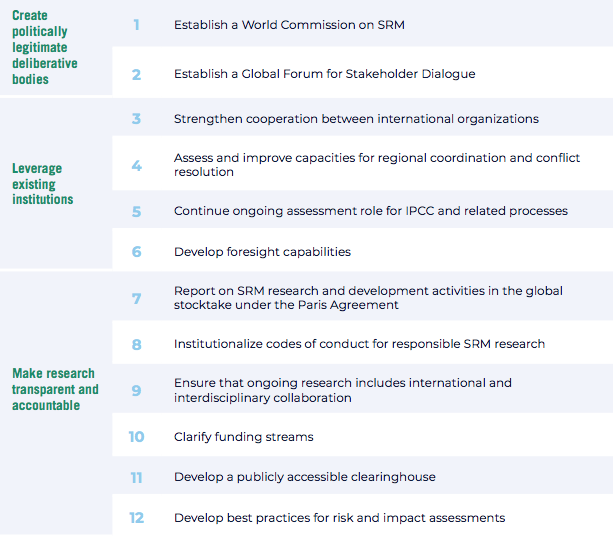
Urgent steps
The recommendations outlined in the report are “essential, practical first steps to manage controversies around research, guide the emerging public conversation about SRM and help build the scaffolding for whatever long-term governance may be required,” according to the authors. They add:“SRM technologies and policies will remain contentious…Recognition of disagreement, though, should not delay governance action. At this point, the idea of SRM can neither be wished away nor delegated to technicians.”
However, the report does not take a position on whether or not SRM should be carried out, nor does it propose that SRM should be seen as an alternative to mitigation, McKinnon says:“We’re all agreed that we ought to put mitigation first. That bears emphasising repeatedly and very strongly. None of us see SRM as a replacement for mitigation.”
Article information
Chhetri, N. et al. (2018) Governing Solar Radiation Management. Washington, DC: Forum for Climate Engineering Assessment, American University. https://doi.org/10.17606/M6SM17