
China Briefing 1 October 2026: Xi-Trump summit | ‘Trade war’ plea | ‘Strongest’ El Niño
Welcome to China Briefing, where Carbon Brief handpicks and explains the most important climate and energy stories from China over the past fortnight. Sign up below. In this edition…
-
- Trump-Xi summit skirted climate and inked a deal for coal.
- China urged EU to keep its car market open and avoid “a trade war”.
- Five-year plan for the battery industry released.
- Carbon Brief looks at China’s response to the unfolding El Niño.
- New science on wind potential, humid-heat extremes and GDP exposure.
Key developments
Xi-Trump summit
PRESIDENTIAL SUMMIT: The summit between Chinese president Xi Jinping and US president Donald Trump yielded an agreement for China to buy 10m tonnes of US coal a year in 2027 and 2028, roughly 2% of China’s annual coal imports, reported Reuters. China’s commerce ministry said the imports would “complement China’s domestic coal market while providing stable revenue and employment for the US coal industry”, said state news agency Xinhua. Bloomberg described the coal deal as the summit’s “most specific pledge” and “an easy promise to keep”, given the size of China’s coal market.
CLIMATE MISSING: Ahead of the main summit events, the Guardian noted that any “meaningful” discussion of climate would be “notably absent”. Belinda Schaepe, China lead at the Centre for Research on Energy and Clean Air (CREA), told Carbon Brief: “China has been quite clear in recent international meetings…that it sees action on climate change and an acceleration of the energy transition as a crucial global priority. The fact that Xi didn’t bring it up in the US at all, shows that they are looking for partners on this elsewhere.”
FINANCE CALL: Xi skipped the UN general assembly after his Trump summit, noted Hong Kong-based newspaper South China Morning Post. The newspaper reported that Han Zheng, China’s vice president, travelled to New York. Han said that the UN “should effectively address global challenges including climate change” and that China urged developed countries to “honour their commitment” to development and climate financing, according to the full text of Han’s speech published by Xinhua.
China-Europe trade relations
TOUGHER STANCE: “For the first time indicated”, German automotive association VDA said it would consider tariffs on Chinese hybrid vehicles, said the Guardian. One day later, German industry association BDI also pushed for a “tougher China policy”, noted Reuters. In the same week, the EU Chamber of Commerce in China outlined concerns among its 1,600 members and urged Beijing to “address overcapacity” in a position paper, reported Nikkei Asia. The EU’s automotive sector “needs a plan, not undue protection”, Brussels-based thinktank Bruegel argued in a policy brief, saying that European automotive policy should prioritise “affordable competitiveness over protectionism”.
‘BACKDOOR’ FEARS: The Financial Times disclosed that Brussels is concerned that the UK could “become a backdoor into the [EU] market for Chinese goods” and asked the UK to raise tariffs on Chinese electric vehicles (EVs). After the EU’s request, UK business secretary Jonathan Reynolds said that London is keeping it “under review”, reported Politico. This year, Chinese brands have taken a combined 16% share of the UK’s new car market, up from 7.8% in 2026, said the Financial Times in another report. China’s EV exports grew 33% year-on-year in August overall, reported Bloomberg.
‘NO TRADE WAR’: After the EU asked China to “voluntarily limit” hybrid vehicles exports, China’s foreign ministry said Beijing would “closely monitor” its action, according to Reuters. The following week, the Chinese foreign minister told his German counterpart that China and Europe “should not fight a trade war”, Reuters said in another report, adding that Germany has been one of the EU’s “leading” voices expressing concern about “unbalanced trade” with China. Separately, after meeting with the VDA president, China’s commerce minister urged the EU to keep markets open for Chinese automakers, noted Bloomberg.
More China news
- BATTERY GOAL: China issued a five-year battery plan that aims to begin “volume production” of solid-state batteries, a technology still in early commercialisation, by 2030, according to the South China Morning Post.
- SOLAR DIP: China added 11 gigawatts (GW) of solar capacity in August, down 22% month-on-month, according to official figures covered by data provider OPIS.
- ‘NEW THREE’ RECYCLE: China will promote the recycling of “new three” products – EVs, lithium-ion batteries and solar cells – said the Ministry of Ecology and Environment, reported state-run news agency China News Service.
- DISASTER LOSSES: Natural disasters caused $5.4bn in economic losses in China in August, around 78% of it from Typhoon Dolphin, said Reuters, citing the Ministry of Emergency Management.
- UK-CHINA TIES: UK climate envoy Rachel Kyte told financial news outlet Caixin that she saw “significant” room for cooperation with China on carbon markets, low-carbon technologies and power-sector reforms.
- ‘CLIMATE ALLIANCE’: Nepal proposed a “climate alliance” with China and India to protect the “fragile Himalayan ecosystem after catastrophic flooding across the region”, said Bloomberg.
Captured
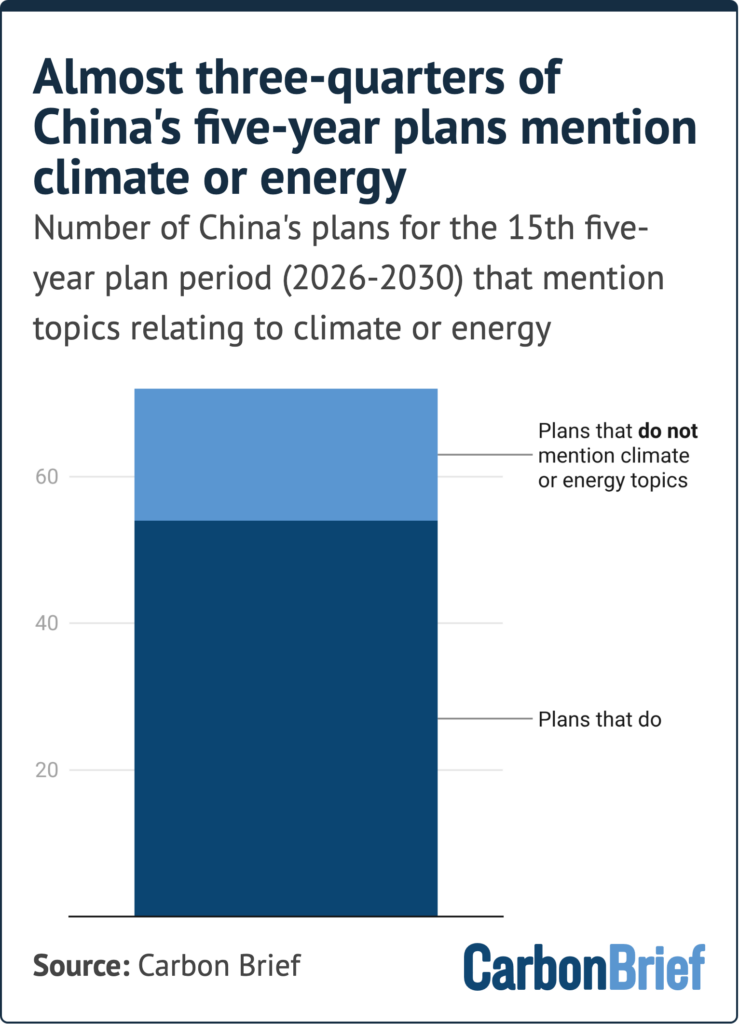
Almost three-quarters of the 72 five-year plans published by China this year include policies or targets related to climate change and energy, according to a Carbon Brief analysis.
Spotlight
How China is responding to the ‘strongest’ El Niño on record
A week after warning of impacts on food production and air quality, Chinese government officials said on Tuesday that this year’s El Niño will be the “strongest” on record.
In this issue, Carbon Brief looks at how the public, policymakers and media have been responding as the onset of the event has developed.
Crops, air pollution and typhoons
On 29 September, Chao Qingchen, director of China’s National Climate Centre, said the “strongest” El Niño on record would peak around November. She advised the agricultural and energy sectors to prepare for impacts.
On 22 September, Li Chao, a spokesperson for the National Development and Reform Commission, the country’s top economic planner, had said that China has the “confidence, conditions and capacity” to deal with the risks to agricultural production. Li added that the government would monitor the event and tap grain reserves to keep supplies stable.
On the same day, Pei Xiaofei, a spokesperson for the Ministry of Ecology and Environment, had warned that a “super El Niño” could weaken the winter monsoon, making it harder for air pollution to disperse in northern China.
These statements came after a summer of typhoons, which Chinese media outlets also linked to El Niño.
China has been hit by an above-average number of typhoons this summer, according to state news agency Xinhua. Typhoon Dolphin travelled more than 6,000km before making landfall in eastern China in August and reportedly forced more than one million people to evacuate.
Dong Lin, chief forecaster at the National Meteorological Centre, told current affairs outlet Beijing news that warm ocean conditions during an El Niño year helped the typhoon maintain its strength over the long journey.
The discussion, however, has not been limited to weather risks.
Dr Sun Shao, a research fellow at the Chinese Academy of Meteorological Sciences, told Carbon Brief that people are now also paying attention to how El Niño will affect grain harvests, electricity supply, water resources, transport and health.
He said this reflects a shift in how Chinese society understands climate risk, “from ‘weather disasters’ to a chain of risks running from weather to industries, the economy and society”.
Change of focus
The questions were different in March, when media reports and social media discussion began focusing on whether a “super El Niño” would develop.
Claims that a “super El Niño” could make 2026 or 2027 the hottest year on record trended on social media, with state broadcaster CCTV reporting in response that it was too early to determine how strong the El Niño would become.
Similar explainers continued through the spring. Meanwhile, China’s National Climate Centre said the tropical Pacific entered El Niño conditions in May.
Throughout the year, the developing El Niño has caused spikes in public interest, as shown in the figure below of index data from WeChat, China’s largest social media app.
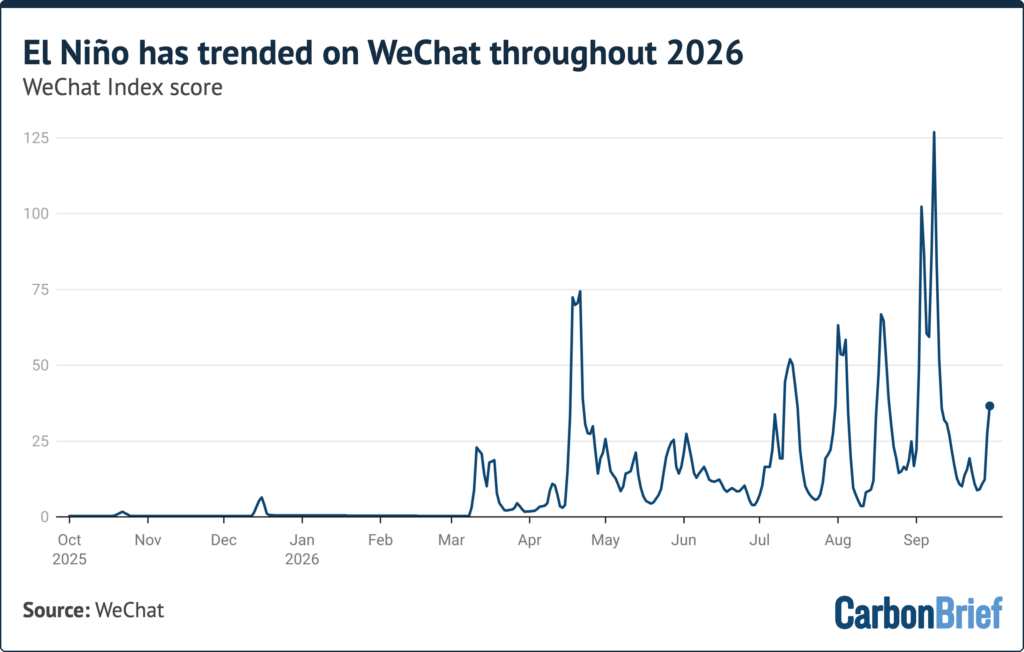
By August, media coverage had shifted from whether it would form to how strong it could become and what impacts it might bring. Xinhua, for example, explored what a “super El Niño” would mean for China.
Sun told Carbon Brief that the expected strength of this El Niño was one reason for the attention it had received in China. He added that the memories of major floods following previous strong El Niño events also shape public concern about what could happen in 2027.
But he also cautioned against linking individual floods, heatwaves or typhoons directly to it. “El Niño provides a predictable climate-risk background, rather than a deterministic disaster forecast,” he explained.
For China, Sun added, next spring and summer, particularly the flood season, may warrant the most attention, as El Niño’s influence can continue even after it begins to weaken.
Watch, read, listen
PLEDGE PROGRESS: Thinktanks CREA and PACS tracked “gaps” in China’s 2021 pledge to stop building overseas coal-power projects.
ENERGY RESILIENCE: The Columbia Energy Exchange podcast talked with experts on what the oil shock revealed about China’s energy strategy.
PAKISTAN ‘COLLISION’: Bloomberg looked at how “China’s coal past and solar present are colliding in Pakistan”.
‘PLANET CHINA’: An Inside Climate News video explored what China-Canada EV ties mean for US automakers and the environmental impacts of the Belt and Road Initiative.
65%
Share of China’s carbon dioxide (CO2) emissions now covered by the country’s national emissions trading scheme, according to an official annual report.
New science
- “Well-designed land policies” could “help reconcile wind-power development with ecological and farmland protection” in China | Communications Earth & Environment
- Limiting warming to 1.5C would avoid 70% of eastern China’s “extreme compound humid-heat days” and reduce GDP exposure to heat by 86%, compared to a 3C world | Atmospheric Research
This edition of China Briefing is written by Lekai Liu. It is edited by Dr Simon Evans. Please send tips and feedback to [email protected]