
China Briefing 26 November 2026: China’s COP31 ‘disappointment’ | APEC oil deal | China energy outlook
Welcome to China Briefing, where Carbon Brief handpicks and explains the most important climate and energy stories from China over the past fortnight. Sign up below.
In this edition…
- China expressed “disappointment” with the COP31 outcome.
- Xi agreed to boost oil-products production with Putin and Trump.
- IEA said China’s emissions could fall 1.9bn tonnes by 2035.
- Carbon Brief digs into the role China played in trying to salvage COP31.
- New science on heat exposure, flood resilience and low-carbon city pilots.
Key developments
Unpacking COP31
‘DEEP DISAPPOINTMENT’: China’s foreign ministry expressed “disappointment” in the outcome of the COP31 climate talks, reported Singaporean newspaper Lianhe Zaobao. Nevertheless, the ministry stressed that China believes there is no reason to “lose faith in the multilateral process”. The comments echoed Li Gao, head of the Chinese COP31 delegation and vice-head of the Ministry of Ecology and Environment. According to the Paper, a Shanghai-based outlet, Li said: “Mutual recriminations do nothing to build trust; upholding multilateralism and maintaining solidarity and cooperation are the only way forward in addressing climate change.”
MEDIA REACTIONS: Wang Yanhui, deputy executive director of Beijing-based thinktank the Institute for Global Decarbonization Progress, said in comments shared with Carbon Brief that the failed negotiations “do not mean that climate action can come to a standstill”. An editorial in the state-run newspaper China Daily said that, although COP31 “ended without a formal pact”, the “obligation to cooperate” remains. It added that others should “facilitate the free flow…of green technologies”. Bloomberg reported that the presence of Chinese clean-tech companies at the talks “showed that some aspects of the green transition are persevering despite geopolitical tensions”.

Trilateral oil agreement
PROMISES OF ‘STABILITY’: Meeting on the sidelines of the Asia-Pacific Economic Cooperation (APEC) summit on 19 November, China, Russia and the US agreed to “increase the production and supply of refined petroleum products” in the name of benefitting “all nations”, said Bloomberg. The three countries also reaffirmed the importance of “stable energy flows”, according to the full joint declaration published by state news agency Xinhua.
NOT GUARANTEED: In a separate report, Bloomberg said the declaration gave “no specifics or timelines” on how ramping up output of refined oil products would be achieved. It added that China has the “greatest ability” of the three nations to boost global fuel supplies, but said analysts were “doubtful” of whether China would “immediately follow through”. Meanwhile, Bloomberg also reported that China’s crude imports have rebounded “faster than expected” in the final months of 2026 as the country “returns” to stockpiling.
CLIMATE COOPERATION: Chinese president Xi Jinping called on countries to “promote a green and low-carbon transition” as he opened the APEC summit, reported France24. Speaking at the APEC economic leaders’ meeting, Xi also pledged $20m to “establish a Center for Asia-Pacific Community Studies” that would focus on four key areas, including “clean energy”, reported Caixin. Separately, Reuters reported that at the summit, China pledged $22.5m to support Peru in addressing impacts from El Niño.
Wind and solar growth by 2035
ENERGY TRAJECTORY: The International Energy Agency’s World Energy Outlook 2026 said China’s overall energy demand is set to reach “a plateau” by 2035. It said that under China’s “stated policies”, energy-related carbon dioxide emissions are set to peak before 2030 and then see the “largest absolute decline of any region”, falling by 1.9bn tonnes of carbon dioxide (CO2) by 2035. The report said the increase in China’s wind and solar power output between 2025 and 2035 was set to be “more than double” that of the previous decade.
FOSSIL FUELS FALLING: Surging wind and solar generation is “squeezing” fossil fuels out of China’s electricity system, said Bloomberg. It reported that thermal power generation has fallen for “four straight months”, leaving output 0.1% lower in the first 10 months of 2026. State broadcaster CCTV News reported that “new clean-energy generation” is expected to meet all growth in electricity demand by 2030. Citing a government-affiliated institute, it said renewables generated more than 3,000 terawatt-hours of electricity in the first nine months of 2026, accounting for more than 40% of total power output.
NEW PLANS: A new implementation plan aims to increase China’s installed new-type energy storage capacity to 300 gigawatts (GW) by 2030, said finance news outlet Cailianshe. The National Energy Administration (NEA) issued guidelines to “accelerate” developing integrated hydro-wind-solar energy bases in major river basins, reported industry news outlet BJX News. The outlet estimated that such projects could add at least 20GW of new renewable energy capacity. A new five-year plan for “green transport development” has set a goal to peak carbon emissions in the transport sector by 2030, reported BJX News.
More China news
- BATTERY CONTROLS: China has “suspended export controls” on certain lithium batteries and battery materials until early January, reported energy news outlet China Energy Net.
- CARBON RECOGNITION: China’s carbon market has officially been “recognised” under both the UK and EU carbon border adjustment mechanisms, said climate-focused outlet Ideacarbon.
- COAL CHEMICALS PARTNERSHIP: China and Indonesia signed a strategic partnership on coal-to-ethanol technology worth$1.8bn, reported Reuters.
- CAR CAP: The EU has set a “provisional cap” on Chinese hybrid cars imports from December 2026 to mid-June 2027 at just under 192,000 cars, said Bloomberg.
- POWER UP: China’s total installed power generation capacity reached 4,160GW in the first 10 months of 2026, up 10.9% year on year, said Xinhua.
- VIRTUAL POWER PLANTS: China has established 592 “virtual power plant” projects, up 79% year-on-year, said BJX News, citing the NEA.
Captured
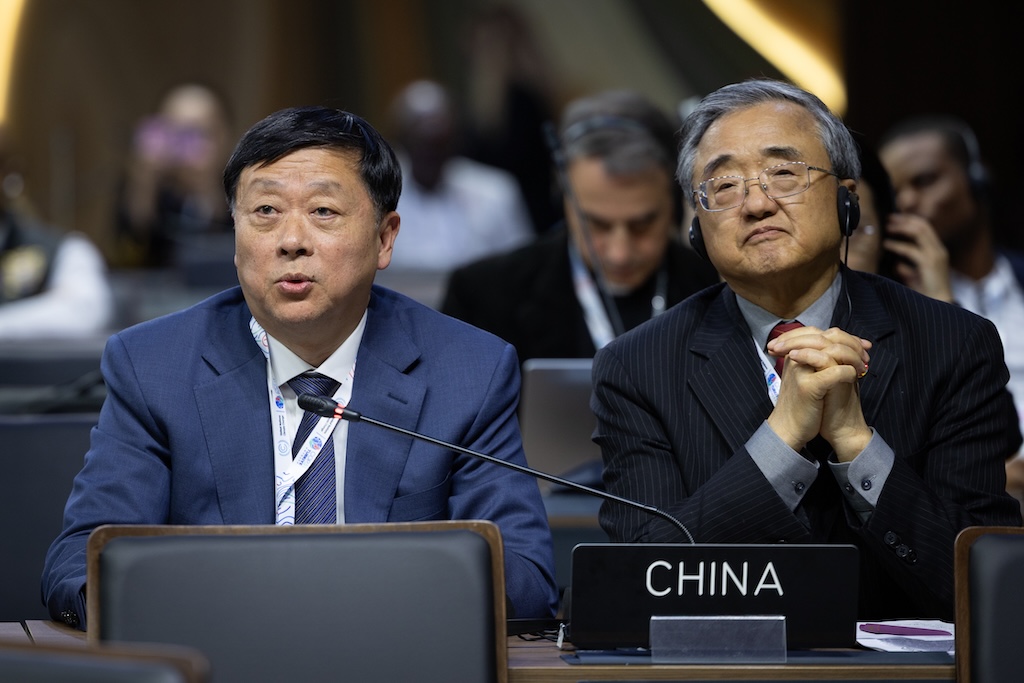
China’s environment vice-minister Li Gao and special envoy for climate change Liu Zhenmin at the closing session of COP31. (Photo: UN Climate Change/Flickr.)
Spotlight
China leaves COP31 ‘disappointed’
In this issue, Carbon Brief breaks down China’s role at COP31, both through negotiations and through its wider presence around the “blue zone”.
This is an abridged version of the “China at COP31” section of Carbon Brief’s COP31 summary. The full version can be found on the Carbon Brief website.
At the opening plenary of COP31, China said that ending the summit with a signal of “solidarity and multilateralism” was “more important than specific problems”.
Its climate officials said repeatedly that not every COP required a “new outcome” and noted the need to “manage expectations”.
These comments seemed prescient when negotiations broke down at the end of COP31 over the overarching “cover decision” promoted by the Turkish-Australian presidencies.
China’s priorities, as outlined by environment vice-minister Li Gao in late October, were committing developed countries to enhanced ambition on mitigation and finance, as well as trade and the just transition.
Li had also “commend[ed]” the presidency’s “35 by 35” electrification goal.
One of the biggest questions hovering over the COP was whether China would support the pledge’s inclusion in the – ultimately failed – cover text, known as the “Antalya pact”.
Observers had told Carbon Brief from early in the negotiations that it would be very likely that China would support the pledge in some form.
But the strongest signal came from a China-Australia joint statement published in the second week, in which they “welcome[d] growing international ambition and cooperation on electrification…on a voluntary basis”, mentioning the goal specifically.
Li Shuo, director of the China Climate Hub at the Asia Society Policy Institute (ASPI), told Carbon Brief that the “carefully curated” language in the joint statement helped “firm up” support for the electrification pledge in the final cover-decision draft.
But the Australia-China joint statement was mostly “unambitious”, argued Prof Christoph Nedopil Wang at the University of Queensland. In his view, it would have been “more meaningful to sign a more ambitious statement” before negotiations began.
As talks broke down at the closing plenary, China endorsed the cover text in the name of “unity and collective efforts”, though it noted “concerns”.
China also tried to build consensus around passing the “mitigation work programme” at the closing plenary. However, the suggestion was rejected by Russia.
Meanwhile, trade matters were not mentioned in the COP’s successful outcomes, despite being raised by China in several negotiation tracks.
China did also focus significant attention on the “just transition work programme”, where agreement was successfully reached.
In general, ASPI’s Li says, “China’s position was right in the middle of the political spectrum” on most of the issues being negotiated, maintaining a “quiet, but self-assured posture”.
This surprised many observers, who had wondered if China would signal greater leadership at COP31, such as by announcing a bid to host COP33. News emerged in the first week that China had decided against this.
Prof Hu Bin, director of global climate governance research at Tsinghua University’s Institute of Climate Change and Sustainable Development, told Carbon Brief that China is “still very hesitant” to take up the mantle of climate leader, largely due to domestic economic pressures.
China instead continued to position itself as a champion of the global south, both in negotiations and through announcing several new deals on the sidelines of the COP.
The largest was an agreement with Turkey to invest $15bn in developing 7GW of solar and wind power, as well as 4GW of electricity transmission capacity.
According to Kate Logan, director of the China Climate Hub and climate diplomacy at ASPI, this deal was evidence that “China will continue exercising its influence through real-economy actions, even while its negotiators press for developed-country accountability on finance”.
Watch, read, listen
PROGRESS STALLING: The Financial Times looked into why hydrogen cars are failing to gain traction in Foshan, a city designated the hydrogen “capital” of China.
FIRST STEPS: Bloomberg broadcasted a “primer” on the opportunities and challenges of scaling up China’s “nascent” zero-carbon factories.
EMISSIONS PEAK?: BBC Inside Science talked with Lauri Myllyvirta of the Centre for Research on Energy and Clean Air and Prof Michael Grubb of University College London, about whether China’s carbon emissions have peaked.
IMPLEMENTING COP: The Paper interviewed Ma Jun, founder of the Institute of Public and Environmental Affairs, on how data can be used to verify emissions reduction by countries and companies.
37%
The share of China’s investments in Asia from 2022-2024 that went towards new “green technology projects”, according to the Boston University Global Development Policy Center.
New science
- A study of 250m children in China found a “sharp increase” in extreme heat exposure in 2019-2021 compared to 1989-1991 | Proceedings of the National Academy of Sciences
- New research found that flood resilience across 92 cities in China improved overall between 2006-2022, amid rising risks from “climate change and rapid urbanisation” | Nature Scientific Reports
- A new study looking at 112 Chinese cities in the Yangtze river region found that after 17 years, it could not detect any statistically-significant impact on emissions due to China’s low-carbon city pilot programmes | Nature Scientific Reports
This edition of China Briefing is written by Lekai Liu and Anika Patel. It is edited by Anika Patel and Dr Simon Evans. Please send tips and feedback to [email protected]