
China Briefing 29 October 2026: Plenum ‘Long March spirit’ | Clean-tech exports surge | What China wants at COP31
Welcome to China Briefing, where Carbon Brief handpicks and explains the most important climate and energy stories from China over the past fortnight. Sign up below.
In this edition…
- Top leaders of China’s Communist party met at the “fifth plenum”.
- Clean-tech exports in 2026 to cut emissions in the rest of the world by 2%.
- China’s environment ministry outlined its positions ahead of COP31.
- What key experts are expecting from China at COP31.
- New science on cyclone damages, flooding impacts and September rainfall.
Key developments
Fifth plenum
‘LONG MARCH SPIRIT’: On 26 October, Chinese president Xi Jinping opened the “fifth plenum”, a major meeting of top leaders from the Communist party, reported Reuters. A China Daily editorial published ahead of the meeting said policymakers needed a “Long March spirit” to confront climate change. The Communist party-affiliated People’s Daily carried a frontpage commentary on the plenum under the byline “Ren Zhongping”, indicating the view of the ruling Communist party. It said that under “rigorous” party self-governance, China is accelerating its “green energy transition” and building an “ecological civilisation”.
Clean-energy generation at 37%
COAL DOWN: Clean-energy sources generated 37% of China’s power in the first three quarters of 2026, according to government figures covered by industry news outlet China Electric Power News. Data from the National Bureau of Statistics showed nuclear-power generation in September rose 22% year-on-year, while solar and wind were up 20% and 11% respectively, said power news outlet BJX News. (These statistics typically do not cover distributed wind and solar.) Meanwhile, coal production and coal-power generation both dropped, reported Bloomberg, with “thermal power output…falling 1.4% over the month”.
COAL SHAVING: The National Energy Administration published opinions on the “integrated development of coal-fired power and new energy”, reported finance news outlet EastMoney. It said the document calls for “deep peak-shaving retrofits” for coal plants, in order to “free up generation capacity for the integration of nearby new-energy sources”. Meanwhile, the National Development and Reform Commission issued draft rules for the power spot market, said business news outlet Caixin, to encourage “newer participants” such as distributed energy and battery storage, while making renewables “more responsive” to prices.
AVOIDED EMISSIONS: China’s exports of clean-energy technologies in 2026 are on track to cut emissions in the rest of the world by 450m tonnes of carbon dioxide (MtCO2), according to new analysis for Carbon Brief by the Centre for Research on Energy and Clean Air. It added that, “over the lifetime of the equipment”, the 2026 exports are “on track to avoid 8,400MtCO2”, with 76% of this in the global south. The analysis was covered by Reuters, Bloomberg and the Associated Press.
EU leaders meet following hybrid car deal
EU MEET: Following an agreement between the EU and China on hybrid cars, EU leaders “rallied behind a tough new set of powers to counter coercive trade practices”, said Bloomberg. “Conclusions” published by the European Council urged the European Commission to “urgently enhance the EU toolbox” on trade imbalances. The document did not mention China by name. At a press conference, commission president Ursula von der Leyen said “progress” on electric vehicles “cannot fix” the structural imbalance in EU-China trade, according to remarks published on the European Commission website.
CLEAN-TECH SECURITY: Soon after the EU-China talks ended, Reuters reported that China proposed export controls on 12 technologies needed to make certain solar-energy products, citing national security concerns. According to a Polish state-backed thinktank, Chinese wind companies are “replacing” European components with domestic alternatives due to “security and control” concerns, reported Bloomberg.
Signals ahead of COP31
HUANG AT COP17: Chinese environment minister Huang Runqiu met with Teresa Ribera, executive vice-president of the European Commission, at the COP17 UN biodiversity summit, reported the state-run newspaper China Daily. It said Huang “expressed hope that China and the EU would support positive outcomes at COP17 and COP31 [climate talks] and work together to build a clean, beautiful and sustainable world”. China Daily also reported that Huang “urged developed countries…to mobilise resources and build capacity to help developing countries” implement biodiversity programmes in his address at COP17.
COP31 SIGNALS: At a press conference in Beijing, environment vice-minister Li Gao said “China will play a positive and constructive role” at COP31, according to a transcript published by the Ministry of Ecology and Environment. Li flagged the “old problems” of developed countries’ emissions cuts and climate finance, as well as the “new problem of unilateralism and protectionism”, said Reuters. He called for “road maps for developed countries” to provide $300bn in annual climate finance and to triple adaptation finance, said China Daily. [See Spotlight below.]
More China news
- NEPAL ‘WARNING’: Huang cited the deadly glacial collapse in Nepal as an “urgent warning” of accelerating climate risks, reported Bloomberg.
- ‘GREEN COOPERATION’: Separately, Huang reaffirmed China’s commitment to “green development cooperation” with the global south, said China Daily.
- JOINT STATEMENT: China and Russia pledged to use “various energy sources”, including fossil fuels and renewables, to strengthen energy security, said Xinhua.
- INDUSTRIAL PLANS: China issued a plan for “refining the dual control [of carbon] system” for industry, which reiterated targets for carbon-intensity reduction and building zero-carbon factories, said CN Energy News. China also published a five-year plan on “enhancing its industrial infrastructure capabilities”, said Xinhua.
- AVOIDING OVERCAPACITY: China announced it is drafting a policy to “avoid overcapacity in its hydrogen industry”, said Bloomberg.
Captured
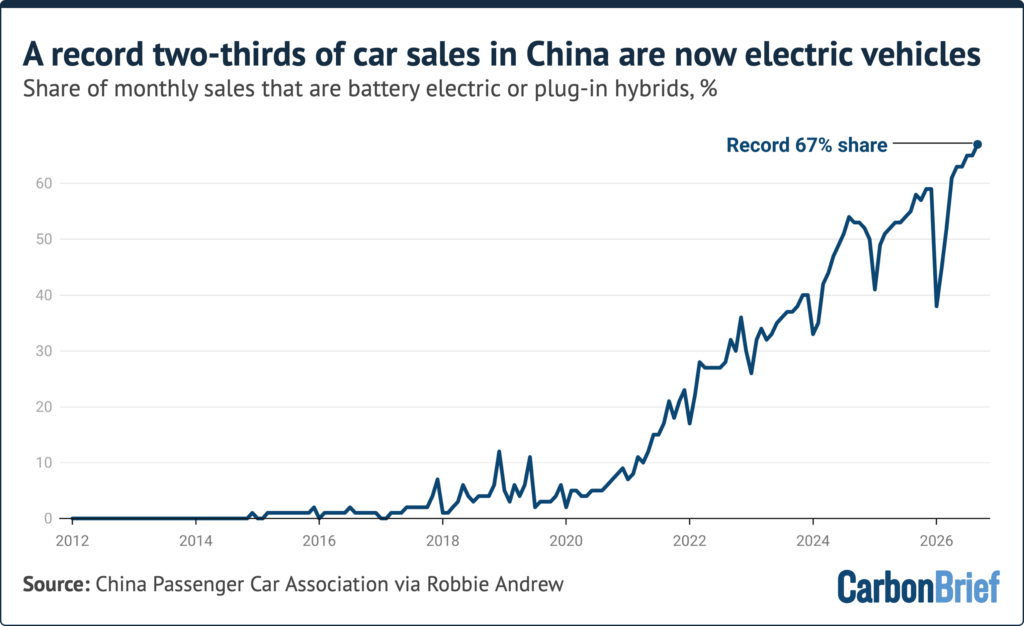
Electric vehicles’ share of monthly passenger car sales reached a record 67% in September, while combustion-car sales hit a new low. This was helped by the strait of Hormuz crisis pushing up petrol prices, reported Carbon Brief.
Spotlight
Experts: What China wants from the COP31 climate talks
With the COP31 climate summit in Turkey looming, all eyes are on China to see what the country will push for in the negotiations.
Carbon Brief asked six experts what they will be watching for at COP31. Below are excerpts of their responses, edited for length and clarity.
The article with their full responses can be found on the Carbon Brief website.
Kate Logan, director of the China climate hub and climate diplomacy, Asia Society Policy Institute
After vice-premier Ding Xuexiang shared at COP29 that China has provided and mobilised over 177bn yuan ($26.5bn) in climate finance for developing countries since 2016, China has refrained from issuing further quantitative updates, while maintaining the imperative for developed countries to take the lead on climate finance. China may be happy to let other developing countries push this agenda while serving as a broker in the end game to ensure its own interests are protected.
Ma Jun, founder and director, Institute of Public and Environmental Affairs
I think China wants COP31 to reaffirm confidence in multilateral climate cooperation and translate commitments into action. With the risk of overshooting 1.5C almost unavoidable, I expect China to seek clearer delivery of climate finance for developing countries; encourage reductions in potent, short-lived greenhouse gases such as methane; support a just transition; and highlight trade barriers affecting clean technologies.
Yao Zhe, global policy advisor, Greenpeace East Asia
I will be watching how China responds to the COP presidency’s electrification initiative. Beijing increasingly views climate diplomacy through the lens of clean-energy diplomacy…While China should naturally welcome a global electrification initiative that will lead to larger overseas markets [for its industrial exports], it likely remains reluctant to link these targets to any commitments regarding transitioning away from fossil fuels.
Prof Ryna Cui, associate research professor and research director at the University of Maryland Center for Global Sustainability
One thing exciting for me to watch is that, as China reaches its coal and oil peak, it may open up space for increased interests and leadership in the global “transitioning away from fossil fuels” agenda. This may not happen immediately through formal government negotiations, but more likely through broader bilateral and multilateral engagements.
Dr Joseph Dellatte, resident fellow and head of energy and climate studies, Institut Montaigne
China will likely seek recognition as a climate leader while defending its position as the world’s cleantech manufacturing hub, amid growing trade tensions. I’ll watch whether it continues to frame the global transition primarily around access to Chinese technologies and open markets for its exports, or shows greater willingness to discuss cooperation that shares industrial benefits through local manufacturing, joint ventures and technology sharing.
Prof Jeremy Wallace, professor of China studies, Johns Hopkins School of Advanced International Studies
China seems more interested in fighting…“unfair” tariffs on [its clean-tech] products than about demonstrating their effectiveness by accelerating adoption…at home. [Its] renewables buildout has slowed dramatically in 2026, while new coal power and coal-chemical facilities continue to be built…Climate leadership is up for grabs. I’m watching to see if Beijing will play its cards and show that they are a winning hand.
Watch, read, listen
CLIMATE REPORT: The Ministry of Ecology and Environment published the 2026 edition of its annual report outlining China’s response to climate change.
TRANSITION FINANCE: Caixin examined how China’s banks are “ignoring [financing decarbonisation in] polluting industries in favour of pure green projects”.
‘GREEN OPPORTUNITY’: The London School of Economics’ Grantham Institute said the “green growth opportunity” in China could move emissions from peaking to falling.
HYDROGEN TENSIONS: The International Energy Agency analysed whether China’s “cost advantage in producing electrolysers” could lead to its industry “dominat[ing] global supply”.
170,000
The average number of “avoided” annual deaths in China between 2016 and 2023, due to reductions in “fossil fuel-derived” air pollution, said the latest Lancet Countdown report.
New science
- Later this century, economic damage to China’s coastal renewable energy by tropical cyclones could be 10-20 times greater than 1975-2014 levels | Earth’s Future
- Loss of Arctic sea ice in the Lapteve Sea since 2005 is a “previously unrecognised” driver of September rainfall in central China | npj climate and atmospheric science
- “Impoverished regions” of China experience “disproportionately severe” impacts from flooding as the climate warms | Earth’s Future
This edition of China Briefing is written by Carbon Brief staff. It is edited by Dr Simon Evans. Please send tips and feedback to [email protected]