
Cited 1 September 2026: Himalayan floods | Record-warm global ocean | Caribbean drought

This is an online version of Carbon Brief’s fortnightly email newsletter, Cited, an essential guide to new climate research.
Sign up below.
In the news
‘BROADER CLIMATE SIGNAL’: Science explained how “hundreds of scientists around the globe” have been trying to determine how the recent flash floods in Nepal and Tibet – which left more than a thousand people dead and many more still missing – unfolded. Dr Zeke Hausfather, Carbon Brief’s climate science contributor, wrote on the Climate Brink substack that “formal attribution is premature”, but climate change is “increasing risks of these sorts of events in the region”. A post on the Backchannel substack said that scientific “uncertainty about one event should not obscure what we already know about the broader climate signal”.
FEELING THE HEAT: A joint investigation between National Public Radio and researchers at Boston University found that heat-related deaths in the US over 2018-25 were a “factor of five higher than the official average”. A Science Advances study, covered by the Associated Press, found that emergency-room admissions for a variety of conditions – “including some that most people don’t associate with heat” – became more frequent during heatwaves. The Guardian covered new data from the UK’s Office of National Statistics that found that “extreme heat [was] linked to 40,000 deaths in England” over 1988-2025. (See Carbon Brief’s explainer for more on how heat-related deaths are variously calculated across different countries.)
Research picks
Oceans
- Six narwhals outfitted with transmitters explored remote East Greenland waters for three years, bringing back data showing that warm Atlantic water is reaching glaciers located deep within East Greenland’s fjords | Science Advances
- The layer of cold, fresh water at the bottom of the ocean – known as “Antarctic bottom water” – is warming and becoming less salty, due to increasing glacial melt in Antarctica | Journal of Geophysical Research: Oceans
- The growth rates of southern bluefin tuna larvae off north-western Australia increased significantly between 1985 and 2022, suggesting they may be more resilient to a warming ocean than previously thought | Proceedings of the National Academy of Sciences
Atmosphere
- Droughts in the Amazon exacerbate emissions of carbon monoxide and particulate matter from fires, posing “severe” risks to public health – “even under stable deforestation rates” | Atmospheric Chemistry and Physics
- In 2021, wildfires in the boreal forests of North America and Eurasia contributed an “exceptional pulse” of reactive nitrogen emissions, driven in part by severe drought in those regions | Atmospheric Environment
- “Coatings” of sulphates, nitrates and other materials increase the warming effects of black carbon particles in the atmosphere | Nature Geoscience
Energy
- Achieving Indonesia’s biodiesel target by 2030 “will require extensive land conversion” and could undermine the country’s climate commitments | Nature Sustainability
- Constructing windfarms in the “most suitable” areas of the deserts of north-west China could generate up to 37% of the country’s power needs | Earth’s Future
- Greenhouse gas emissions from hydropower reservoirs could represent nearly 90% of energy-sector emissions by 2050 under a net-zero scenario consistent with projections from the International Energy Agency | Communications Earth & Environment
Captured
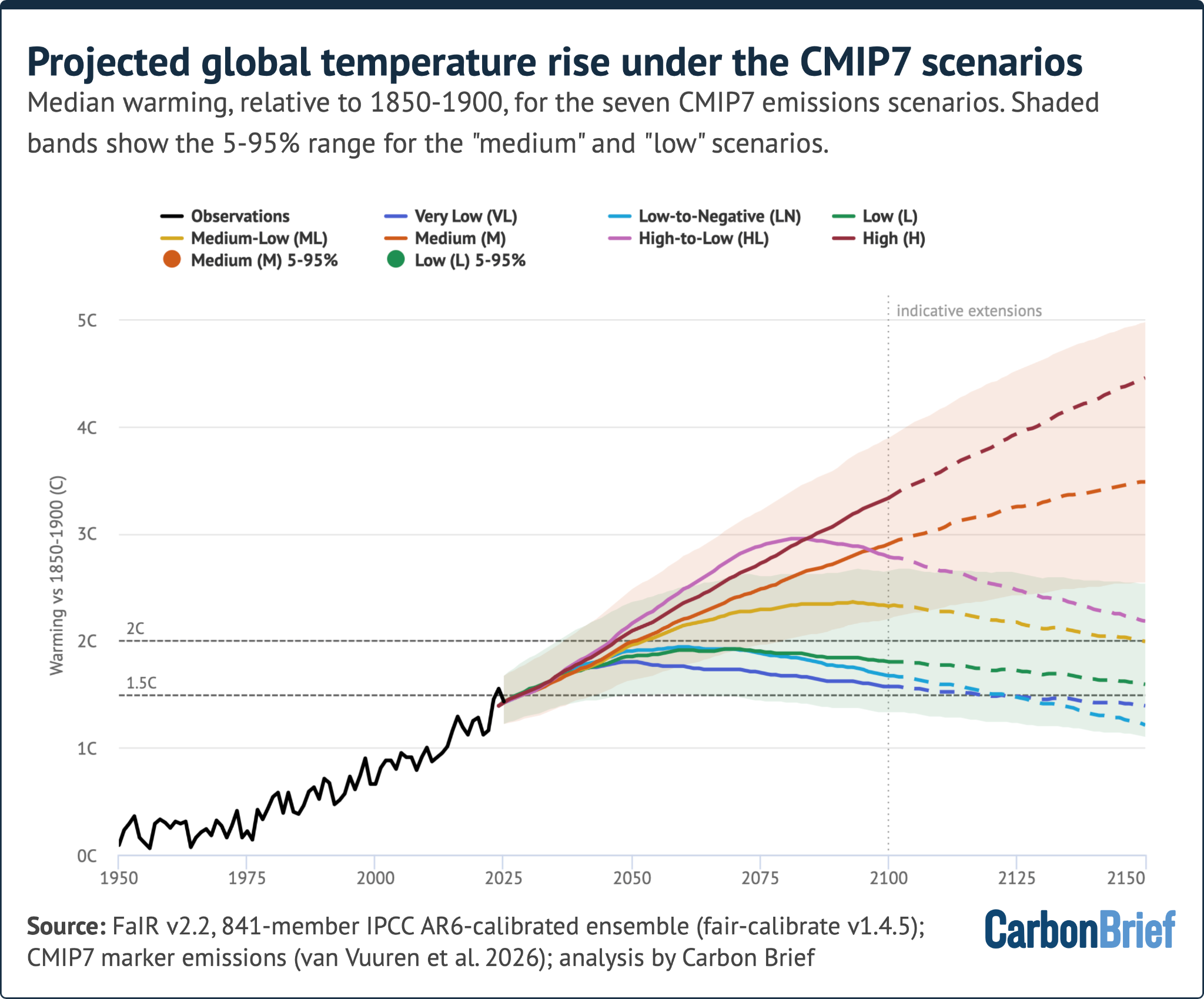
Projected warming, up to 2150, for the seven new emissions scenarios that will underpin the seventh phase of the Coupled Model Intercomparison Project (CMIP7). The temperatures are expressed relative to a baseline of 1850-1900. Carbon Brief’s Dr Zeke Hausfather explored the updated “pathways” in a new explainer.
21.10C
The new record average daily global sea surface temperature, set on 22 August, according to Copernicus Climate Change Service. The data, which comes from the ERA5 reanalysis product at the European Centre for Medium-Range Weather Forecasts, covers the ocean between the latitudes of 60S and 60N, extending back to 1979.
Spotlight
The role of climate change in the Caribbean drought

This week, Carbon Brief interviews Dr Jhordanne Jones, a climate scientist at Pennsylvania State University. Jones is one of the authors of a new attribution analysis examining the role of climate change in the ongoing drought in the Caribbean.
The analysis focused on Jamaica, Puerto Rico and the Lesser Antilles. It found that, between May and July, human-caused climate change decreased the amount of rainfall in Jamaica by 6% and in Puerto Rico by 9%.
Carbon Brief: What does drought look like for these islands?
Dr Jhordanne Jones: We tend to have a fairly predictable pattern of rainfall and drought [in the Caribbean]. One of the notable things about this year is that we came into 2026 particularly dry. When we hit that early rainfall season – May, June and July – we actually did not get as much rain as we, on average, would [typically] get.
Previously, we had intermittent rainfall seasons to cope with those intermittent dry, or drought, seasons. The early rainfall season would help us to replenish what we didn’t get during the dry season. So, what has happened now is that since we did not have that early rainfall season, we actually had an extended period of drought starting last year and well into the middle of this year.
This might be for a number of factors. But, predominantly, what the report is saying is that this particular decline in early rainfall season is actually due to a trend downwards in rainfall for the Caribbean. So, this is climate-driven.
CB: How might the current El Niño influence the drought over the next few months?
JJ: The current El Niño that is occurring now is also acting to suppress further rainfall from happening across the region. That is likely to extend well into next year, which means that we are looking at possibly, or very likely, a year-round drought if we don’t get the usual rainfall that we do in the late season. Hurricanes or thunderstorms that might roll through at that time might not occur because El Niño also suppresses that late-season rainfall.
Currently, we’re already [under] heightened water conservation efforts that are very likely to last well into the next year. That is detrimental to the Caribbean, which is very dependent on agriculture as a main source of income, as well as livelihood and nutrition.
CB: What are some of the challenges of studying the Caribbean?
JJ: You have intra-region variability. That means that [different regions] can [experience] a different impact from the same phenomena. Parts of the Caribbean might actually have [higher-than-average] rainfall due to being in close proximity to that El Niño-driven rainfall [in the Pacific Ocean], while other sections might be incredibly dry, such as Puerto Rico and Jamaica. In terms of an average of rainfall over the entire Caribbean, you do have some relationship to El Niño and to other climate drivers. But what happens on specific islands might vary.
The report is very comprehensive, but it has its own limitations. So, for example, we use gridded data sets here. Gridded data sets may not have a small enough resolution to capture all that is happening within these islands. It only captures a very broad trend or a very broad pattern. But, overall, it does show pretty clearly that there is a climate-driven force that is due to global warming.
Preprints to watch
Carbon Brief’s pick of new papers under review
- Using tide gauge records, atmospheric forcing and satellite altimetry, researchers reconstruct an hourly time series of coastal sea level from 1940 to the present day | Natural Hazards and Earth System Sciences
- An El Niño event with the forecasted peak strength of the current event is around six times more likely to occur in the current climate than in a world without human-caused climate change | Environmental Research Letters
- Cold-water corals accumulate carbon at a rate that is “approximately one magnitude lower” than tropical corals, but may play a significant role in the carbon cycle on a local scale | Biogeosciences
Noticeboard
- 6 September: Abstract submission deadline for 2026 Overshoot Conference, Beijing
- 13 September: Research fellow in artificial intelligence for energy and transport at University College London | Salary: £43,981-54,019. Location: London
- 15 September: Mid-level impact modeller at the Euro-Mediterranean Center on Climate Change | Salary: €40,000-55,000. Location: Milan
- 15-16 September: 71st bureau meeting of the IPCC, Geneva
- 21 September: Paper submission deadline for workshop on machine vision for Earth observation, Lancaster, UK
- 23 September: Research associate in hydrogeology/hydrology at Flinders University | Salary: A$90,930-110,197. Location: Adelaide, Australia
- 25 September: Registration closes for review experts for working group one of the IPCC’s seventh assessment cycle
- 1 October: Internship in machine learning for snow monitoring at Mila | Salary: Unknown. Location: Montreal
This edition of Cited was written by Dr Giuliana Viglione and edited by Cecilia Keating. Please send tips, feedback and upcoming climate research to [email protected].