
Cited 10 November: WMO heat warning | Skea’s COP31 appeal | Global carbon budget

This is an online version of Carbon Brief’s fortnightly email newsletter, Cited, an essential guide to new climate research.
In this edition…
- New science on extreme heat, wildfires and flooding.
- The WMO warned that the Earth is gaining heat at an “accelerated rate”.
- The IPCC will resume its suspended talks on report timelines in December.
- Carbon Brief reports on how land areas are already facing warming of 1.5C.
In the news
‘OFF THE CHARTS’: The World Meteorological Organization (WMO) has warned that heat is accumulating in Earth’s systems at an “accelerating rate”, said the Guardian. The newspaper quoted UN secretary general António Guterres, who said the world has “entered a new age of climate extremes” as a result of a “supersized El Niño” colliding with a “planet already superheated by manmade climate change”.
‘SUPERCHARGING’ WEATHER: The WMO’s “state of the climate” report, prepared to inform negotiations at the ongoing COP31 climate summit in Turkey, showed that ocean heat content had reached a record high in 2025, with “preliminary data showing continued warming in 2026”. According to Bloomberg, WMO secretary general Prof Celeste Saulo warned that “it’s challenging to adapt to a world that’s warming and warming – and we see no change to this curve, unfortunately”.
TESTING TALKS: The Intergovernmental Panel on Climate Change (IPCC) will resume talks to agree on a timeline and budget for the seventh assessment report (AR7) in a virtual meeting over 1-3 December. The 65th “session” of the IPCC in Addis Ababa, Ethiopia, was suspended last month after delegates failed to agree on a timeline for publishing “work plan” to publish the AR7 reports.
‘ELUSIVE DECISION’: In a speech to the opening plenary of COP31 yesterday, IPCC chair Prof Jim Skea said the IPCC faced “operational challenges and reputational risks from the current impasse” on the AR7 timeline. Ahead of the resumed IPCC meeting, Skea encouraged delegates to “use your influence here to prepare for a successful outcome”.
Research picks
EXTREME HEAT
- Of 250 million children in China, the share exposed to strong heat for at least 12% of hours rose from 8.1% to 23.7% between 1989-91 and 2019-21 | Proceedings of the National Academy of Sciences
- Recent record-breaking heatwaves in many regions of the world are “no match” for potential future 21st century events as the climate warms | Nature Communications
- Conventional coarse resolution model projections “may underestimate” localised coastal humid-heat risk | Science Advances
WILDFIRES
- As the climate warms, fire-weather extremes over the Iberian peninsula will “increasingly emerge in late spring and persist into early autumn” | Weather and Climate Extremes
- Analysis of satellite records since 2001 shows that, on average, afforestation increased fire occurrence by 26% and burned area by 23% in global temperate regions | Proceedings of the National Academy of Sciences
- Satellite observations of wildfires over 2001-20 reveal that post-fire summer surface albedo and radiative balance shifts “vary significantly across ecosystems” | npj Climate and Atmospheric Science
FLOODING
- Without human-caused warming, peak flooding brought by Storm Boris in central Europe in 2024 would have been 14-22% lower | Science Advances
- The contribution of sea level rise to tropical cyclone-induced coastal flooding has increased from about 5% in the 1950s to 18% in the last decade | Environmental Research Letters
- The combined impact of population growth and human-caused climate change left tens of thousands more people in Mozambique exposed to flooding from Tropical Cyclone Idai in 2019 | Scientific Reports
Please send upcoming climate research and preprints to [email protected]
Captured
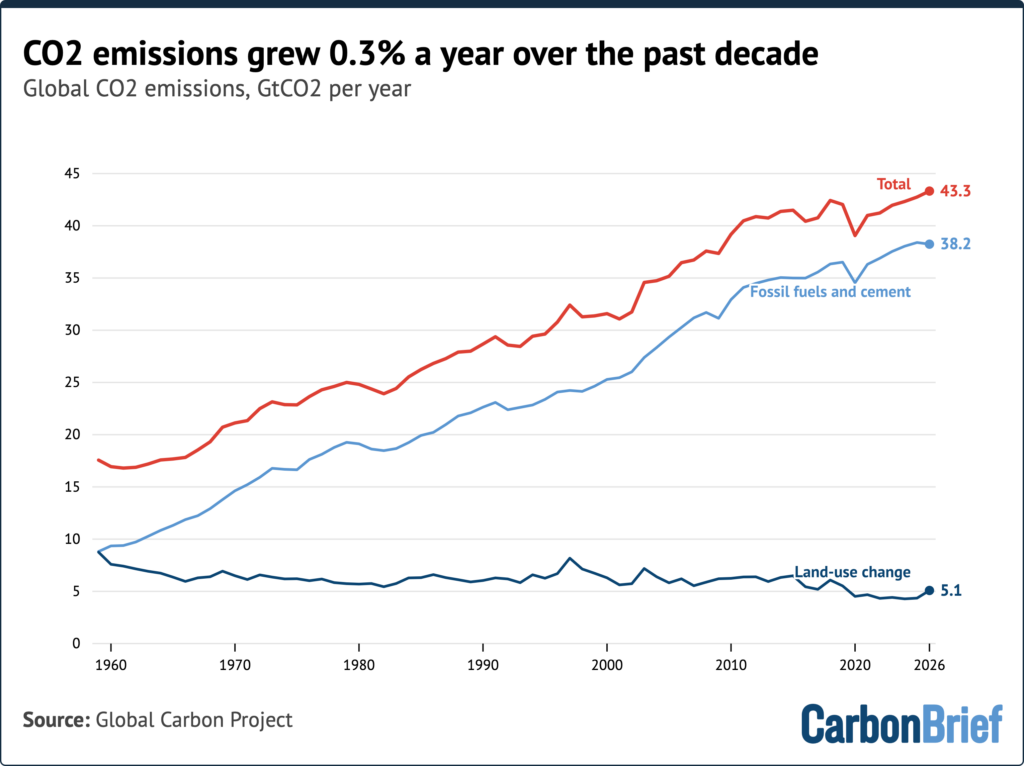
The annual rate of increase in global CO2 emissions over the past decade (2016-25) has slowed to 0.3% per year, compared with 1.7% per year over 2006-15, according to the 2026 global carbon budget. While the slowdown reflects “real progress”, wrote report authors Dr Zeke Hausfather and Prof Pierre Friedlingstein in their analysis for Carbon Brief, a plateau is “still a long way from the rapid declines needed to reach net-zero emissions and stabilise global temperatures”.
432.2 parts per million
The UK Met Office forecast for the average atmospheric CO2 concentration at the Mauna Loa Observatory in Hawaii for 2027. The expected rise of 3.51 parts per million over the 2026 average is the “largest annual increase ever forecast”, the Met Office said. While “human emissions are still driving the long-term increase”, Met Office scientist Emily Wright said the strong El Niño event is also “playing an important role”.
Spotlight
Approaching 1.5C
Carbon Brief unpacks new research that looks at how average temperatures have increased in different regions around the world since pre-industrial times.
Warming across most land regions is already “statistically indistinguishable” from levels expected when the planet as a whole exceeds the 1.5C limit set out in the 2015 Paris Agreement, according to a new study.
More than a decade after world governments agreed to keep average global warming “well below” 2C above pre-industrial temperatures and to aim to limit warming to 1.5C, the planet is nearing the lower threshold.
However, the world is not warming uniformly. Land warms more rapidly than the ocean. Meanwhile, ocean currents and atmospheric circulation patterns are constantly redistributing heat around the planet.
Research published yesterday in Nature Climate Change combines observations of surface air temperature with climate model simulations to estimate how much warming, across the 46 land regions defined by the IPCC, is due to human-caused climate change.
The greatest level of warming linked to greenhouse gas emissions occurred in high northern latitudes. The scientists found regional warming of 3.3C in the Russian Arctic, 2.6C in north-east North America and 2.4C of warming in north-west North America.
Meanwhile, areas surrounded by the ocean – including south-west South America, south South America, south-east Asia and New Zealand – have seen the least human-caused warming to date.
Crossing 1.5C in a specific region or calendar year is not the same as exceeding the Paris Agreement’s temperature threshold. The goal refers to average long-term global warming, rather than annual temperatures that include the short-term influence of natural fluctuations in the climate, such as El Niño.
The researchers also simulated how much warming each region would expect in a world where global temperatures were, on average, 1.5C and 2C higher than pre-industrial levels.
They found that most land regions have already reached a level of warming that is “statistically indistinguishable” from the temperatures expected in a 1.5C world.
Most regions have experienced 90-94% of the warming expected when the global average reaches 1.5C of warming and 65-76% of that expected at 2C warming, according to the research.
The study also found that greenhouse-gas emissions were the main driver of warming across all regions, with their effects partially offset by the cooling effects of aerosols.
However, the authors noted that attributing warming to human-caused greenhouse gas emissions is particularly difficult in parts of Africa, South America and the polar regions, where historical temperature observations are often sparse or absent altogether.
Study author Dr Francis Zwiers, a scientist emeritus at the Pacific Climate Impacts Consortium at the University of Victoria, told Carbon Brief that research on regional warming can help inform local efforts to prepare for climate change.
His research group “interact[s] a lot with the engineering community”, he said, adding:
“Engineers, regulators [and] infrastructure owners are requiring that new infrastructure be designed to be climate resilient to future climate. We’ve been thinking very carefully about how to advise those people.”
With the Paris temperature thresholds likely to be crossed within years or decades, Zwiers warned that this is “a blink of the eye when you think about how long it takes to build new infrastructure, to change energy systems and emissions patterns and so on”.
Preprints to watch
Carbon Brief’s pick of new papers under review
- The European forest carbon sink has seen a reduction in carbon uptake of 17-27% in 2020-23, compared to the average of 1990-2019 | Earth Observation
- A “hydrological paradox”, where global soils have dried out despite increases in rainfall, has been caused by a shift from low and moderate to heavy rainfall | Nature portfolio
- More than 60% of the route of the 2026 Tour de France was ridden under “strong to very strong heat stress” | Scientific Reports
Noticeboard
- 9-20 November: COP31 UN climate summit, Antalya, Turkey
- 14 November: COP31 “gender, diversity, equity and inclusion in the IPCC” event, Antalya, Turkey
- 14 November: COP31 “CDR and CCUS in national inventories – IPCC methodologies” event, Antalya, Turkey
- 25 November: Research fellow in climate change and health at the University of Bristol | Salary: £52,788-£59,390. Location: Bristol, UK
- 30 November: Postdoctoral researcher in the effects of multiple stressors on marine organisms at the University of Sorbonne’s laboratoire d’océanographie de Villefranche | Salary: €35,556-€47,964. Location: Villefranche-sur-Mer, France
- 2 December: Doctoral researcher in forest carbon attribution from Earth observation and atmospheric constraints at the GFZ Helmholtz Centre for Geosciences (part time) | Salary: “TVöD Bund” salary group 13. Location: Potsdam, Germany
- 28 December: Assistant professor in terrestrial biogeosciences at the University of California, Irvine | Salary: $84,100-$108,900. Location: Irvine, US
This edition of Cited was written by Robert McSweeney and Ayesha Tandon. It was edited by Cecilia Keating. Please send tips, feedback and upcoming climate research to [email protected].