
Cited 13 October 2026: IPCC’s crunch talks | El Niño peak | Himalaya flood risk

This is an online version of Carbon Brief’s fortnightly email newsletter, Cited, an essential guide to new climate research.
In this edition…
- New science on high-mountain floods, plant diversity and menstrual health.
- The UN provided an update on when El Niño might peak.
- Climate change-warmed waters strengthened the winds of Hurricane Isaias.
- Carbon Brief looks at what is at stake at the IPCC-65 meeting.
In the news
EL NIÑO: A World Meteorological Organization report said El Niño will intensify over the coming months, peak in December and is “nearly 100% certain” to last until February 2027, reported the Independent. France24 said the UN weather body warned the event could be “among the strongest witnessed since at least 1950”. Meanwhile, an update from the US National Oceanic and Atmospheric Administration’s (NOAA) Climate Prediction Center, covered by the Hill, said a “strong-to-very strong El Niño” would be “likely” from January through March.
HURRICANE ISAIAS: Hurricane Isaias – which made landfall in the US on Friday – is the latest-forming first hurricane of the Atlantic storm season since “reliable records began”, reported Scientific American. The Associated Press explained that El Niño – which typically suppresses hurricanes – and warm, “storm-fuelling” waters in the Gulf of Mexico were “battling over the future strength” of Isaias. Yale Climate Connections quoted Dr Daniel Gilford as saying the hurricane “clearly shows the fingerprints of climate change”, noting that “climate-warmed Gulf waters” meant Isaias’s winds were forecast to be 7 miles (11km) per hour stronger than in a world without human-caused warming.
Research picks
WATER
- The total footprint of buildings exposed to high-mountain flooding in Nepal and adjoining border regions in India and China increased by 46% over 2016-23 | Nature
- Rainfall in eight global arid regions decreased by 40mm per decade over 1980-2024 | Journal of Climate
- Record-setting heavy rainfall around the world in 2024 was driven by long-term warming, along with El Niño and “rare concurrent multi-basin tropical ocean warmth” | Science Advances
FORESTS AND GRASSLAND
- Ozone emissions generated by fires in the Amazon increase carbon losses by almost one-quarter of the carbon emissions of the fires themselves | Communications Earth & Environment
- Loss of plant diversity will prohibit grasslands’ ability to adapt to climate change, harming their productivity and carbon storage capacity | Proceedings of the National Academy of Sciences
- Extreme drought and heat seen in tropical forests during the El Niño of 2023-24 could become the “new normal” in the Amazon and Congo basin over the coming decades | Earth’s Future
REVIEWS
- Climate change is undermining menstrual health and hygiene in a number of ways, including by disrupting access to menstrual products, privacy, safety, healthcare and treatment of discomfort and disorders | PLOS Climate
- Three decades of climate-attribution research reveals that the scientific evidence for human “fingerprints” on the Earth’s climate system is “remarkably robust” and “far stronger” now than in 2009 | Earth’s Future
- High temperature and humidity can degrade the active ingredients in pharmaceutical drugs and change their formulas, potentially making medications less effective and increasing the risk of harmful side effects | PLOS Climate
Please send upcoming climate research and preprints to [email protected]
Captured
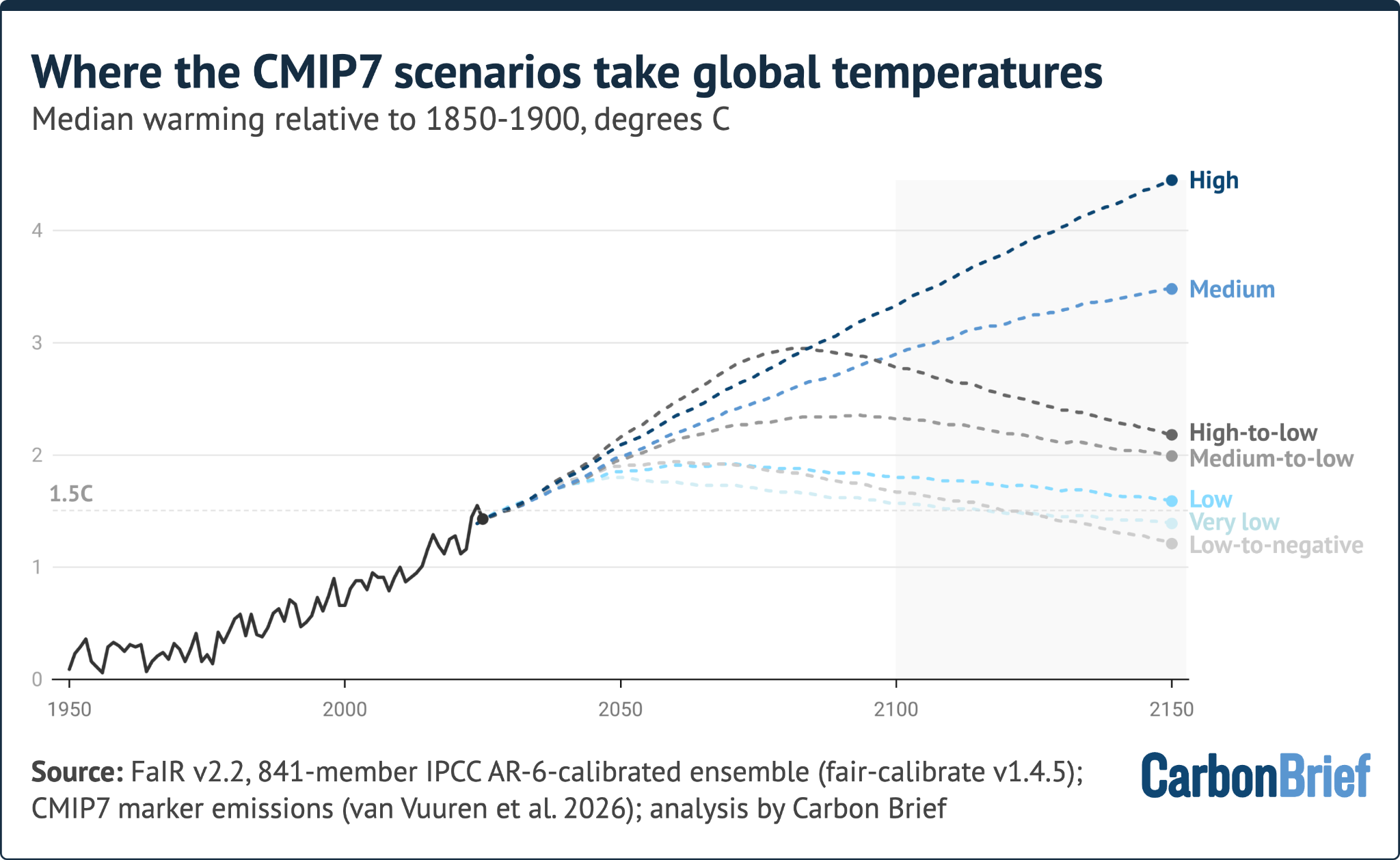
Carbon Brief updated the graphics in its explainer that explored the seven emissions scenarios that will inform the seventh phase of the Coupled Model Intercomparison Project (CMIP7). The article showed how all the new scenarios produce warming in 2100 relative to a pre-industrial baseline, ranging from 1.6C in a “very-low” scenario to 3.3C in a “high” scenario.
13,511
Number of terrestrial vertebrate species that could be exposed to sea level rise by 2050 under the intermediate SSP2-4.5 scenario, according to a Science Advances study. By 2100, this figure could rise to 14,831, the researchers found.
Spotlight
Crunch time at the IPCC
Can this week’s Intergovernmental Panel on Climate Change (IPCC) meeting break the deadlock over the timeline of the reports for its seventh assessment cycle? Carbon Brief reports.
This week, governments from around the world are meeting in Addis Ababa, Ethiopia to finalise the timeline for the publication of reports of the Intergovernmental Panel on Climate Change (IPCC) seventh assessment cycle (AR7).
In a packed agenda, the 65th session of the UN’s climate-science body (IPCC-65) is the last chance for countries to greenlight a schedule where the three “working group” reports can be aligned with the second global stocktake.
A key pillar of the Paris Agreement, the global stocktake is a formal assessment of the world’s collective progress on tackling climate change. It is designed to inform future global climate action, including decisions on national emissions targets and climate finance.
Drafting of the reports is well underway, but governments have been unable to sign off on their publication dates for five consecutive IPCC sessions.
India, Kenya, Russia and Saudi Arabia have been among the loudest voices calling for a slower timeline, arguing that scientists and governments from developing nations with fewer resources need more time to prepare, review and approve working group reports.
But other nations – and many climate scientists – have warned that delivery of reports after the global stocktake process culminates in late 2028 would delay global climate action.
Late last week, more than 30 climate and environment ministers from around the world, under the banner of the “high ambition coalition”, urged the IPCC to align publication of the reports with the stocktake.
The ministers said that “divorcing the policy cycle under the UN from the scientific evidence provided by the IPCC would undermine the global effort to address the climate crisis and weaken international cooperation”.
The call was backed by the chair of the Least Developed Countries negotiating group, climate-threatened island states Fiji, Tuvalu and Vanuatu, as well as the European Commission and UK.
Three options
Ahead of the meeting this week, the IPCC’s secretariat, on behalf of IPCC chair Sir Jim Skea, published a document setting out three options for a timeline for the working group reports.
The secretariat said the options had been informed by a survey sent out over the summer to IPCC chairs and member governments on what criteria should be considered. Some 59 – less than one-third – of the IPCC’s 195 member states took part.
Two of the options would see all three reports published in 2028. The third – “based on submissions by Saudi Arabia and India” – would see two reports published in 2029, after the global stocktake is completed.
| Option 1 | Option 2 | Option 3 | ||||
| Report approval | Plenary | Proposed month of approval | Plenary | Proposed month of approval | Plenary | Proposed month of approval |
| Working Group I | IPCC-69 | May 2028 | IPCC-69 | May 2028 | IPCC-69 | May 2028 |
| Working Group II | IPCC-70 | June 2028 | IPCC-70 | July 2028 | IPCC-71 | April 2029 |
| Working Group III | IPCC-71 | July 2028 | IPCC-71 | Sept 2028 | IPCC-72 | July 2029 |
Source: Table 1 and Appendix A in “Work plan of the IPCC seventh assessment report”, published on 28 September 2026. IPCC
The IPCC’s document states that none of the proposed timeline options “satisfies all the criteria proposed by governments, [IPCC] bureau member[s] and secretariat”.
Options one and two pose challenges related to organisation, travel, public messaging and overlapping report review periods, whereas option three has “consequences in terms of author retention and [scientific] literature becoming out of date” by the time reports are published, it notes.
Dr Bill Hare, CEO of Climate Analytics, described the document as “strange”, stressing there had been no previous agreement for the IPCC to set out three options ahead of IPCC-65. He told Carbon Brief:
“There have been eyebrows raised about the wisdom or legality of that. Is it the right thing for the IPCC chair to have given equal status to all of these ideas?”
Brokering agreement on the issue in Ethiopia will take “deft politics” from governments, as well as “real courage” from IPCC leadership, said Hare.
Levels of political pressure on the IPCC are “unusual” – but not unprecedented, he added, noting a long history of “pressure on the IPCC and IPCC chairs from fossil-fuel producers”.
However, he added:
“What is different now is the geopolitical circumstances are far worse than anyone can ever recall…That empowers forces that want to break off the IPCC from the Paris Agreement climate process.”
Speaking to Carbon Brief in April, Skea said he was confident a constructive outcome would be possible in Addis Ababa, but stressed it would “require a lot of hard work”.
A key issue the secretariat would need to consider, he said, was how to address a “loss of trust between different groups of countries”, as well as the “technicalities of how the timeline is constructed”.
Preprints to watch
Carbon Brief’s pick of new papers under review
- Projections of relative sea level rise set out in the IPCC’s sixth assessment report (AR6) “skillfully reproduce” the overall magnitudes, scales and patterns of observed trends | Earth’s Future
- In July 2026, human-caused climate change reduced river flows by 26-38% along major European rivers, including the Danube, Po, Rhine and Rhone | Geophysical Research Letters
- Comparing “overshoot” pathways with those involving an “abrupt” stop in emissions, model simulations suggest “consistently higher global precipitation” in a world that overshoots a particular warming limit | Earth System Dynamics
Noticeboard
- 12-16 October: 65th session of the Intergovernmental Panel on Climate Change | Addis Ababa, Ethiopia
- 19-21 October: UN biodiversity summit, COP17 | Yerevan, Armenia
- 27 October: Applications open for full proposals for the Advanced Research and Invention Agency’s “forecasting tipping points” programme
- 29 October: Postdoctoral researcher in climate and development at Africa Climate Collaborative | Salary: R380,000. Location: University of Cape Town, South Africa
- 30 October: Postdoctoral researcher in regional ocean zooms, enhancements and hybrid methods for climate extremes and impacts at Met Éireann | Salary: €55,949, rising to €59,567 after one year. Location: Dublin, Ireland
- 4 November: Climate scientist at the British Antarctic Survey | Salary: £42,688-£46,957. Location: Cambridge, UK
This edition of Cited was written by Cecilia Keating, section editor for science. It was edited by Robert McSweeney, senior science editor. Please send tips, feedback and upcoming climate research to [email protected].