
Cited 21 July 2026: Fossil-fuelled ‘firewave’ | US attribution report | West Africa floods

Welcome to Cited, your essential guide to new climate research.
In the news
‘FIREWAVE’: Scientists have linked wildfires that ravaged Europe and North America this week to climate change. The Financial Times reported: “Scientists say that although most wildfires are caused by human activity, climate change is increasing their frequency and intensity.” It added that the UK has had “25 non-consecutive days with temperatures of 30C or more, including nine days above 34C”, creating a “firewave” and putting pressure on emergency services. Meanwhile, an “orange haze from Canada wildfires” could be “seen in Ontario and northern US”, said BBC News.
ATTRIBUTION REPORT: The “top scientific advisory body” in the US has issued a report “backing” extreme event attribution science, a research field that “could help governments hold oil, gas and coal companies responsible for the damage caused by extreme weather”, said the New York Times. The new National Academies of Sciences, Engineering and Medicine (NASEM) report “doesn’t make recommendations on how attribution science should be used in policy and the law”, the newspaper said, but notes that “attribution findings could be relevant in several types of legal cases”.
POLITICAL PRESSURE: Agence France-Presse noted that, ahead of the report’s publication, “Republican lawmakers sought to cast doubt on the authors’ work, sending a letter in April to the president of NASEM alleging bias and demanding details on the authors’ professional ties”. Following the report’s release, an editorial in climate-sceptic comment pages of the Wall Street Journal described it as a “climate coup”, adding that the findings were a “textbook case” of scientists being “political”. Shortly after, US president Donald Trump attacked a separate NASEM report on social media, arguing – without evidence – it published “fraudulent, biased and misleading manuals on climate change”, reported the New York Times.
Research picks
Ice
- The Arctic experienced record-low sea ice in the winters of both 2025 and 2026, “restoring” a long-term trend of decline | Proceedings of the National Academy of Sciences
- “Ice-related land forms”, such as glaciers, can act as a refuge for cold-adapted plants and insects threatened by climate change | Ecography
- Taking into account fractures present in ice increases sea level contributions from West Antarctica “by up to 4.5-fold by 2300”, when compared to projections assuming no damage to ice | Proceedings of the National Academy of Sciences
Oceans
- “Mitigation measures”, such as seasonal restrictions and noise-reduction technology, can help reduce the impact of offshore wind expansion on critically endangered North Atlantic right whales | Nature Climate Change
- The impact of marine heatwaves on wildlife is “strongly affected” by seasonal changes to nutrient availability | Communications Earth & Environment
- During a mass coral bleaching event in 2024, there was a “marked difference” in mortality between different species in the north-eastern Brazilian coastal reef, due to differences in “thermal vulnerability” | Coral Reefs
Forests
- Methane emissions from “ghost forests” – submerged dead trees – contribute an additional 15% to the greenhouse gas budget of a subtropical reservoir | Biogeosciences
- Some 43-63% and 53-83% of lost forest area in South America and Africa, respectively, would need to be restored to compensate for the “hydrological effects” of deforestation | Nature Climate Change
- Biodiversity in forests can act as a “buffer” against compound extreme weather events | Nature Communications
Captured
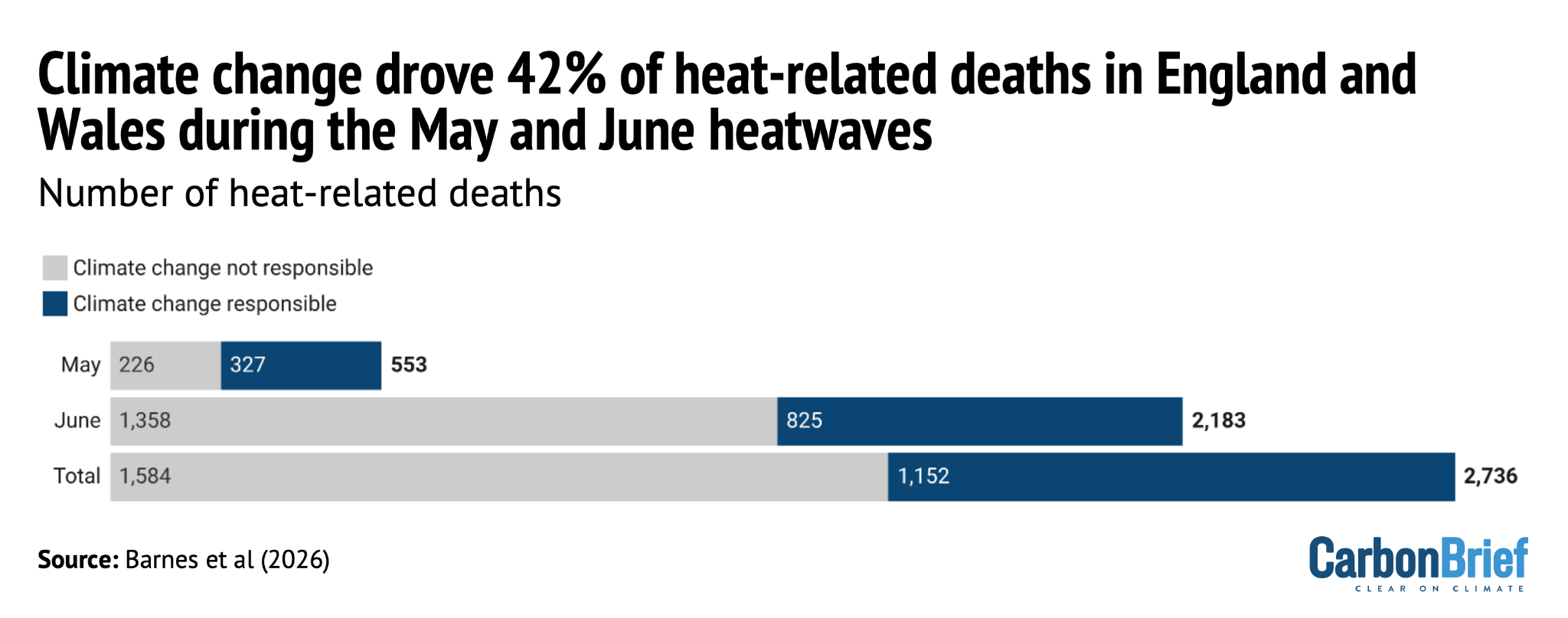
Carbon Brief explained how more than 1,000 heat-related deaths in England and Wales during the May and June heatwaves were attributed to climate change, accounting for almost half of all heat-related deaths experienced during those months. The article also unpacked the different methods for estimating heat deaths around the world.
4.5C
The amount that the average hottest day of the year has increased in temperature this decade across an area of England stretching from Kent to Lincolnshire, when compared to 1961-90, according to the Met Office’s latest “state of the UK climate” report.
Spotlight
Intense rainfall strikes west Africa
This week, Carbon Brief interviews Dr Joyce Kimutai, a Kenyan climate scientist and lead author of a new attribution analysis investigating the role of climate change in recent floods in west Africa.
Around 100 people were killed in the floods across Cote d’Ivoire, Ghana, Nigeria and Togo in late June.
The analysis found that climate change made the three-day burst of intense rainfall that led to the floods about five times more likely to occur.
Carbon Brief: You have carried out a lot of extreme event attribution analyses. What stood out to you about this one?
Dr Joyce Kimutai: The thing that stood out is there was a strong signal [of the influence of climate change on heavy rainfall] in the observations, but the models didn’t give us that. The models are struggling to simulate these kinds of events in west Africa. This is not a problem unique to this region, we have also seen this in other parts of the continent.
[Extreme weather event attribution studies involve scientists looking at past data, or “observations”, to see how the frequency and intensity of events, such as the heavy rainfall in west Africa, have changed over time. They also use computer models to compare the frequency and intensity of such events in simulated worlds with, and without, human-caused climate change. See Carbon Brief’s attribution explainer for more information.]
The big message from that is we are, for sure, seeing an intensification of these short, intense rainfall events in this part of the world, even higher than what the models are telling us.
CB: Why is it that the models are underestimating the impact of climate change on rainfall in this region and other parts of the continent?
JK: Most models were not built for the climate of this region. You will find that a lot of people who are involved in model development are based at institutions in the global north. [They are not] the people that have expertise in tropical weather, which is very different from the weather of the higher latitudes of the northern hemisphere. There is a lot of what we call “parametrisation”, which is an estimation of systems and processes [within models]. There is a lot that needs to be done to improve the simulations of these processes for models to be fit for purpose to study events [in this region].

CB: Sometimes extreme weather events in regions such as west Africa do not get the same high-level attention as those in the global north. What do you do to ensure your findings reach policymakers?
JK: We hold press briefings. We involve the locals [in the analysis]. We try to make sure that there is a way for our findings to get to the stakeholders that operate in the region. The end goal is to make sure that the findings continue to raise awareness of changing risks, of how climate change continues to modify the weather that we experience and is continuing to impact people’s lives and livelihoods.
Preprints to watch
Carbon Brief’s pick of new papers under review
- Researchers explore the “drivers and uncertainties” of regional climate changes in various future “overshoot” scenarios | Earth System Dynamics
- The energy-intensive process of manufacturing AI hardware “rivals” the emissions generated by AI datacentre operations | Nature portfolio
- Small tropical islands could be exposed to “dangerous humid heat levels” by the end of the century | Geophysical Research Letters
Noticeboard
- 13-31 July: Meeting of the International Seabed Authority assembly and council, Kingston, Jamaica
- 23 July: Registration deadline for SCAR Open Science Conference, Oslo, Norway
- 30 July: Early-bird registration deadline for Challenger Society meeting, Bangor, UK
- 31 July: MedCLIVAR early bird registration deadline, Limassol, Cyprus
- 31 July: Submission deadline for special issue of Journal of Water & Climate Change
- 1 August: Early-bird registration deadline for International Partnerships in Ice Core Sciences, Banff, Canada
- 9 August: Application deadline for science advisor role at the Climate Litigation Network | Salary: €50,000-65,000. Location: London or Amsterdam
- 16 August: Application deadline for postdoctoral research associate in Caribbean marine heatwaves at Princeton University | Salary: Unknown. Location: New Jersey, US
Cited is researched and written by Cecilia Keating, Robert McSweeney, Ayesha Tandon, Daisy Dunne and Dr Giuliana Viglione.
Please send tips, feedback and upcoming climate research to [email protected]
This is an online version of Carbon Brief’s fortnightly Cited email newsletter. Subscribe for free here.