
Cited 29 September 2026: Record-breaking El Niño | The EU ‘OceanEye’ project | Antarctic sea ice peak

This is an online version of Carbon Brief’s fortnightly email newsletter, Cited, an essential guide to new climate research. This week…
- New science on coastal flooding, atmospheric dust and heat stress.
- Carbon Brief unpacks ‘OceanEye’ – the EU’s ocean monitoring initiative.
- Developing El Niño is officially the strongest on record.
- Antarctic sea ice reaches the third-smallest winter peak on record.
In the news
EL NIÑO BREAKS RECORDS: Carbon Brief analysis found that this year’s “super El Niño” has entered record-breaking territory, as sea surface temperatures in the tropical Pacific have exceeded the previous daily record set in 2015. The Guardian quoted Carbon Brief’s Dr Zeke Hausfather, who said the event “will pile extra heat into an atmosphere in which temperatures are already rising rapidly due to human-caused global heating”. The Daily Mail, Independent and New York Times also reference the Carbon Brief’s analysis. There was also widespread media coverage of a Climate Impact Lab report that found that the event could cause 451,000 excess heat-related deaths by February 2027.
HIMALAYAN GLACIER STUDY: World Weather Attribution published a rapid analysis of temperatures at the site of the ice-rock avalanche that caused the deadly floods in Nepal and China last month. The authors found that July and August temperatures have increased by 1.5C due to human-caused climate change – a rate that is “just slightly faster than the average rate of global warming”. The study identified permafrost thaw and glacial thinning as a key contributor to the disaster, in addition to a “massive” 2015 earthquake that “likely influenced” the collapse by weakening the “underlying rock mass over the long term”. (See Carbon Brief’s updated Q&A on the Himalayan floods.)
‘ANTI-CLIMATE CAMPAIGN’: Politico found that “right-leaning groups” are filing “open records requests” at US universities, demanding documents including emails and research drafts from academics studying climate change. The outlet said this was part of a “decades-long campaign” to “discredit scholars whose work could persuade judges and juries in…high-stakes climate cases”. The investigation uncovered more than 100 open records requests filed at 19 public universities over the past five years. Separately, the Guardian covered new research which documented that “fossil-fuel firms have spent years trying to regulate climate research by donating to US universities”.
Research picks
Past
- A decline in atmospheric dust might have “modestly contributed” to global warming over 2003-23 | Science Advances
- On average, globally, heatwaves are starting 3.2 days earlier and ending 5.4 days later per decade since 1979 | Nature Climate Change
- Logged forests in central Vietnam over 2016-24 showed “no evidence of net aboveground carbon accumulation” as they recovered, although they maintained their existing carbon stocks | Environmental Research Letters
Present
- Analysis of more than 20,000 articles on climate tipping points finds that the Greenland ice sheet and Atlantic Meridional Overturning Circulation “received substantial attention”, but thawing boreal permafrost and the North Atlantic subpolar gyre did not | Proceedings of the National Academy of Sciences
- High-resolution heat-stress modelling systems could be an effective tool to help develop heat management strategies for outdoor endurance events | PLOS Climate
- Current carbon budgets “probably” underestimate the ocean carbon sink by 10% by excluding the effects of “rain-induced dilution” | Nature Geoscience
Future
- More than two-thirds of newly flooded coastlines worldwide could become suitable habitat for 122 “non-native marine species” by the middle and end of this century | Nature Ecology and Evolution
- The historical carbon emissions of major oil, gas, coal and cement producers will contribute to global warming “for centuries”, regardless of the level of future emissions | PLOS Climate
- Projections of regional temperature changes under net-zero or net-negative pathways reveal a “distinct pattern of northern-hemisphere cooling and southern-hemisphere warming”, which could take “many decades” to reverse | Environmental Research Letters
Please send upcoming climate research and preprints to [email protected]
Captured
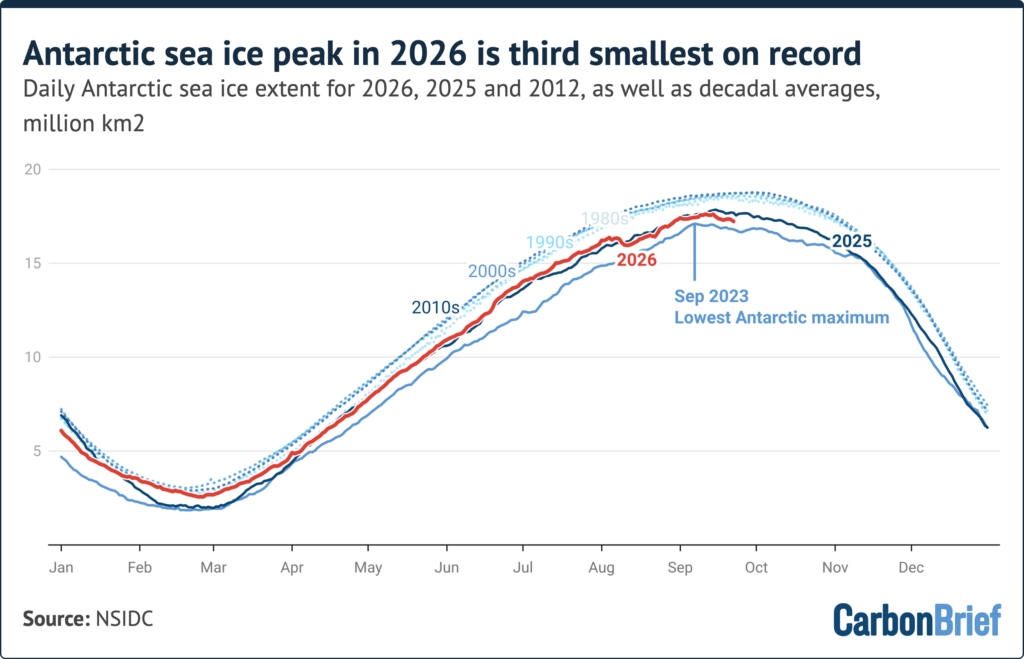
Antarctic sea ice has recorded its third-smallest winter peak extent since satellite records began 48 years ago, according to provisional data from the US National Snow and Ice Data Center. One expert told Carbon Brief that it is “concerning to see these low values persisting”, but added that scientists need more time to determine whether this represents a “structural shift” in Antarctic sea ice extent.
236,732,332
The number of downloads of data from the sixth Coupled Model Intercomparison Project (CMIP6) between January 2018 and January 2025, according to a study in Geoscientific Model Development. CMIP6 is a coordinated set of climate model runs that featured heavily in the Intergovernmental Panel on Climate Change’s sixth assessment cycle.
Spotlight
‘OceanEye’ – the EU’s ocean monitoring initiative
Carbon Brief unpacks how a new EU initiative could support global efforts in weather forecasting, climate prediction and coastal protection.
At the UN General Assembly last week, a raft of countries pledged €211m (£181m) to a new ocean monitoring system that aims to be the “world’s leading provider of ocean intelligence”.
Canada, Costa Rica, South Korea and the UK were among the nations to commit to funding the EU-led scheme, dubbed OceanEye.
The OceanEye initiative will directly support the Global Ocean Observing System – the world’s largest ocean observing network, which enables scientists, governments and research organisations to develop ocean observation tools and forecasts.
The EU initiative will strengthen ocean observation by helping to maintain existing observation networks, reinforce international cooperation by developing “coordination hubs” and address gaps in under-monitored regions in the southern hemisphere, the Arctic, the deep sea and coastal areas.
At a “high-level pledging event” at the UN meeting, European Commission president Ursula von der Leyen warned that “ocean observation is under huge pressure”, adding that “with OceanEye, we can gather the data we need to understand and protect our ocean”.
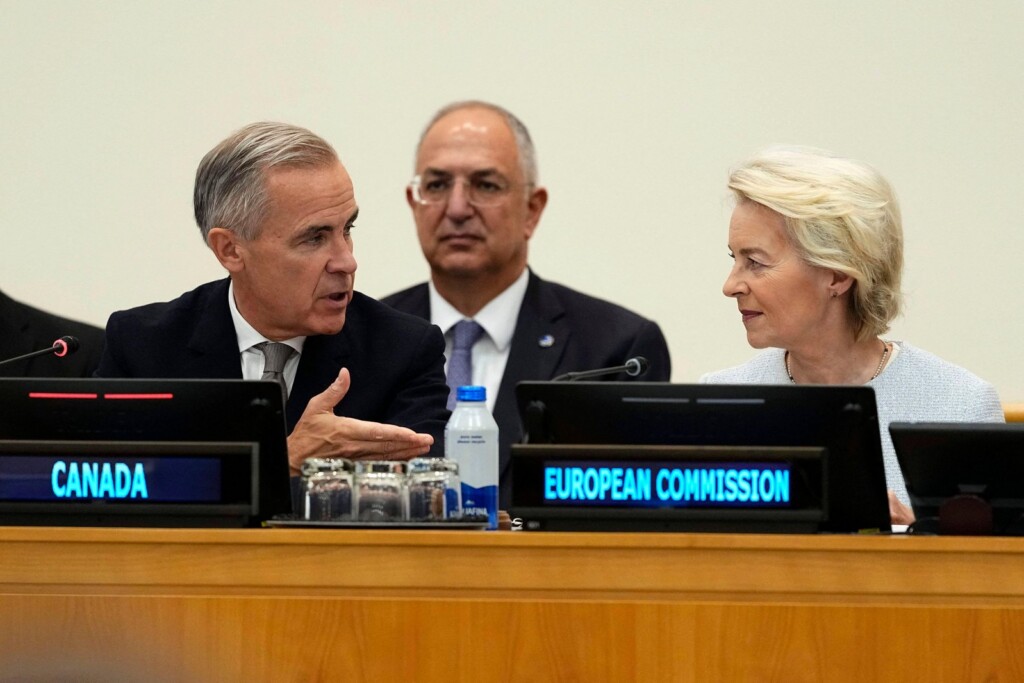
In total, 30 countries pledged money and joined the alliance, committing to ongoing cooperation on ocean monitoring. For example, the Guardian reported that the UK Met Office will now share more data with the EU.
The ocean funding was announced as world leaders convened in New York to discuss topics ranging from AI to international security. Climate change was high on the agenda, with speakers including UN secretary general António Guterres addressing the topic.
Virtual ocean
As part of the OceanEye scheme, scientists are also developing a “virtual ocean”, known as the European Digital Twin Ocean project, which pulls together data on key aspects of the ocean – including temperature, ocean currents and pollution – from satellites, sensors, computer models and smartphone apps.
The data will constantly feed into a real-time digital model of the ocean, called a “digital twin”. The resource will be free to use by 2030 and will provide continuous, up-to-date information about the ocean.
Dr Lőrinc Mészáros is a research advisor in marine and coastal systems at Deltares and is leading the organisation’s contribution to the Horizon Europe EDITO-Model Lab – the project that “provides the engine” for the digital twin.
He told Carbon Brief that “digital twins for single objects”, such as a specific area, are “not particularly novel”. However, he said that bringing together the “entire European marine community” to build and operate digital twins that work on a “local to global level” using public resources was “very new”.
Researchers, policymakers and the general public are already using the digital twin to simulate specific aspects of the ocean under a range of different past and future climate scenarios. Mészáros added:
“Together with our partners, we have created a series of applications to produce indicators and maps for habitat suitability in marine protected areas, optimised ship routing to find the least-CO2 emission routes in the Pacific green corridor, oil spill and microplastic hazards.”
Mészáros also pointed to OpenBerg – a model that can be used to give “reliable information on the location and movement of sea ice and icebergs for navigation safety in the Arctic area”.
The push for improved EU-led ocean monitoring and modelling comes as scientists have warned that the global marine monitoring system is at risk, after the US administration under president Trump threatened to dismantle parts of the network.
Mészáros told Carbon Brief that OceanEye “openly positions Europe as the new leader” in ocean observation as the US withdraws.
Preprints to watch
Carbon Brief’s pick of new papers under review
- Climate change literacy has declined across most of Africa since 2016, according to a major public opinion survey | Nature portfolio
- Across the northern hemisphere, climate change caused soil to thaw roughly three days earlier and freeze three days later per decade over 1979-2025 | Earth System Science Data
- Climate change is increasing the likelihood of extreme European wildfires that are “virtually impossible” to suppress | Nature portfolio
Noticeboard
- 28 September-1 October: Second meeting of authors of the Intergovernmental Panel on Climate Change’s third working group report | Pathum, Thailand
- 6-9 October: Global heat forum meeting | Bangkok, Thailand
- 8 October: Postdoctoral assistant in numerical weather prediction at the Cooperative Institute for Research in Environmental Sciences at the University of Colorado, Boulder | Salary: $65,000-$70,000, Location: Boulder, US
- 12 October: Head of observations at the National Centre for Atmospheric Science’s atmospheric measurement and observational science capability | Salary: £58,225-£67,468 per year. Location: York, UK
- 12-16 October: Atmospheric processes and their role in climate (APARC) general assembly | Location: Pune, India
- 13-15 October: GRACE/GRACE-FO science team meeting | Location: Potsdam, Germany
- 15 October: Postdoctoral researcher in feedback effects of offshore wind turbines on the environment at Delft University of Technology | Salary: €3,546-€5,538. Location: Delft, Netherlands
This edition of Cited was written by Ayesha Tandon, science correspondent and edited by Cecilia Keating, section editor for science. Please send tips, feedback and upcoming climate research to [email protected].