
Cited 4 August 2026: Record-breaking fires | 2026 warming projection | Wildfire scientist Q&A

This is an online version of Carbon Brief’s fortnightly email newsletter, Cited, an essential guide to new climate research
Sign up below.
In the news
FOSSIL-FUELLED FIRES: Many European countries have been afflicted by wildfires, with “hundreds of thousands” of people evacuated in France, Italy and Spain, according to the Guardian. Blazes also spread in Greece and Turkey, reported Al Jazeera. Human-caused climate change made the hot, dry and windy weather that fuelled the fires in France twice as likely and the conditions in Spain 20 times more likely, according to a rapid attribution analysis covered by Reuters.
RECORDS BROKEN: The New York Times reported that the wildfires in Spain and France had “broken modern records”. It continued that 40% more land had burned in France than the entire previous record year, whereas in Spain the amount of land consumed is “nearly at record levels” for this point in the year. Carbon Brief factchecked a misleading claim circulated on social media by climate sceptics, which stated that Europe was seeing its “quietest” year for wildfires. Our World in Data’s Dr Hannah Ritchie also pulled apart the claim on Substack.
Research picks
Earth system
- There has been a three-fold increase of co-occurring atmospheric and river heatwaves in the US and central Europe under climate change since the 1980s | Nature Geoscience
- Achieving net-zero emissions this century could lead to global cooling of “at least 0.6C” over the following centuries | Nature Climate Change
- “Diverging” wildfire trends in eastern Australia and the south-western US are linked to weather patterns in the tropical Pacific | Environmental Research Letters
Humans and society
- Only 23 out of 198 UN member states mention “sexual and gender minorities” – encompassing sexual orientation, gender identity, gender expression and sex characteristics – in their national adaptation plans | npj Climate Action
- Satellite observations reveal that CO2 emissions are underestimated by “about 30%” in Africa and the Middle East | Science Advances
- People with pre-existing mental illness face more severe mental-health impacts from extreme weather and climate events than those without such conditions | Nature Mental Health
Ecosystems and agriculture
- A further increase of 1C in global temperature would reduce global rice yields by an average of 8.1% | Science Advances
- An analysis of how different types of global environmental change impacts island ecosystems finds that climate change is the “dominant” threat for 65% of islands | Proceedings of the National Academy of Sciences
- Common bird and butterfly species in Europe will continue to decline up to 2050, even under optimistic conservation and land-use scenarios | Nature Ecology and Evolution
Captured
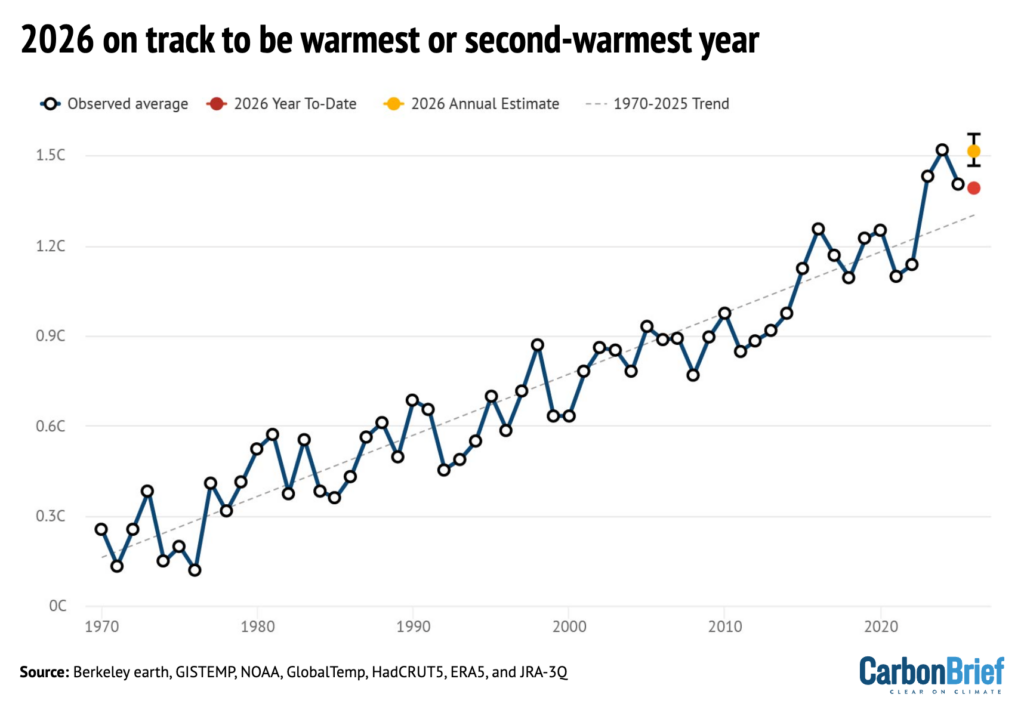
Carbon Brief’s latest “state of the climate” report by Dr Zeke Hausfather estimated that global temperatures in 2026 could average around 1.51C warmer than pre-industrial times. This estimate would make 2026 the second-warmest year on record, just below 2024 (1.52C) and ahead of 2023 (1.43C) and 2025 (1.41C).
2.9C
The projected rise in sea surface temperature in the “Niño3.4” monitoring region of the tropical Pacific for August-October 2026, relative to the long-term average for those months, according to a new report from the World Meteorological Organization.
Spotlight
‘Era of unstoppable fires’
Carbon Brief speaks to Dr Raúl Cordero, an assistant professor at the University of Groningen in the Netherlands, about research published last week in Scientific Reports that found there has been a “major intensification” of “fire weather” in southern Europe in recent decades.
To reach their conclusions, the researchers analysed records of total burned area, number of fires and days of extreme fire risk dating back to 1980 in France, Greece, Italy, Portugal and Spain.
Carbon Brief: What are the key findings of your research?
Dr Raúl Cordero: Over the past four decades or so, the number of days with extreme fire risk have nearly doubled in most of southern Europe. In the 80s and 90s, we used to have about 10 days of high fire risk. Over the past decade, we have seen more than 20 – and sometimes 25, depending on the region. Over the past 40 years, the number of days with extreme fire risk has more than doubled in southern Europe.
There is another detail that is important [in our study] and it relates to fire metrics. The number of fires is an important fire metric, but there is another one which is even more important, which is the area being burned every year, or burned area. Burned area was decreasing in most of Europe over most of the past 45 years. But when looking at the statistics, we found that the burned area started to increase after 2018.
CB: What is behind the increase in days with extreme fire risk in Europe?
RC: The metric that we use is called the fire weather index, which is a number calculated by using different metrics that have an influence on fire propagation – moisture, wind, precipitation and temperature.
The most important of those factors is temperature. And, so, because global warming is pushing temperatures up, it is no surprise to find that the fire weather index – meaning the fire risk – has increased on average by 50% over the past 40 years.
It’s not a big surprise, because Europe now has double, even triple – depending on the region – the number of days with extremely high temperatures. Fire risk is extremely sensitive to temperatures – so, if you have an escalation in the number of heatwaves, of course you’re going to have an escalation in the number of fire-risk conditions.

CB: Why is the increase of burned area in Europe after 2018 significant?
RC: [The previous decrease in burned area in Europe] was attributed to successful fire suppression. But nowadays – despite the fact that the resources invested in fighting fires are still there – those resources are not up to the challenge anymore.
There are fires all over the world – in South America, in particular in central Chile [and] in North America, in particular in southern California. We also have them in Australia. In all these hotspots, burned area has been increasing.
This suggests that it doesn’t matter the resources you have – there are some fires you cannot stop. That’s particularly clear in the case of California. California is the richest state in the richest country. They have all the planes, the firefighters and resources.
Europe was an anomaly [in this regard] because it was able to cope. Well, not anymore.
This is suggested in the paper. We can’t say there is a “significant trend” [yet] because [the increase in burned area] only began in 2018. Unfortunately, it is about to become statistically significant because the 2026 season is confirming what we argued in the paper, which is that we are entering an era of unstoppable fires.
Preprints to watch
Carbon Brief’s pick of new papers under review
- A better understanding of the role of the “biosphere” – the global sum of all ecosystems – is needed to improve prediction of Earth’s responses to human-caused “perturbation” | Earth System Dynamics
- Perceived thermal stress – individuals’ subjective experience of discomfort or strain due to heat exposure – has “persistent effects” on brain-related outcomes in “extraordinarily” healthy individuals | Nature portfolio
- Satellite observations reveal a “renewed intensification” of melting within Antarctica’s Pine Island glacier cavity since 2018, following a period of relative slowdown | Proceedings of the National Academy of Sciences
Noticeboard
- 3-7 August: Fourth lead author meeting for IPCC special report on cities and climate change, Bhopal, India
- 10-14 August: Second lead author meeting for IPCC methodology report on carbon dioxide removal, Mexico City
- 21 August: Deadline for abstracts for the second overshoot conference in Beijing
- 13 September: Deadline for research pitches for “AI for ocean” programme run by the Coalition for Responsible AI and Mercator Ocean International
- 15 September: Application deadline for assistant professor role in political science and environmental studies at Tulane University | Salary: Unknown. Location: New Orleans, US
- 23 September: Deadline for proposals for sessions at the European Geosciences Union 2027 in Vienna, Austria
- 2 October: Application deadline for assistant professor role on impacts of global environmental change, University of California, Berkeley | Salary: $84,100-132,900. Location: Berkeley, US
This edition of Cited was written by Cecilia Keating. It was edited by Dr Giuliana Viglione. Please send tips, feedback and upcoming climate research to [email protected].
This is an online version of Carbon Brief’s fortnightly Cited email newsletter. Subscribe for free here.