
Cited: IPCC talks stuck | 1.5C ‘imminent and unavoidable’ | New UK Arctic strategy

This is an online version of Carbon Brief’s fortnightly email newsletter, Cited, an essential guide to new climate research.
In this edition…
• New science on coral reefs, food and land, and climate behaviour.
• Key IPCC talks in Ethiopia were suspended.
• Crossing 1.5C is now “inevitable” following decades of delay, said the UN.
• Carbon Brief reports on how a UK Arctic update focuses on climate change.
In the news
‘DISAPPOINTMENT’: The Intergovernmental Panel on Climate Change’s (IPCC) 65th session, seen by many as the final opportunity for countries to agree on a report schedule in line with the UN’s second “global stocktake” of climate action, ended in “profound disappointment”, explained Carbon Brief. The week-long meeting in Ethiopia earlier this month descended into fraught disagreements between governments, forcing IPCC chair Prof Jim Skea to suspend the session. The Guardian explained “who wants a delay” at the talks and “why”.
EMISSIONS GAP: A temporary breach of the 1.5C global-warming limit is now “inevitable” following “decades of insufficient climate action”, according to an UN Environment Programme (UNEP) report covered by Carbon Brief. In its “sobering” annual assessment of the global “emissions gap”, UNEP said that exceeding the Paris Agreement’s 1.5C limit is “imminent and unavoidable”. The report also said that current country policies would cause 2.8C by the end of the century, said the Financial Times.
Research picks
CORAL REEFS
- Nearly half of shallow-water corals face an “elevated risk of extinction” due to climate change | Nature
- Reintroducing the symbiont organisms that corals lose during bleaching episodes can help reefs to recover more rapidly | Science Advances
- Despite ocean warming, conditions in the Mediterranean Sea are currently too cool to support coral reefs | Coral Reefs
FOOD AND LAND
- Adoption of plant-based meat alternatives could “substantially” reduce agricultural greenhouse gas emissions and land expansion | Nature Food
- CO2 emissions from Amazon deforestation and degradation can be “amplified” by drought | Nature
- Dry forests and savannahs in the tropics provide around 20% of the global land carbon sink, despite losses from deforestation and degradation | Global Change Biology
CLIMATE BEHAVIOURS
- US Democrats are consistently more likely to exhibit “pro-climate choices” than Republicans, with “no evidence of moderation by objective extreme weather exposure” | Nature Climate Change
- Climate-change disinformation is a “layered, structurally sustained phenomenon” where “political-economic, rhetorical and platform-mechanical processes” reinforce each other | Climatic Change
- Citizens’ assemblies on climate change in Europe have produced “ambitious” plans, but implementation remains weak | Nature Climate Change
Please send upcoming climate research and preprints to [email protected]
Captured
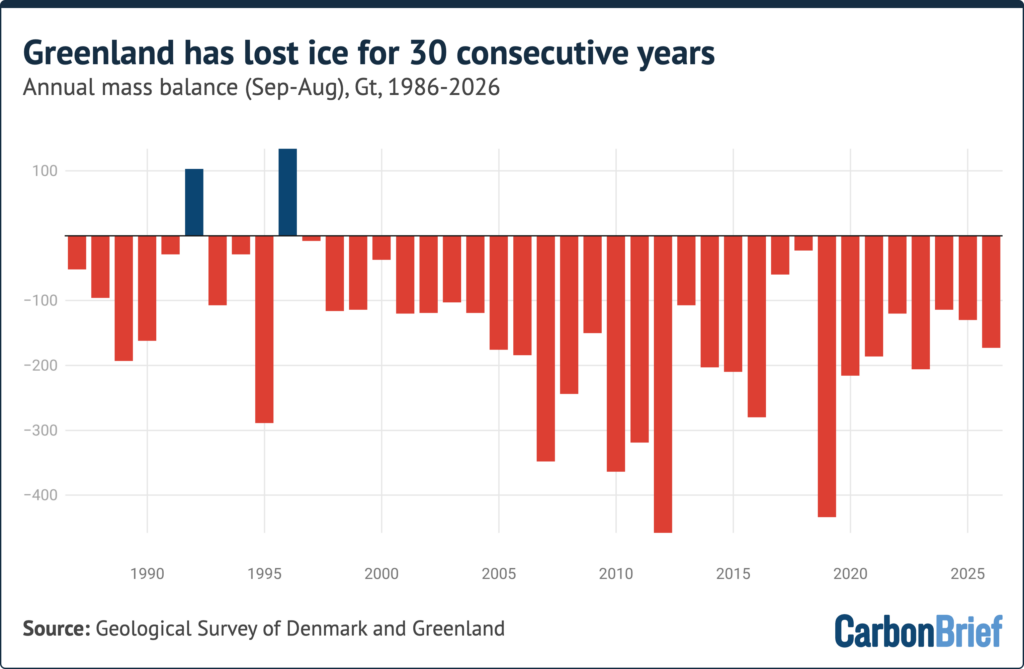
The 12-month period to August 2026 marked the 30th consecutive year of ice loss in Greenland, according to Carbon Brief’s annual update of ice cover in the region. The analysis shows how 1996 was the last year where the world’s second-largest ice sheet gained more ice than it lost.
426.8 parts per million
The concentration of CO2 in the atmosphere in 2025 – 153% higher than the pre-industrial baseline (before 1750), according to the World Meteorological Organization greenhouse gas bulletin.
Spotlight
UK puts climate at heart of Arctic strategy
This week, Carbon Brief reports on how the UK is updating its Arctic strategy to focus on the threat of climate change.
Earlier this month, the UK government launched a new update to its Arctic policy framework.
First launched in 2023 under the Conservative government, the framework has now been updated to centralise the UK’s response to the threat of climate change in the Arctic, said polar minister Uma Kumaran.
At a launch event for the policy update at the foreign office in London, she told Carbon Brief:
“The whole point of refreshing the UK’s Arctic policy framework is precisely to do with a changing Arctic. The ice is melting. It’s making it more strategically accessible. It’s bringing with it opportunity, but also challenges.
“For us, it’s looking at that holistically. Climate challenges pose a security concern, but [we’re] also looking at what we can do in terms of science, research, partnership, collaboration and investment.”
Much of the update focuses on the accelerating impacts of climate change in the Arctic and how UK scientists are working to record and study these changes.
The document says that the “UK has built its reputation as a leader in polar research” and reconfirms its commitment to continue investing in Arctic science.
It notes that “understanding the environmental impacts of an increasingly ice-free Arctic” and how best to respond is now a “focus” for the UK Research and Innovation’s (UKRI) climate, adaptation, environment and resilience priority programme.
UKRI has plans to invest £13m in projects in this area up to 2032, alongside the Research Council of Norway, according to the update.
It adds that the government is “looking forward to continuing to develop and deepen our research presence in Svalbard”, an Arctic island where the UK has a permanent research base (visited by Carbon Brief in 2024).
The UK’s position comes after the Trump administration gutted its polar research, leaving many US scientists with lost jobs, cancelled grants and suspended fieldwork.
Security centred
In addition to noting the opportunities for research, the update also focuses on how climate change in the Arctic could pose risks to the UK’s security. Kumaran told Carbon Brief:
“There’s no UK security without Arctic security. And Arctic security doesn’t just mean defence, it means climate resilience. Warming temperatures means melting glaciers and rising sea levels. That brings with it climate risks.”
The updated stance comes after new foreign secretary Ed Miliband made a presentation to other ministers at New York Climate Week in September about how climate change risks the UK’s national security.
The presentation was based on a report prepared by the UK’s security services, which was initially “suppressed” by former prime minister Keir Starmer, according to the Guardian.
Preprints to watch
Carbon Brief’s pick of new papers under review
- Uncertainty in historical climate records is the “primary driver” of uncertainty in climate projections | Science Advances
- Scientists calculate the “deforestation footprints” of 183 agricultural commodities across 179 countries | Environmental Science & Technology
- A research paper reconstructs the series of events that led to catastrophic floods in Nepal in August | Journal of Mountain Science
Noticeboard
- 19-30 October: COP17 biodiversity summit, Yerevan, Armenia
- 1 November: Informed Climate Journalism Network training programme deadline
- 9-20 November: COP31 climate summit, Antalya, Turkey
- 1 December: Tenure-track professor position in biodiversity, conservation or land surface processes at Harvard University | Salary: $110,000-$165,000. Location: Cambridge, Massachusetts
- 14 December: PhD position in quantifying uncertainties in the Antarctic ice sheet response to climate overshoot scenarios at Kings College London | Salary: Unknown. Location: London
- 31 December: PhD position in AI-based prediction and climate change attribution of extreme events at the Spanish National Research Council | Salary: €1,655 per month. Location: Madrid
This edition of Cited was written by Daisy Dunne. It was edited by Cecilia Keating. Please send tips, feedback and upcoming climate research to [email protected].