
Cropped 28 October 2026: ‘Slow progress’ at COP17 | Lula’s ‘unprecedented’ win | Protected-area finance falls

Welcome to Cropped, where Carbon Brief handpicks and explains the most important stories at the intersection of climate, land, food and nature over the past fortnight.
In this edition…
- Concerns over the “slow” pace of progress at the UN biodiversity talks.
- Financing for nature remained “contentious” at COP17.
- EU agricultural ministers agreed their position on the bloc’s agricultural policy.
- Carbon Brief covers the reactions to Lula’s re-election at COP17.
- New science on agropastoralist migration, the land carbon sink and coral reefs.
Key developments
‘Slow progress’ at COP17
‘SLUGGISH PACE’: The first week of the COP17 biodiversity summit in Yerevan, Armenia, yielded “slow progress”, said BusinessGreen, as “concerns are mounting over the sluggish pace”. During the stocktaking plenary at the end of the first week, delegates adopted 14 decisions, “but disagreements over conservation finance, corporate contributions and community participation remain unresolved”, reported the Climate Watch. Ministers have arrived in Yerevan to “help bridge political divisions”, it added.
‘VIRTUALLY EMPTY’: The Guardian reported on the “virtually empty” Cali Fund, noting that “no money has so far been given by major pharmaceutical companies”. Meanwhile, DeSmog unearthed evidence “of lobbying by a leading international pharmaceuticals group to weaken” the fund. A spokesperson for the group told DeSmog that the lack of participation in the fund “reflects ongoing questions about the design and implementation of the mechanism, rather than a lack of commitment to biodiversity”.
CONTENTIOUS CASH: At COP17, “financing remains one of the most contentious issues”, with countries disagreeing over expanding the pool of contributors and how to best ensure that “conservation funding reaches the people protecting ecosystems on the ground”, reported the Dhaka Tribune. A press release from the Global Environment Facility welcomed five new pledges to the Global Biodiversity Framework Fund, totalling more than $60m. UN biodiversity chief Astrid Schomaker said the pledges are “encouraging signs of growing support for biodiversity finance”.
High costs, falling funds
INDIGENOUS ASKS: Indigenous leaders – alongside women’s and youth groups – have “called for direct access to biodiversity finance and greater decision-making power” to better reflect their contributions to protecting nature, reported the Climate Watch. Peru Reports noted that the communities protecting Indigenous lands in the Amazon rainforest are facing “high costs, both financial and human”. Other local communities at COP17 have argued that their traditional knowledge is “insufficiently recognised in scientific research and global conservation policy”, according to the News Minute.
30 BY 30: Nature World News covered research published in Nature showing that the world is closer to the global goal of protecting 30% of land and seas by 2030 than previously thought – but that “hitting the area number alone will do little to halt biodiversity loss”. More than 61.5m hectares of protected or conserved areas “overlap with ongoing and planned oil and gas blocks” across the tropics, reported Mongabay. Analysis from several NGOs showed that annual international financing for protected areas “fell for the second consecutive year in 2025”.
News and views
- LULA VICTORIOUS: Brazilian president Lula da Silva defeated Flávio Bolsonaro in a run-off election on Sunday to win an “unprecedented” fourth term, despite trailing after the first round of voting, reported Folha de S.Paulo. The “unexpected” victory “means the country won’t make a sharp pivot in its approach to climate change” and deforestation, said Bloomberg. (See Spotlight below.)
- AG AGREEMENT: EU agricultural ministers reached a “unanimous agreement” on their negotiating position for the future of the bloc’s Common Agricultural Policy, which must still be agreed with the European parliament, reported RTE. According to EUObserver, the governments’ proposal will “speed up and simplify the payment of farming subsidies” by giving greater autonomy to member states.
- FAST FUNDS: Analysis from the Wildlife Trusts found a funding gap of more than £2bn for the environmental land management schemes programme in England. Separately, Farmers Guide reported that the UK Department for Environment, Food and Rural Affairs “was aware of the possibility” that funding for its sustainable farming incentive programme would run out “within hours of opening”, as occurred in September.
- BASIC INCOME TEST: A two-year pilot project in Peru to provide a basic income “roughly equivalent to £2 a day” found that nearly 90% of recipients “adopted environmentally beneficial practices, such as collective reforestation”, said the Guardian. The outlet added that the researchers “also noted a reduction in food insecurity”.
- LOBBYING ‘BLITZ’: A report from the NGO Mighty Earth identified a “major US corporate lobbying blitz” to “delay, derail or severely weaken” the EU deforestation regulation. The investigation identified 258 lobby meetings in the European Parliament related to the legislation, 178 of which “involved businesses and/or industry associations”.
Spotlight
Lula’s Brazil bounceback
This week, Carbon Brief details how the surprise re-election of Brazil’s president impacted the mood at COP17.
Brazil’s election results shocked the world this week – and brought some hope to negotiators wading through the divided UN nature talks in Armenia.
The country’s current president, Luiz Inácio Lula da Silva, was re-elected for an unprecedented fourth term, beating far-right senator Flávio Bolsonaro.
Bolsonaro led in polls for the runoff ballot on 25 October after receiving more votes than Lula in the first round earlier this month.
The historic result arrived at the halfway point of the COP17 UN biodiversity summit in Yerevan, where delegates remain deadlocked over key outcomes.
Ahead of the vote, Brazil’s Indigenous groups had rallied in front of the COP venue to “defend” democracy and biodiversity.
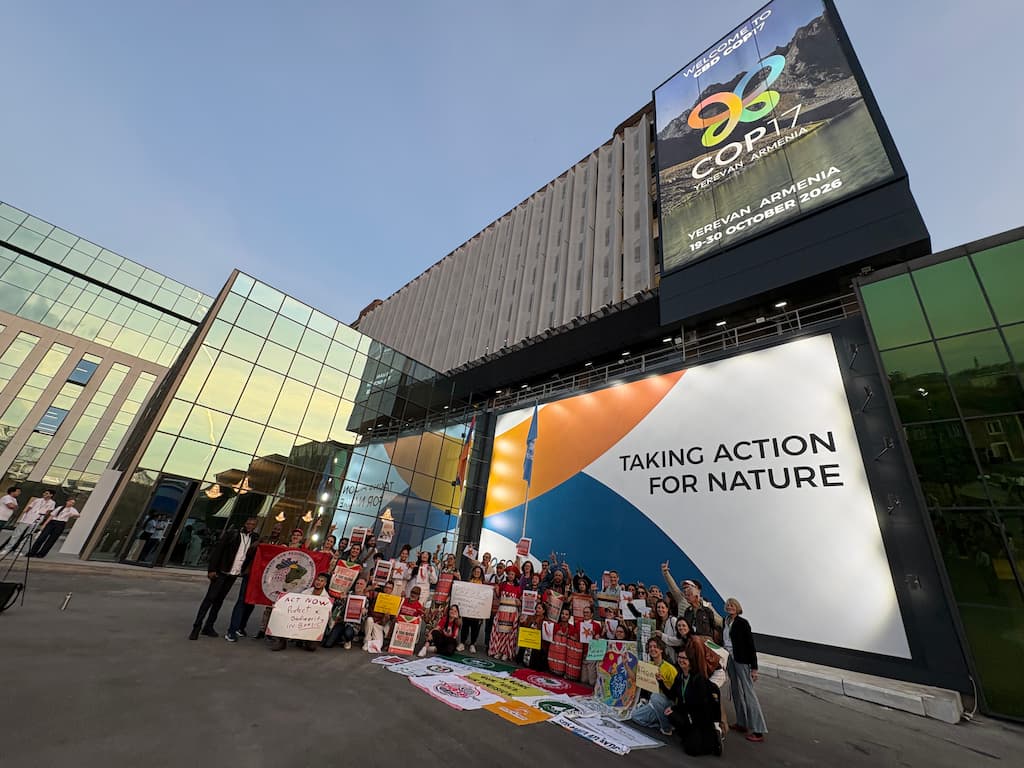
At a side-event on 23 October, Brazilian diplomats discussing details of a global deforestation roadmap were bracing for an outcome that could directly impact their work. Some confided to Carbon Brief that a win for Lula was “not impossible” – but not realistic.
At a Brazil-led event on Monday, hours after the result was announced, COP17 delegates broke into rapturous applause after Inger Anderson, executive director of the UN Environment Programme, said:
“Let me start off by giving a big, big shoutout to Brazil. I’m encouraged to acknowledge this political announcement.”
Representatives from the UK and Norway also welcomed the results at this event.
Also on Monday, the Netherlands pledged $500m to Brazil’s Tropical Forest Forever Facility.
Next steps
Forest loss in the Amazon reached its lowest level since records began in 1988 under Lula’s current presidency.
Carbon Brief analysis also showed that his government prevented the deforestation of an area of Amazon rainforest roughly the size of the US state of New Jersey.
These deforestation efforts “must be sustained”, said Camila Jardim from Greenpeace Brazil in a statement:
“Efforts to protect and restore ecosystems across Brazil’s biomes must intensify, respecting the rights of Indigenous peoples and local communities.”
Jardim, who is at the COP17 talks, told Carbon Brief at a press briefing that the incoming Brazilian Congress will, nonetheless, have a stronger ability to “dismantle” environmental protections.
Following Congressional elections earlier this month, Lula faces a “legislature dominated by the far right”, noted Brazilian environmental civil society network, the Climate Observatory.
Many of the politicians taking office next year want to “reshape the nation’s Supreme Court, economy, human rights protections and environmental policies”, said the Associated Press.
Meanwhile, Brazil continues to play a key role at the nature talks in Yerevan – from advancing proposals to get companies to pay for genetic data through to calling for existing funds to be infused with fresh deposits.
At home – as in the halls of COPs – what Brazil says and does will have ripple effects that will be felt in ecosystems and territories far beyond its own borders.
Watch, read, listen
SEA CHANGE: Dr Sylvia Earle – a pioneering deep-sea oceanographer – wrote in Reuters that the Azores are setting “an example worth following” in ocean conservation.
SPILL THE TEA: Tea growers in Taiwan spoke to Mongabay about how adopting more environmentally friendly farming practices increased soil health and reduced irrigation needs.
REFLECTIONS: For the Pacific News Service, Ian Fry, former climate change and environment ambassador for Tuvalu, reflected on how the CBD COP process has changed since 1994.
ROAD BLOCK: Atmos covered Indigenous resistance to the Ambler road project, which would cross key caribou migration routes and open remote parts of Alaska to mining claims.
New science
- Tanzanian agropastoralists are migrating in response to “environmental degradation”, according to a survey of 1,000 households | Ecology & Society
- Evidence from climate models, ecosystem-scale experiments and the palaeoclimate record showed that changes that occur in response to temperature “overshoot” should not be assumed to be reversible | Environmental Research Letters
- Dry forests and savannahs in the tropics provide around 20% of the global land carbon sink, despite losses from deforestation and degradation | Global Change Biology
- Nearly half of shallow-water corals face an “elevated risk of extinction” due to climate change | Nature
Noticeboard
- 19-30 October: UN biodiversity summit COP17, Yerevan, Armenia
- 25-29 October: Cairo Water Week, Cairo
- 3 November: US Congressional elections
- 4 November: Executive office projects and operations manager at the Ocean Conservancy | Salary: $85,000-$95,000. Location: Remote in select states
- 5-6 November: Global Pollinator Conference, Rome
- 9-20 November: UN climate summit COP31, Antalya, Turkey
- 20 November: Nature markets senior technical manager at Conservation International | Salary: Unknown. Location: Several countries in Africa
This edition of Cropped was written by Aruna Chandrasekhar, Orla Dwyer and Dr Giuliana Viglione.
This edition of Cropped was edited by Daisy Dunne and Leo Hickman. Please send tips and feedback to [email protected].