
Cropped 7 October 2026: Forests ‘degraded’ | COP17 nears | ‘Wild river’ risks
Welcome to Cropped, where Carbon Brief handpicks and explains the most important stories at the intersection of climate, land, food and nature over the past fortnight.
In this edition…
- More than 4.6m square kilometres of forest is degraded, said the UN.
- Ahead of COP17, businesses called for nature-harming subsidy reform.
- Carbon Brief explores risks facing the Vjosa, one of Europe’s last “wild rivers”.
- More than 100 nations ratified the High Seas Treaty.
- Coastal areas could face invasive species due to sea level rise, said a study.
Key developments
Degraded forests
FOREST RESILIENCE: Globally, more than 4.6m square kilometres (km2) of forest is degraded, according to a UN report. This is equivalent to the size of the EU. The state of the world’s forests report from the Food and Agriculture Organization (FAO) said the rate of forest loss has slowed in recent years, but deforestation and land degradation “persist”. Separately, the FAO launched a “call to action on dryland forests”.
BIG ELECTION: Far-right senator Flávio Bolsonaro won the largest vote share in Brazil’s presidential election first round, leading over the incumbent, Luiz Inácio Lula da Silva, reported Folha de S. Paulo. Bolsonaro received 47% of votes, and Lula 45%, noted the outlet. The two candidates face a runoff vote on 25 October. Since 2022, Lula’s presidency averted at least 20,000km2 of Amazon deforestation, according to Carbon Brief analysis.
50BN TREES: Yale Environment 360 covered Ethiopia’s progress on a goal to plant 50bn trees by 2030. The country has already planted more than 47bn seedlings, noted the outlet, in “one of the world’s largest environmental restoration campaigns”. Ethiopia’s tree cover declined from 35-40% in the early 20th century to less than 3% by 1989, it added, after trees were “cleared for agriculture, pasture, fuel and construction”.
Incoming COPs
YEREVAN TALKS: Many “challenges and gaps” remain in actions to tackle nature loss, the president of the UN biodiversity summit COP17 told Sustainable Views. The outlet said Hambardzum Matevosyan wants Armenia to be a “neutral moderator” of the summit, which runs from 19-30 October. He told the outlet that although many countries may not achieve key nature targets, they should “not surrender”.
SUBSIDIES: Ahead of COP17, more than 130 businesses and financial organisations signed an open letter calling for governments to reform nature-harming incentives. The letter was signed by organisations whose revenues total more than $600bn, including Danone, Nestlé, Unilever and Triodos Bank. Elsewhere, the Tyee covered criticism of Canada’s decisions to subsidise mining and fossil fuel-related projects.
CLIMATE COP: Fiji’s environment minister urged “greater focus on oceans and the blue economy” at negotiations hosted by the country ahead of next month’s COP31 climate summit in Turkey, reported Anadolu Agency. Reuters noted that ocean protection, access to finance and safeguarding the 1.5C temperature target are among the key priorities of Pacific nations at the talks.
News and views
- MILESTONE: More than 100 countries have ratified the High Seas Treaty, reported Oceanographic. Belgium, Chile and China all continued their bids to host the treaty headquarters, said Climate Home News.
- FOOD ‘RESILIENCE’: More than 150 experts criticised the UK government for being “complacent” around food security pressures from climate change and other issues, reported the Independent.
- ‘ECOCIDE’: Latin American lawyers and environments put forward a “mock law” that would punish serious environmental destruction by “eliminating excuses for failing to protect ecosystems”, reported Agence France-Presse.
- BACKLASH: Conservationists criticised Newcastle University’s appointment of an “heir to an Indian oil and gas fortune who runs a controversial mega-zoo” as a professor of sustainability, according to the Guardian.
- FOOD PRICES: Analysis from Zero Carbon Analytics used peer-reviewed methods to identify “food price spikes caused by extreme climate events between 2022 and 2026”.
- PLANS DROPPED: The Guardian reported that the UK government “quietly scrapped” plans for a wildfire risk programme in England.
Spotlight
How climate change and development threaten a ‘near-natural’ river
This week, Carbon Brief covers the dangers facing the Vjosa river, one of the last “wild rivers” in Europe.
The Vjosa river flows, interrupted, for more than 270km – from the Pindus mountains in northern Greece, across southern Albania to the Adriatic coast.
It is often described as one of the last remaining “wild rivers” in Europe outside of Russia.
After a hard-won fight from campaigners to protect the waterway from hydroelectric power development, the Albanian government made the Vjosa and its tributaries a national park in 2023.
But, just three years later, the river faces myriad challenges, including from a major coastal development linked to US president Donald Trump’s son-in-law, Jared Kushner.
‘Near-natural condition’
The Vjosa is beloved by ornithologists, hydrologists, botanists and biologists alike for its rich biodiversity and the insights it provides into life on an interrupted, unbroken waterway.
Prof Aleko Miho, a biologist at the University of Tirana and chairman of the board of NGO EcoAlbania, told Carbon Brief that the Vjosa’s “combination of near-natural condition and biodiversity makes [it] an outstanding model system for river research and management”.
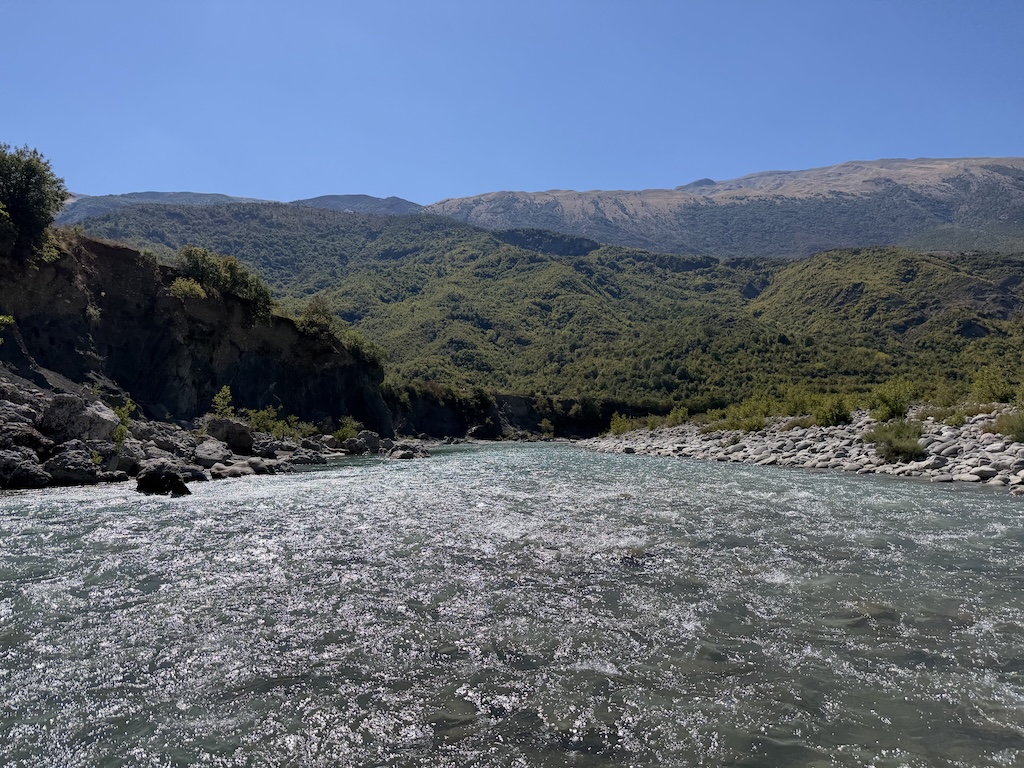
The river and its tributaries are home to a number of rare and previously undiscovered invertebrates and fish, including the “almost-extinct, tiny but mighty, Prosopistoma pennigerum mayfly”, he said.
Other key species include the Albanian water frog, Egyptian vulture, European eel and long-fingered bat.
And yet, campaigners and scientists have warned that the Albanian government needs to step up its efforts to protect the river to prevent it from being a “park only on paper”.
A 2025 report detailed the threats to the Vjosa, including from intensive agriculture, extractive industries, urban waste and sewage, as well as projected reductions in water flow due to climate change.
Furthermore, a tourism development planned where the Vjosa meets the Adriatic Sea has prompted outcry among scientists, who have warned the project would cause “irreversible harm” to a unique and sensitive ecosystem.
In the Vjosa-Narta delta, the river fans out into a network of salt marshes, lagoons, dunes and forests that host more than 2,300 species, dozens of which are endangered, such as monk seals, dalmatian pelicans and flamingos. According to BirdLife International, the region is one of “Europe’s most ecologically important coastal habitats”, as a home to more than 200 bird species and a “critical migration corridor” for “millions” more.
According to US NGO Pew Charitable Trusts, the mouths of free-flowing rivers often “harbour…extremely rich biodiversity”, in part because of the unimpeded flow of nutrients, minerals and sediment from upstream environments.
‘Sacred site’
The government’s decision to greenlight the new resort in the delta and on nearby Sazan island – which is being funded by Kushner’s investment fund, Affinity Partners – prompted major protests in Albania this summer. The so-called “Flamingo revolution” has been described as “one of the largest civic movements since the fall of the communist system in Albania”.
Miho was among hundreds of scientists to sign a petition in August that called on the government to halt the development and integrate the delta into the wild river national park.
The scientific community is “highly concerned and alarmed” by the plans, he said:
“The Vjosa delta, with its coastal lagoons, is not only one of the last remaining intact deltas with an active ecosystem along the entire Mediterranean coast, but also an ecological asset of European importance and a critical node [for birds travelling between Europe and Africa].
“Placing luxury infrastructure in this sacred site would constitute a direct violation of the coastal landscape’s protected legal status and breach Albania’s commitments under international agreements.”
Watch, read, listen
ICE ISSUES: “Ancient artifacts” are being revealed by melting glaciers in Switzerland, explained a New York Times video.
FIERY DEBATE: The Heated podcast examined whether “forest management” can tackle wildfires.
‘SEA SONGS’: Researchers are playing “lullabies” and using other “emergency measures” in an effort to restore damaged coral reefs, explained Nature.
NEW SIGHTINGS: The Guardian delved into the insects arriving in the UK due to climate change – including new types of crickets, moths and praying mantises.
New science
- Sea level rise could leave coastal areas vulnerable to the “invasion” of non-native marine animals | Nature Ecology & Evolution
- Researchers detailed how and why they developed Africa’s first “permanent, multi-ecosystem ocean observatory” | Frontiers in Marine Science
- Forest fragmentation has a larger effect than tree cover on land surface temperature of almost half of forests around the world | Proceedings of the National Academy of Sciences
- A synthesis report of 423 studies highlighted that “biodiversity underpins a wide range of ecosystem functions and ecosystem services | Nature Ecology & Evolution
- Exposure of non-Indigenous people to land acknowledgements in Australia mainly leads to “improve[d] organisational reputation rather than generat[ing] sociopolitical change” | Nature Human Behaviour
Noticeboard
- 12-16 October: 65th session of the Intergovernmental Panel on Climate Change, Addis Ababa, Ethiopia
- 12-16 October: Rome water dialogue 2026, Rome and online
- 19-30 October: UN biodiversity summit COP17, Yerevan, Armenia
- 21 October: Deadline for senior officer of local nature recovery strategy spatial data leadership at Natural England | Salary: £41,550. Location: England
- 25 October: Deadline for Africa director at Re:wild | Salary: $115,000-130,000. Location: Remote, based in Africa
This edition of Cropped was written by Orla Dwyer and Cecilia Keating.
Cropped is edited by Dr Giuliana Viglione. Please send tips and feedback to [email protected].