
DeBriefed 2 October 2026: Diesel ‘emergency’ | Brazil deforestation drop | Mumbai’s sea level fears

Welcome to Carbon Brief’s DeBriefed, an essential guide to the week’s key developments relating to climate change.
In this issue…
- Europe held “emergency talks” after the US threatened to cut off diesel supplies.
- Brazil is holding elections after four years of declining Amazon deforestation.
- Carbon Brief explores Mumbai’s response to warnings of catastrophic sea level rise.
- Key dates for next week and pick of the job vacancies.
This week
Diesel alarm
‘EMERGENCY TALKS’: European countries have held “emergency talks” after US president Donald Trump demanded that they release some of their diesel stockpiles, reported the Times. The US administration has “threatened to cut off” its supplies of the fuel if they refuse, according to the Guardian. The US oil industry has tried to avert a full US diesel-export ban to maintain the nation’s role as a “reliable energy exporter”, reported the Financial Times.
‘GLOBAL ALARMS’: The New York Times noted that Trump’s threats have set off “global alarms”, as the US is a major diesel supplier. Financial Times columnist Gilian Tett wrote that one response to “Trump’s Iran war” is likely to be “acceleration of the green transition”. Meanwhile, Foreign Policy reported that crude oil volumes exported through the strait of Hormuz have returned “nearly to prewar levels”.
CARS AND POWER: The Trump administration also finalised new rules to “significantly weaken” fuel-efficiency standards for new cars that were meant to hasten the shift to electric vehicles, reported the New York Times. Meanwhile, a coalition of 25 US states and cities has launched a lawsuit trying to block the Trump administration’s repeal of greenhouse-gas emission limits for power plants, according to Reuters.
Around the world
- THIN ICE: Antarctica’s winter sea ice has peaked at its third-lowest level on record, according to the Guardian.
- BANGKOK DANGEROUS: Floods in Thailand have claimed 23 lives since mid-September, according to Agence France-Presse. The outlet said such events are expected to increase in “intensity and frequency” as the planet warms.
- CLIMATE ‘EMERGENCY’: More than 120,000 people took part in 260 protests across France, demanding an “emergency climate plan”, reported Le Monde.
- DOUBLE TAKE: The World Trade Organization’s dispute settlement body agreed to Russia’s second request for a panel to examine whether the EU’s carbon border levy “violates international trade” rules, reported Reuters.
- DRY RUN: The Indian Express reported that India recorded a rainfall deficit “of about 14%” at the end of the monsoon and has lowered its food production target.
- GOVERNMENT GRID: UK prime minister Andy Burnham promised to create a “new government-backed” body to invest in the country’s electricity grid, according to the Guardian.
€100bn
Additional spending by EU nations on energy imports since the Iran war broke out, sending fossil-fuel prices spiralling, reported the Associated Press.
£5.9bn
Money saved by the UK on gas imports during the Hormuz crisis thanks to record wind and solar generation, according to new Carbon Brief analysis.
Latest climate research
- Marine heatwaves could cause declines in ocean biomass by up to 7% per degree of warming | Global Change Biology
- Limiting global warming to below 2C would result in wildfire impacts “comparable to modern levels”, while exposure would increase by more than 300% by the end of century under a very-high-emissions scenario | Environmental Research: Climate
- Many young people are experiencing “institutional betrayal” because of a perceived “disconnect” between their visions for climate action and the actions of institutions | Environmental Science & Policy
(For more, see Carbon Brief’s in-depth daily summaries of the top climate news stories on Monday, Tuesday, Wednesday, Thursday and Friday.)
Captured
Deforestation drops on Lula’s watch
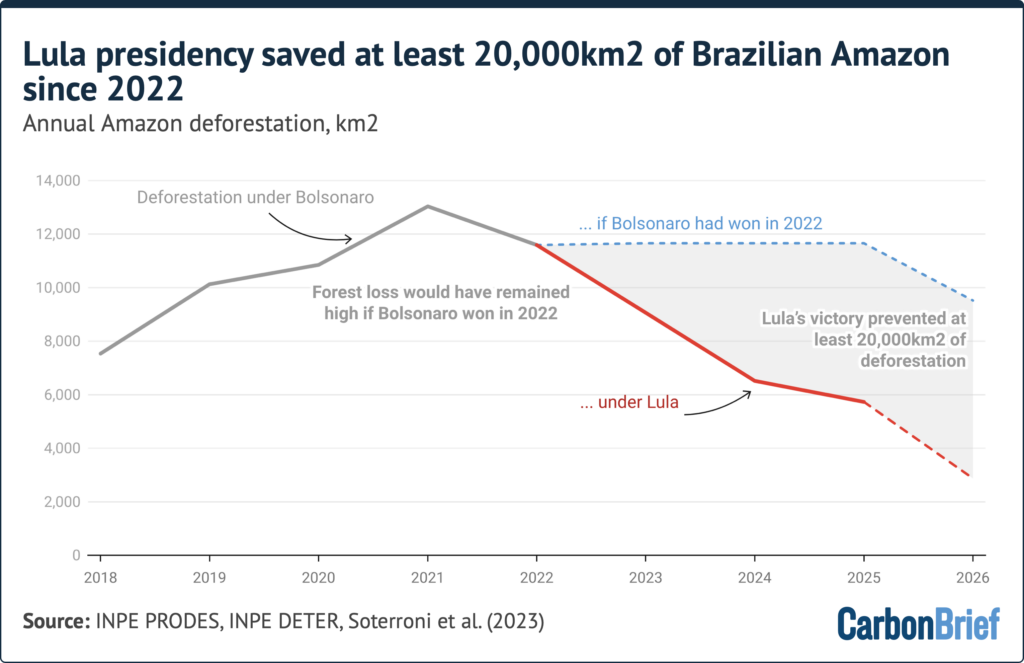
New Carbon Brief analysis suggested that at least 20,000km2 of Amazon forest – an area roughly the size of the US state of New Jersey – remains standing today due to the leadership of Brazilian president Luiz Inácio Lula da Silva. In contrast, deforestation would have remained high if the far-right Jair Bolsonaro had won the election in 2022, showed the analysis. On Sunday, Brazilians will go to the polls to vote in an election that is expected to be a runoff between Lula and Bolsonaro’s son, Flávio.
Spotlight
Mumbai vs the sea
Following a UN report on sea level rise and media alarm about the threat facing Mumbai, Carbon Brief looks at how the Indian megacity is preparing for floods.
Mumbai is a city that was – and continues to be – built on land reclaimed from the sea.
Every year, intensifying bursts of monsoon rainfall meet high tides to create compound floods that inundate the city.
In recent weeks, a new report from the UN secretary general on sea level rise has given this issue even more salience.
‘Permanent inundation’
The UN report is a stark reminder of what is at stake for Mumbai – a city that is home to more than 20 million people.
One paragraph from the report, in particular, has caused alarm among Mumbaikars:
“In the low-lying deltas of south Asia, in cities such Kolkata and Mumbai in India…the defining impact is human displacement, with more than 14 million people at immediate risk of losing their homes to permanent inundation.”
It is the only direct reference to the city in the 19-page report. However, the warning of mass displacement has been echoed across Indian news headlines and social media, with many framing it as a doomsday projection of a “drowning” Mumbai.
Naresh Fernandes, Mumbai-based editor of Scroll.in, told Carbon Brief the reporting has been “pretty abstract”. He added:
“Everyone saying submergence seems to think about Atlantis, rather than what gradually creeping sea levels could mean.”
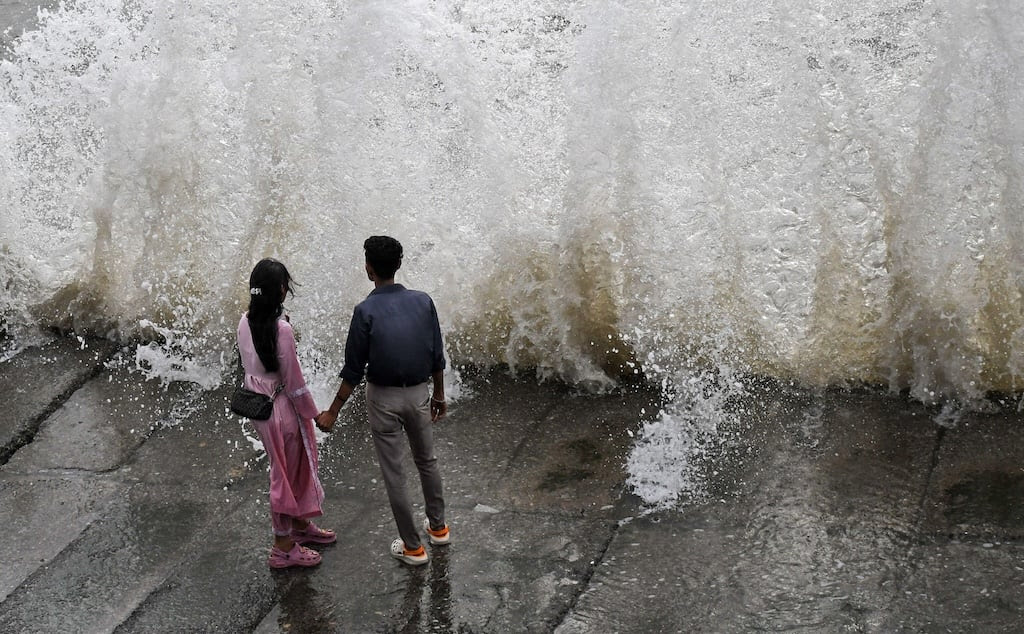
Mumbai’s main civic authority, the Brihanmumbai Municipal Corporation (BMC), has responded to the UN report by commissioning a fresh assessment of the city’s vulnerability to sea level rise – the second such report in five years.
In 2022, BMC also released its climate action plan, citing a study that found, by 2050, the sea could “begin flooding most of Mumbai at least once every year”.
Climate scientist Dr Roxy Koll from the Indian Institute of Tropical Meteorology said that while the city is “highly susceptible” to inundation as sea levels rise, Mumbai “may not submerge” by 2050.
He pointed out, for example, that most studies are based on satellite-based elevation data that is not calibrated over India using “ground truth data”. At the same time, Koll warned:
“Some parts of [Mumbai] have always been at or under sea level. The worst-case…[has] the potential to submerge large parts of Mumbai, at least for several days in the near future.”
Changing coastline
Despite such dire warnings, it is unclear what measures the city has taken since its climate plan was published. Environmental authorities did not respond to Carbon Brief’s questions.
However, a senior civic official told the Indian Express that a new assessment was “necessary given the significant changes along Mumbai’s coastline over the past five years”.
These include “30km of coastal highways, more than 100 hectares of the Arabian sea reclaimed and salt pan lands [that] have been identified for development”.
All of these projects have been greenlit by authorities, along with federal relaxation of rules that allow for construction even closer to the tide lines.
Even the Intergovernmental Panel on Climate Change has warned that Mumbai’s coastal road network is “maladaptation” to climate change. By replacing mangroves with roads, authorities have increased vulnerability to sea level rise.
Fernandes said media coverage of the UN report and the BMC’s promise has failed to communicate the risk of recent coastal deregulation, or what risks specific waterfront projects face:
“I think the link between the science and the ground or sea reality is not being made.”
Watch, read, listen
ASIA INSULATED: A New York Times interactive article illustrated how Asia’s major economies “survived the energy crisis”, following the closure of the strait of Hormuz.
BEEFED UP: A Phenomenal World essay charted the “meteoric rise” of Brazil’s “multinational meat giant” JBS, along with its influence on the nation’s politics.
SLICK FLICK: Director Alejandro G Iñárritu’s film Digger, in which Tom Cruise stars as an oil mogul tasked with “saving the world”, has “split critics”, reported Variety.
Coming up
- 4 October: Brazil general election
- 5-6 October: Pre-COP31 high-level segment, Funafuti, Tuvalu
- 6 October: Pre-COP31 leaders’ plenary and ministerial meeting, Nadi, Fiji
- 12-16 October: 65th session of the Interngovernmental Panel on Climate Change, Addis Ababa, Ethiopia
Pick of the jobs
- UN OPS and NDC Partnership, climate finance specialist | Salary: Unknown. Location: Lome, Togo
- Ocean Conservancy, chief conservation officer | Salary: $280,000-$350,000. Location: Washington DC
- UK Department for Energy Security and Net-Zero, director general | Salary: £150,000. Location: Aberdeen, Birmingham, Bristol, Cardiff, Darlington, Edinburgh, London or Salford
This issue of DeBriefed was edited by Josh Gabbatiss. Please send any tips or feedback to [email protected]
This is an online version of Carbon Brief’s weekly DeBriefed email newsletter. Subscribe for free here.