
DeBriefed 20 November 2026: Deal distant | Fossil-fuel fractions | ‘Coalitions’ seek progress

Welcome to Carbon Brief’s DeBriefed, an essential guide to the week’s key developments relating to climate change.
In this issue…
- COP31 approached its scheduled end with countries divided on a host of issues.
- The latest draft “cover decision” disappointed on fossil fuels and adaptation finance.
- Carbon Brief reports on country coalitions taking forward key climate issues.
- Key dates for next week and pick of the job vacancies.
This week
COP31 crunch time
‘WORD SOUP’: As the COP31 summit in Antalya, Turkey speeds toward its scheduled end later today, much of the attention has been focused on an overarchiving “cover decision” pushed by the presidencies. The second draft dropped any mention of fossil fuels – to the dismay of at least 23 countries – and a $120bn target for adaptation finance. But the “word soup” did retain the presidency’s “35 by 35” electrification target – and controversial wording on carbon capture and storage.
DIVAN DISCUSSION: On Wednesday night, COP31 president Murat Kurum had invited ministers to a “divan” – a group discussion – to look for common ground. But with disagreement on issues including the timing of the next Intergovernmental Panel on Climate Change report, “overshoot” and climate finance, a deal seems distant. A third draft is due later today. COP veterans told Carbon Brief to expect a fourth draft before the close.
FINANCE LACKING: A short “proposal by the president” for a new climate finance “work programme” text also landed yesterday. There are stark divides between developing and developed countries, with the former seeking ways to push the latter into providing more funds. The new text was stripped of virtually all substance, leaving a largely procedural proposal about future meetings and duties. Even this limited outcome is highly uncertain.
‘WORST COP’: This COP was supposed to launch a new ”just transition mechanism”, but disagreements quickly broke out over where it should be established and by whom. Negotiations on the global goal on adaptation have been stuck on the baseline for the target to triple adaptation finance, agreed last year. Both draft texts are wholly contained in brackets, meaning nothing is agreed, as civil society dubbed this the “worst COP in history” at a press conference attended by Carbon Brief.

Around the COP
- ROADMAPS: Vanuatu, Denmark, Spain, Portugal, Luxembourg, Ireland and Tuvalu released or announced intentions to publish roadmaps away from fossil fuels at COP this week – bringing the total number of countries with such plans up to 25.
- 35 BY 35: The latest “cover decision” draft retained the presidency’s “35 by 35” electrification target, which reportedly has backing from “around 90” countries. Carbon Brief understands there is behind-the-scenes confusion on precise numbers.
- PANAMA PAPER: In a highly unusual move, Panama environment minister Juan Carlos Navarro wrote an open letter to COP presidencies declaring that his delegation will block any outcome that does not meet eight demands, including “a cap on oil production”.
- GONE: COP32 president Ethiopia – along with Denmark – was named co-chair of the “group of negative emitters”, an eight-nation coalition that was initially launched in 2023 and aims to advance net-negative emissions policies.
- POLLUTER PAYS: Seven countries, including Kenya, Spain, Tuvalu and the UK, signed an open letter supporting “targeted, small levies” on high-polluting sectors such as aviation, in line with the “polluter pays” principle.
396
The number of times that “electrification” is mentioned in this year’s International Energy Agency World Energy Outlook.
171
The number of mentions in last year’s edition.
Latest climate research
- More than 400 “hyperscale” data centres in the US collectively consumed 1.8% of total US electricity – about half of that from fossil-fuel sources – resulting in around 26m tonnes of CO2 emissions over May 2024-April 2025 | Nature Sustainability
- Accelerating ice melt from Greenland and Antarctica accounted for more than half of global sea level rise over 1993-2023 | Geophysical Research Letters
- Extreme rainfall is expected to increase sixfold in 15 out of 25 major Chinese cities by 2100 | Advances in Climate Change Research
(For more, see Carbon Brief’s in-depth daily summaries of the top climate news stories on Monday, Tuesday, Wednesday, Thursday and Friday.)
Captured
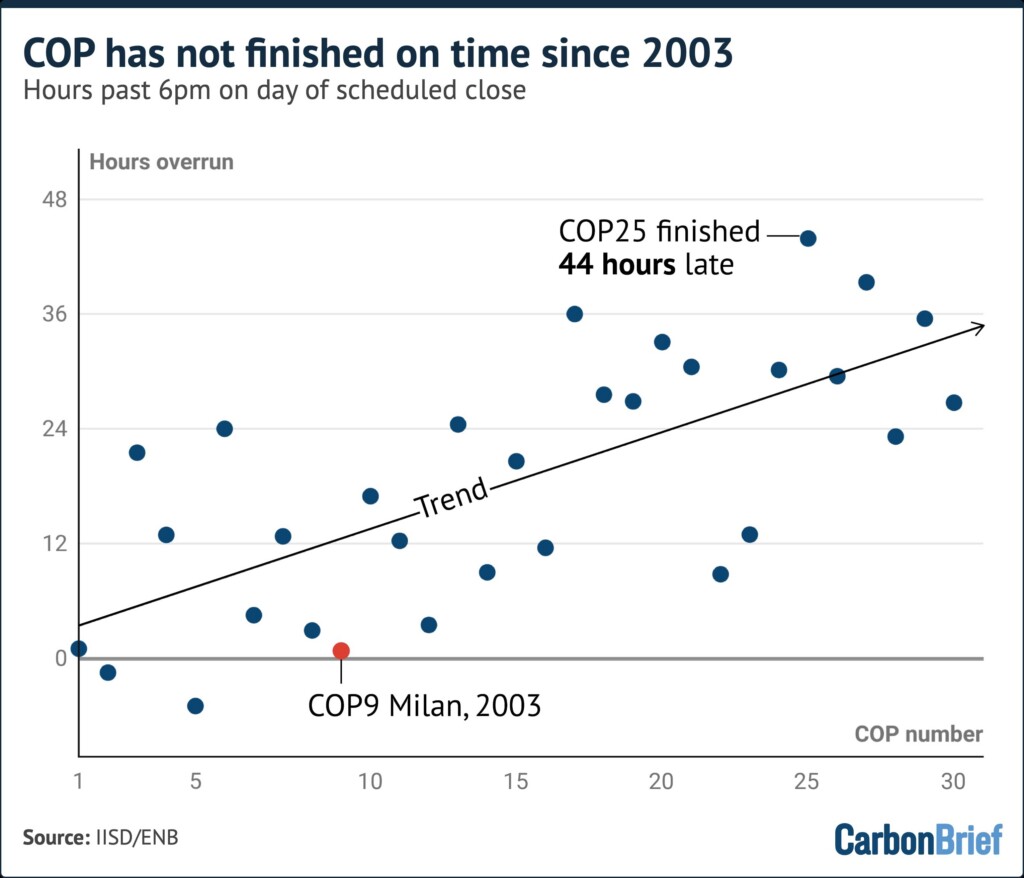
COP has not finished on time since 2003, with the longest summit to date finishing 44 hours after its scheduled end in Madrid in 2019. Carbon Brief’s annual sweepstake on when the Antalya summit will end has revealed a median expected finish time of 10.35pm on Sunday. This would be 28 hours after COP31’s scheduled end.
Spotlight
How ‘coalitions’ are seeking climate progress
This week, two of Carbon Brief’s journalists on the ground in Antalya, Daisy Dunne and Josh Gabbatiss, report on how groups of countries are pushing for faster action on the sidelines of COP.
As COP enters its 31st iteration, ever-present concerns about the ability of 198 countries to unanimously agree to new measures to tackle Earth’s most complex environmental problem are growing louder.
Amid a changing geopolitical landscape and stark climate impacts, countries are expressing divergent views on how best to move forward – making the path to consensus ever more treacherous.
But emerging from the sidelines of COP is a new type of climate diplomacy.
Increasingly, groups of countries are clubbing together to agree to steps on some of the most pressing climate issues, ranging from transitioning away from fossil fuels to electrification.
“We are moving from doing by consensus to by coalition,” one veteran observer told Carbon Brief in Antalya.
Fossil fuels
COP28 in Dubai in 2023 called on all countries to contribute to a global “transition away from fossil fuels” – the main driver of climate change – this decade.
However, at COPs since then – including the present talks in Antalya – countries have failed to find consensus for how to take this forward.
In response, a group of 57 nations – spearheaded by Colombia and the Netherlands – met in Santa Marta in April to discuss practical steps for reducing dependence on coal, oil and gas.
Some 25 of these countries have since committed to publishing national roadmaps away from fossil fuels, the Netherlands announced at the sidelines of COP31 on 20 November.
A second transitioning away from fossil fuels conference – led by Tuvalu and Ireland – is planned for next year.
The “Santa Marta process” builds on several other country coalitions on moving away from fossil fuels.
The Powering Past Coal Alliance, launched by the UK and Canada at COP23 in 2017, is made up of 65 countries.
Meanwhile, the Beyond Oil and Gas Alliance, launched at COP26 in 2021, currently has 13 “core” members.
Electrification
Electrification has been a major theme of COP31, with COP presidents Turkey and Australia pushing a pledge to “increase the share of electricity in final energy consumption to 35% by 2035”.
While much attention has been on efforts to reflect this pledge in the cover decision, it has gathered dozens of national supporters outside of negotiations.
The pledge is part of the presidences’ stated mission to “electrify the world”, set out as one of its “action agenda” priorities. This refers to the part of the UN process that mobilises coalitions of nations and non-state actors to push climate action further.
Even if the “35 by 35” pledge does not make the final text, the Turkish presidency will still likely champion its “electrification delivery package”.
Launched yesterday, the package sets out 14 new international initiatives that were “announced at COP31”, including coalitions to boost grid spending, finance coal transitions and “unlock investment in clean electrification”.
Not everyone is happy about the move to “two-tier multilateralism” at COPs. Some developing countries have expressed concerns about the shift to smaller coalitions distracting attention from parties’ obligations under UN climate treaties.
Reflecting on the need to reform the COP process, Vanuatu climate minister Ralph Regenvanu told Carbon Brief:
“While people innovating and coming together to take action is good, it cannot take the place of negotiations, which need to lead to implementation.”
Watch, read, listen
SEISMIC SHIFT: In the Economist, International Energy Agency chief Dr Fatih Birol said that “energy markets are not going back to the way they were” before the Iran war.
RISING SEAS: A Channel 4 News documentary interviewed people displaced from Tuvalu by sea level rise, ahead of the nation hosting the world’s second conference on transitioning away from fossil fuels next year.
BIG AG: Analysis by DeSmog journalists Clare Carlile and Hazel Healy found that 260 lobbyists from “polluting food and agriculture companies” attended COP31.
Coming up
- 20-21 November: G7 meeting of interior ministers, Lyon, France
- 23-27 November: International Maritime Organization (IMO) talks on adopting a net-zero framework for cutting shipping emissions, London
- 24 November: Carbon Brief’s journalists answer your questions about COP31
Pick of the jobs
- UK Department for Environment, Food and Rural Affairs, head of climate adaptation science | Salary: £58,207-£71,178. Location: Bristol, London, Newcastle-upon-Tyne or York, UK
- Climate Policy Initiative, programme associate | Salary: R650,000-R750,000. Location: Cape Town, South Africa
- Transport & Environment, oil policy manager | Salary: Unknown. Location: Brussels, Belgium