
DeBriefed 24 July 2026: New UK leader | El Niño predictions | Heat stress at the World Cup

Welcome to Carbon Brief’s DeBriefed.
An essential guide to the week’s key developments relating to climate change.
Sign up below.
This week
New UK leader
CABINET SIGNALS: Andy Burnham became the UK’s new prime minister on Monday. After much speculation, he appointed Miatta Fahnbulleh as secretary of state for energy security and net-zero, with Ed Milliband moving to the Foreign Office. BusinessGreen noted that Fahnbulleh’s appointment “will be widely interpreted as strong backing from Number 10 for the government’s clean energy and decarbonisation strategy”.
FUNDING ROW: In his first move aimed at reducing the cost of living, Burnham announced plans to remove VAT from domestic electricity bills, reported BBC News. Following his second major policy announcement, the Independent reported on criticism that the money for a new £2 bus cap policy would come from turning some international climate grants into loans. Meanwhile, the Times reported further speculation around the future of North Sea oil and gas production under Burnham.
European heatwave
‘BRUTAL HEAT’ Many outlets reported on the intense heat continuing to grip southern Europe this week. About 30,000 people have been forced to evacuate in France and Spain as “brutal heat” triggered wildfires, reported the Guardian. A frontpage story in the Independent noted that temperatures exceeded 44C across southern Europe as “yet another” heatwave moved across the continent.
Around the world
- DEADLY FLOODS: At least 41 people died in floods after “torrential” monsoon rains in India’s north-east Assam state, reported Agence-France Presse.
- SCIENCE ‘ATTACKED’: US president Donald Trump “attack[ed]” a chapter on climate science in a reference manual for judges, said the New York Times.
- DELAYS: The EU is set to recommend a three-year delay to fines for breaking new methane emissions rules, noted the Financial Times.
- POWER OUTAGES: Bloomberg covered blackouts in north Africa – from Libya through to Tunisia and Algeria – amid “sweltering” summer heat.
- THREAT TO LIFE: The weather agency in Japan forecasted a second straight day of “kokushobi” – literally translated as “brutally hot day”.
35%
The chance that 2026 will top 2024 as warmest year on record, driven by potentially the strongest El Niño since records began, according to analysis by Carbon Brief.
Latest climate research
- A survey of Syrian and Iraqi refugees revealed the association between war and post-traumatic stress in drought-affected areas | Nature Sustainability
- Winter cold spells have become “less frequent, less intense and smaller” in the northern hemisphere over 1980-2025 | Geophysical Research Letters
- A survey of climate COP attendees showed “broad support” for reforms to “enhance transparency” | Nature Climate Change
(For more, see Carbon Brief’s in-depth daily summaries of the top climate news stories on Monday, Tuesday, Wednesday, Thursday and Friday.)
Captured
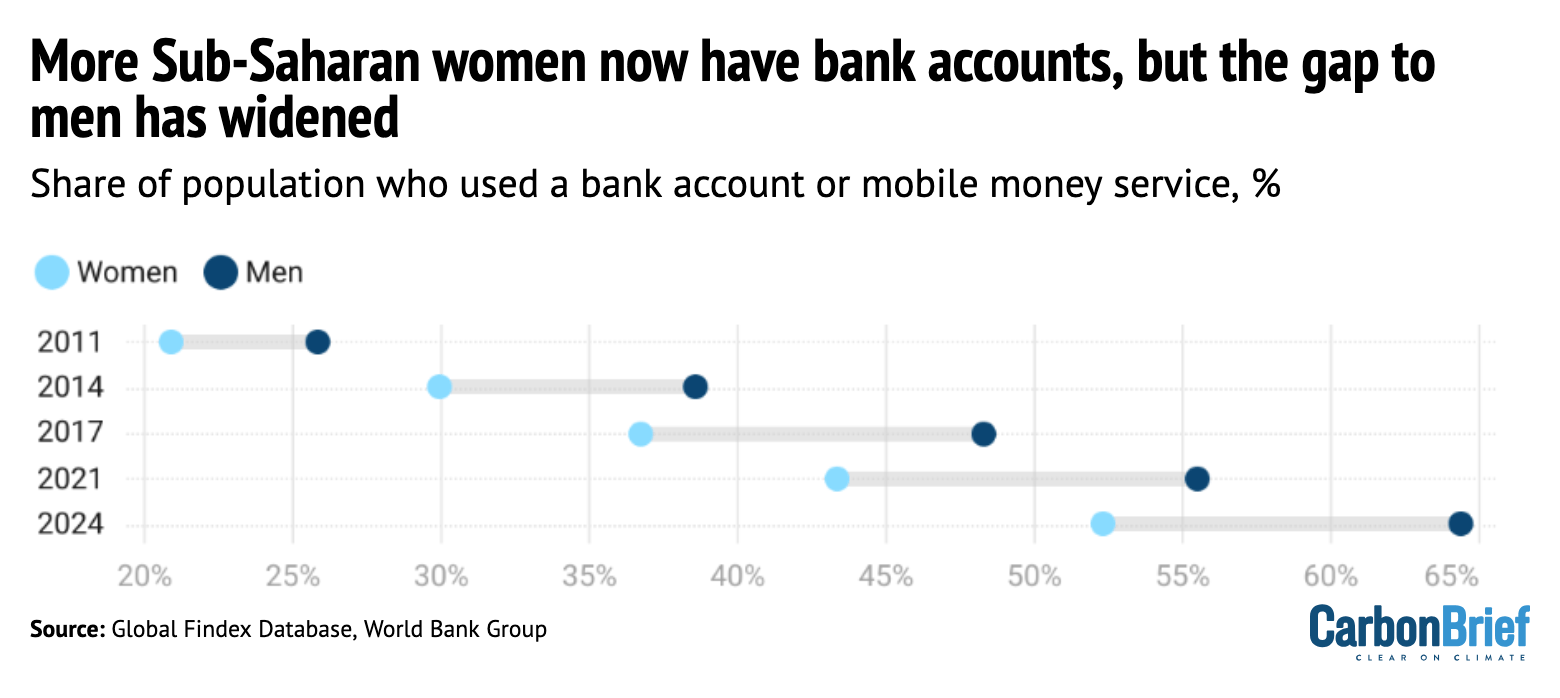
Carbon Brief covered new research showing that empowering women in sub-Saharan Africa through greater access to finance could “strengthen” households’ resilience to short-term “climate shocks”. As of 2024, the number of women in the region with bank accounts had risen to 52%, but many women remain dependent on male relatives for access to finance.
Spotlight
Measuring heat stress at the World Cup
This week, Carbon Brief talks to a heat and health expert about how assessments of heat stress in the recent World Cup – and sport more broadly – fall short.
The recent FIFA men’s football World Cup took place amid an extreme heatwave in the US.
Reuters reported that 27 matches took place when the “wet bulb globe temperature” (WBGT) was above 28C – the threshold at which the global players’ union recommends delays or postponement.
Analysis by the Guardian estimated that the WBGT “may have reached or exceeded 33.9C” for France vs Paraguay on 4 July, making it the hottest game in a non-air-conditioned stadium.
Decades-old metric
Combining temperature, humidity, wind speed and direct sunlight, the WBGT is a commonly used metric to assess vulnerability to heat stress and to project future risk.
But assessing heat risk in the World Cup using WBGT alone does not tell the whole story, said Prof Ollie Jay. He is director of the Heat and Health Research Centre at the University of Sydney and a global working group co-chair for the Lancet Countdown initiative on climate change and health.
Jay told Carbon Brief that WBGT was originally developed in the 1950s for a very specific purpose – to prevent heat casualties among young, physically fit military personnel.
While professional footballers may have some similarities to these individuals, other factors not measured by WBGT also play a role in heat stress, Jay told Carbon Brief:
“A lot of games were played in very hot, dry conditions that would not give a very hot WBGT value, but were probably just as problematic physiologically.”
‘Wrong answer’
A bigger problem is that WBGT is now “blindly applied” in a whole range of contexts for which it wasn’t designed, Jay told Carbon Brief:
“The problem can be that you end up getting the wrong answer because you’re using the wrong tool.”
Older adults, people with chronic diseases and pregnant women are among the most vulnerable to heat stress – and the least well-represented by WBGT.
As Jay and co-author Farhana Jahan, a PhD student at the University of Sydney, wrote in a commentary earlier this month:
“One person dies from extreme heat every minute. Very few of them look like the reference adult existing metrics were built around.”
In the context of the recent World Cup, Jay told Carbon Brief:
“The thing I was most worried about for the whole tournament was the fans, because they’re not as well-conditioned [and] they don’t have the physiological protection [that the players have].”

Adaptation measures
In 2019, the Australian Open tennis tournament stopped using WBGT and adopted a new heat stress policy that is more closely linked to human physiology during physical activity, Jay told Carbon Brief:
“Since introducing the new policy, it’s been hotter than ever but we’ve had a reduction in the amount of heat-related call-outs.”
Less successfully, hydration breaks were used “appallingly” in the recent World Cup, Jay said:
“They applied them irrespective of whether it was hot or not, which completely undermined the credibility of what is a very effective tool for managing heat-stress risk.”
Jay has developed a free-to-use tool to guide safe participation in sport in Australia. He told Carbon Brief that, globally, professional sports could do more to manage heat-stress risk:
“They haven’t exhausted all of the adaptation options that are available. In fact, most have barely scratched the surface.”
Watch, read, listen
MISDIRECTION: Guardian columnist Arwa Mahdawi asked: “The world is on fire, and who does Trump blame? The Canadians”.
AIR CON DIVIDE: Sara Yassi – chair of the UK’s youth delegation to COP30 – warned in the Los Angeles Times that “air conditioning alone won’t save us from killer heat”.
PARTY POLITICS: Former Green Party MP Caroline Lucas discussed what the UK’s changing electoral map means for future climate action on the Political Heat podcast.
Coming up
- 27 July – 12 Aug: 28th Meeting of the CBD Subsidiary Body on Scientific, Technical, and Technological Advice (SBSTTA 28) and 7th Meeting of the Subsidiary Body on Implementation (SBI 7), Nairobi
- 28 July: Beating the heat together: City diplomacy and the global mobilisation against extreme heat, online
- 29 July: Global hydrogen review 2026 webinar, online
Pick of the jobs
- Centre for Science and Environment, deputy programme manager for climate change and green economy programme | Salary: Unknown. Location: New Delhi
- Arctic Council, director of Arctic Council secretariat | Salary: Unknown. Location: Tromsø
- Climate Analytics, head of impacts, adaptation and loss & damage team | Salary: €103,781-114,418 Location: Berlin
- Climate Litigation Network, science advisor | Salary: €50,000-65,000. Location: Amsterdam or London
DeBriefed is edited by Daisy Dunne. Please send any tips or feedback to [email protected].
This is an online version of Carbon Brief’s weekly DeBriefed email newsletter. Subscribe for free here.