
DeBriefed 25 September: AI, ‘big oil’ criticised at UN | El Niño record | Africa’s preparedness

Welcome to Carbon Brief’s DeBriefed, an essential guide to the week’s key developments relating to climate change.
In this issue…
- UN leaders targeted AI and “big oil” at UN general assembly.
- “Super El Niño” broke “remarkable” all-time record.
- Carbon Brief looks at Africa’s readiness for the “super El Niño”
- Key dates for next week and pick of the job vacancies.
This week
AI, ‘big oil’ under fire at UN
TOUGH TALK: In his final speech to the UN general assembly in New York City, outgoing UN secretary general António Guterres said “big oil” companies are treating the atmosphere like an “open sewer”, reported Agence France-Presse. Guterres also for the first time urged all countries to adopt national plans to transition away from fossil fuels with clear timelines, work protections and aligned with 1.5C, said Climate Home News. UN climate chief Simon Stiell used his own speech to criticise the energy needs and emissions from AI, reported Bloomberg.
OCEAN OUTCOME: The UN general assembly “approved a unanimous resolution on how to handle sea level rise”, reported Grist. Leaders including Brazil’s Luiz Inácio Lula da Silva, the European Commission’s Ursula von der Leyen, Japan’s Sanae Takaichi and many others used their speeches to the assembly to call for stronger climate action, reported the Associated Press. According to Climate Home News, climate change and the energy transition were top of the “national security agenda” in New York.
NEPAL’S NEEDS: Towards the end of the UN general assembly, Nepal’s minister of foreign affairs Shisir Khanal called upon the leaders gathered to “treat climate action not as a charity, but as a matter of justice”, reported the Associated Press. Nepal’s prime minister Balendra Shah also addressed the gathered leaders in the wake of deadly floods in August, saying: “We did not create this crisis, yet we are paying a colossal price for it,” according to the Guardian. The article said he continued that the disaster “was a warning to the world” and questioned if leaders “really heard that warning?”.
El Niño records historic high
‘JAW-DROPPING’: Sea-surface temperatures “at the heart of” the El Niño weather pattern reached a “jaw-dropping” new record-high months before they are expected to peak, reported the Guardian. The newspaper cited Carbon Brief analysis by climate science contributor Dr Zeke Hausfather, adding that the “current El Niño is likely to be the largest in at least 1,000 years and will pile extra heat into an atmosphere in which temperatures are already rising rapidly due to human-caused global heating”.
TESTING SYSTEMS: According to the Guardian, while presenting to foreign ministers at a private meeting on the sidelines of the UN general assembly, UK foreign secretary Ed Miliband warned that “the coming El Niño, which has been supercharged by climate breakdown, would test the world’s food systems as never before”.
GRAVE CONSEQUENCES: A new study, covered by CNN, found that El Niño could cause more than 450,000 heat deaths by February. According to Reuters, a report by a UN-linked initiative has warned that thousands of displaced people in Somalia’s south-west could experience famine due to El Niño, if humanitarian aid remains insufficient. Meanwhile, the US state of California has declared a state of emergency due to El Niño, reported Time.
Around the world
- NET-ZERO: Germany published a “roadmap” committing to phase out fossil fuels by 2045, reported Deutsche Welle.
- CLEAN HIGHS: Renewables met more than 80% of demand on Australia’s main power grid in one day, setting a new record for the country, reported the Guardian.
- ENERGY BLUES: According to Reuters, nearly 40% of coal-fired power plants in India are running critically low on fuel due to an increase in power demand and extreme heat conditions linked to El Niño.
- FOSSIL POLITICS: Bolivia eliminated its diesel subsidy after accepting an IMF loan that called for spending curbs, reported Bloomberg.
- BANKING ON RENEWABLES: Nigeria has launched a $300m investment fund aimed at expanding off-grid electricity and distributed renewable energy projects across the country, reported local outlet Punch Newspaper.
- BLUE SUITS: The US states of California and New York sued the Trump administration over its plans to cancel offshore wind leases in favour of fossil fuels, reported the Associated Press.
€180bn
The estimated cost of the damage to Europe’s economy, wrought by this summer’s extreme heatwaves and droughts, according to the European Union, the Guardian reported.
Latest climate research
- Climate change “disproportionately undermine[s]” the physical and mental health of adolescent girls in sub-Saharan Africa, according to a review article published in Climate and Development.
- A study in Geophysical Research Letters found that as the planet warms, storms will become more frequent along the south-eastern US coast but less frequent along the Gulf coast, including Texas.
- Research on climate justice in carbon emissions mitigation has grown substantially, with the bulk of research focusing on “distributive justice”, while “procedural and recognition justice receive insufficient attention”, according to a study in Environmental Science and Policy.
(For more, see Carbon Brief’s in-depth daily summaries of the top climate news stories on Monday, Tuesday, Wednesday, Thursday and Friday.)
Captured
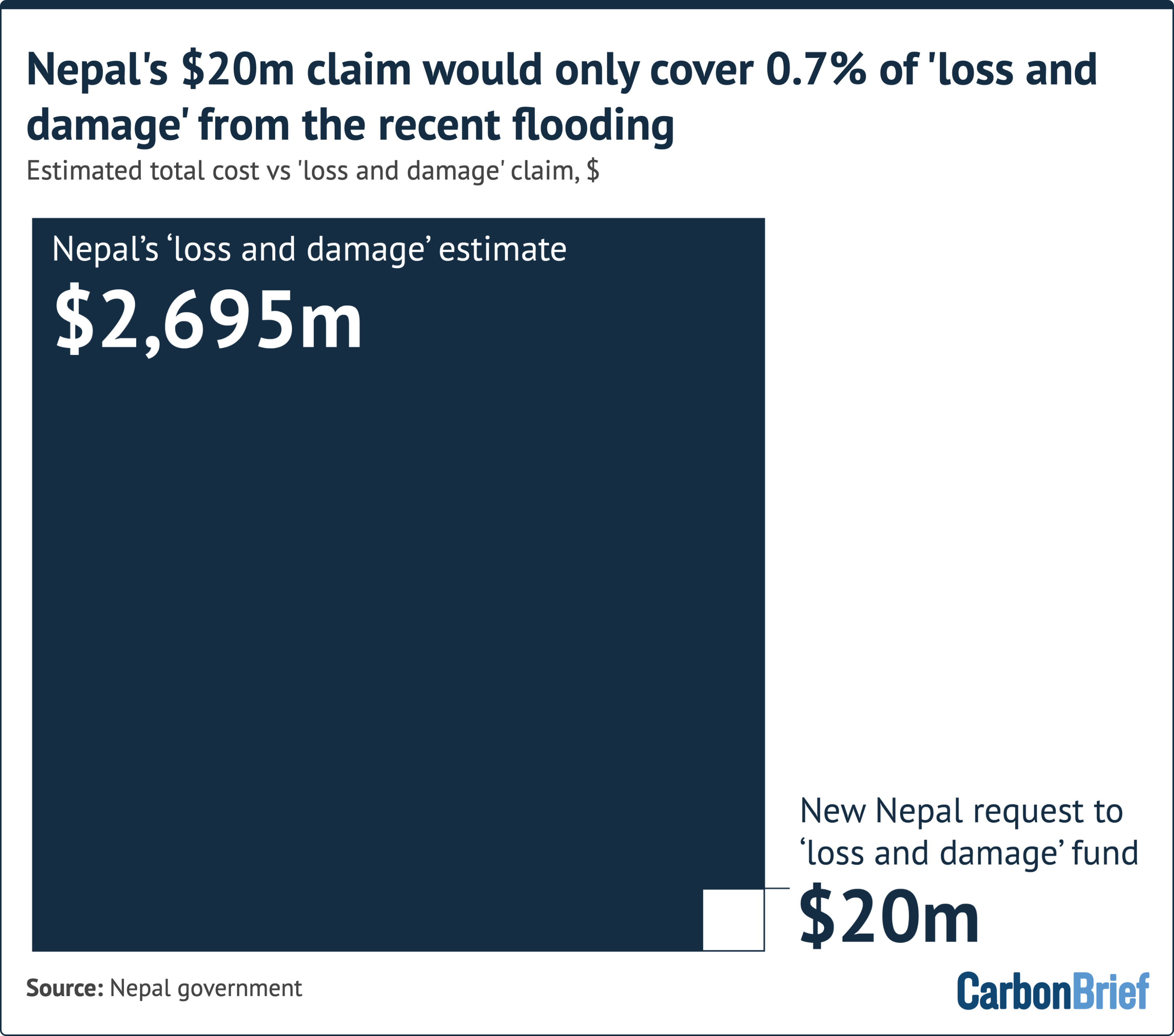
The Nepali government has requested $20m from the UN fund for “loss and damage”, following the devastating floods that hit the country in late August, as covered by Carbon Brief. However, as the chart shows, Nepal’s $20m loss-and-damage claim would only cover 0.7% of the estimated $2.7bn in “total damage and loss” from the floods.
Spotlight
How prepared is Africa for super El Niño?
This week, Carbon Brief speaks to African climate experts to learn about the continent’s readiness for one of the most significant weather events in recent history.
In July 2026, officials met at the African Union headquarters in Addis Ababa, Ethiopia, to discuss the continent’s preparedness for “super El Niño”.
Like the rest of the world, Africa will be affected by the El Niño, an extreme weather event expected to peak between November 2026 and February 2027.
According to the UN Office for the Coordination of Humanitarian Affairs, there is a 70% chance that much of southern Africa will experience record rainfall deficits between October and December 2026 as a result.
In east Africa, the weather event is expected to supercharge flooding, affecting up to three million people.
Alongside extreme weather events such as severe drought and flooding, El Niño is also expected to disrupt food production systems and lead to water shortages and disease outbreaks in parts of Africa.
The climate phenomenon could cost the continent up to $20bn, the African Development Bank has warned.
At the July meeting, African Union officials called for institutions across the continent to strengthen their national preparedness plans and early warning systems.
“There has been a lot of proactive engagement across Africa, at many levels, regarding the super El Niño,” Dr Tafadzwanashe Mabhaudhi, professor of climate change at the London School of Hygiene and Tropical Medicine, told Carbon Brief.
Mabhaudhi said the continent’s early warning capabilities have improved from previous years. However, the critical gap remains financing. He added:
“What Africa lacks is flexible, anticipatory financing mechanisms that can support the identified early actions and scale proven solutions. This gap will prove a major constraint to how well Africa responds.”
‘Not ignorance’
During the 2023/2024 El Niño season, six countries in southern Africa – Botswana, Lesotho, Malawi, Namibia, Zambia and Zimbabwe – declared national drought disasters.
According to experts, this year’s “super El Niño” could be the most extreme on record. On 21 September, Carbon Brief reported the event had entered record-breaking territory.
Dr Arreyndip Nkongho Ayuketang, a researcher at the Euro-Mediterranean Center on Climate Change who studies drought patterns across west Africa, told Carbon Brief that the continent’s “preparedness is low”. He added that:
“The forecasts are not the problem. El Niño is among the most predictable things in the climate system and warnings are typically available months ahead. The problem is what happens between the forecast and the decision.”
He added that his work tracing drought across west Africa ahead of the 2023 El Niño showed that the rainfall deficit was visible in the data well ahead of the subsequent drought. However, it “still translated into measurable food insecurity” due to inaction.
Ayuketang said that further work looking at southern Africa under El Niño and the Indian Ocean Dipole is showing the same pattern. He stated:
“The failure is not ignorance. It is that a forecast sitting in a meteorological agency does not move seed, water, money or medicine by itself.”
A climatologist at the University of Uyo in Nigeria, Dr Archibong Akpan, further told Carbon Brief it was “crazy” that the continent is not as prepared as it should be for super El Niño.
‘Not starting from zero’
For Dr Vincent Owanda Otieno, a meteorologist at the Technical University of Kenya, the continent has to move from a reactive model to an anticipatory and risk-informed approach.
The continent is “not starting from zero”, Otieno said. However, he added that there is an urgent need to improve financing, strengthen infrastructure, reduce poverty and accelerate the translation of forecasts into timely information for communities.
Otieno said:
“A strong El Niño cannot be prevented, but its human and economic consequences can be reduced substantially through timely warnings, pre-arranged financing, resilient infrastructure, ecosystem protection, effective land-use planning and community-centred preparedness.
Watch, read, listen
SEAWEED SAVES: The German broadcaster Deutsche Welle documented how a giant kelp farming project is helping to remove CO2 from waters off Namibia’s Atlantic coast.
RENEWABLE IMPACT: An edition of the Climate Question podcast from the BBC World Service discussed how solar panels largely imported from China are transforming lives in the Philippines and Pakistan.
CONSUMPTION COSTS: The conservation outlet Mongabay reported on how a copper mining project in the high Andes of South America could put nature at risk.
Coming up
- 26 September: Energy Geographies conference, virtual
- 27-29 September: 2026 CCICED annual general meeting, Beijing
- 29 September: International day of awareness of food loss and waste, Rome
- 30 September-1 October: G20 trade ministers meeting, Wisconsin
Pick of the jobs
- Wildlife Conservation Society, lead conservation pilot | Salary: Unknown. Location: Central African Republic
- The Bureau of Investigative Journalism, climate and environment editor | Salary: £59,000-£62,000. Location: London
- Renewable Northwest, senior policy manager | Salary: $100,000-$120,000. Location: Washington state, US
- CrossBoundary Group, communications manager | Salary: Unknown. Location: Nairobi, Kenya
- The New York Times, audience editor for climate and science | Salary: $120,000-$135,000. Location: New York
- The Houston Chronicle, energy and data centre reporter | Salary: Unknown. Location: Houston, Texas
This issue of DeBriefed was edited by Molly Lempriere. Please send any tips or feedback to [email protected].
This is an online version of Carbon Brief’s weekly DeBriefed email newsletter. Subscribe for free here.