
DeBriefed 4 September 2026: Earth to ‘overshoot’ 1.5C | Nepal ‘climate compensation’ calls | EVs’ 200-year road to success

Welcome to Carbon Brief’s DeBriefed.
An essential guide to the week’s key developments relating to climate change.
Sign up below.
This week
‘Overshooting’ 1.5C
PASSING 1.5C: A UN Environmental Programme (UNEP) report said that Earth will heat up by at least 1.8C under even the “best-case” scenario, reported BusinessGreen. It added that the report does say that the world can still limit, adapt to and eventually reduce warming to 1.5C, the aspirational target of the Paris Agreement.
‘NO GOOD OUTCOMES’: According to the Guardian, the UNEP report said: “There are no good outcomes above 1.5C”. It added that, per the report, the “best hope” humanity now has is to adopt an “overshoot, peak and decline” pathway. This would require immediate and sustained cuts to greenhouse gas emissions, along with the use of carbon dioxide removal technologies to bring global temperatures back down.
Nepalese calls for climate compensation
FLOODS: Nepal is intensifying relief and recovery operations following the “catastrophic flash floods along the Nepal-Tibet border a week ago”, reported BBC News. It continued that at least 1,200 people have died and more than 4,200 people are missing, according to Nepal’s disaster agency. On the Tibetan side, at least 21 people have died and more than 540 people are missing, BBC News noted.
‘SEVERE RISKS’: In the wake of the disaster, Reuters covered comments from a UN official, who warned that the Himalayan region was facing “severe risks” from future glacial floods. A 2020 study identified 47 potentially dangerous glacial lakes in Nepal, China and India, it added, although the real number is “estimated to be significantly higher”.
COMPENSATION: The Independent reported that the Nepalese prime minister said in a post on social media that the floods “were driven by the climate crisis” and “demanded international action as the Himalayan country assessed damage”. Bloomberg covered calls for compensation by Nepal’s foreign minister, who said China, the US and India have made “extremely large” contributions to climate change and left smaller nations “enduring the price of it”. Reuters reported that the floods have caused damage to property, housing and infrastructure worth at least $2.56bn.
Around the world
- ‘SUPERSIZED’ EL NIÑO: BBC News covered the latest data from the World Meteorological Organization showing that this El Niño could be the “strongest for more than 70 years and last until at least February 2027”.
- SOLAR SURGE: Bloomberg reported that solar panels are now China’s top source of electricity capacity, surpassing coal in a “key milestone for the country’s green-energy boom”.
- DISASTEROUS COSTS: According to a new forecast, “natural disasters” are now expected to cost $450bn globally in a typical year, with as much as 62% of those losses uninsured, reported the Financial Times.
- PACIFIC ISLANDS CALL: At the Pacific Islands Forum in Palau, the hosts called for “climate funding instead of geopolitics squabbles”, according to the Associated Press. The Financial Times added that the forum had previously declared climate change as “the single greatest threat” to regional security.
- SPAINISH TAX: The Financial Times said that Spain wants the EU to tax oil and gas companies’ profits to fund measures to adapt to climate change, after “drought and wildfires ravaged western Europe during the region’s hottest summer on record”.
- NORTH SEA GAS: BBC News reported that the “controversial” Jackdaw gas project in the UK’s North Sea is set to be approved in mid-September, while the Guardian reported that an announcement could come as “soon as next week”.
130
The number of times that the UK’s record hot summer was made more likely by human-caused climate change, reported the Guardian.
Latest climate research
- New research has found that there is a “misrepresentation” of the human climate fingerprint in Trump’s 2025 climate report | Earth’s Future
- Since 1981, the length of drought each year has increased across “more than half” of the Earth’s land surface | Nature Geoscience
- A review of climate attribution studies has found that more than half detect a “clear anthropogenic influence” on extreme events in east Africa | WIREs Climate Change
(For more, see Carbon Brief’s in-depth daily summaries of the top climate news stories on Tuesday, Wednesday, Thursday and Friday.)
Captured
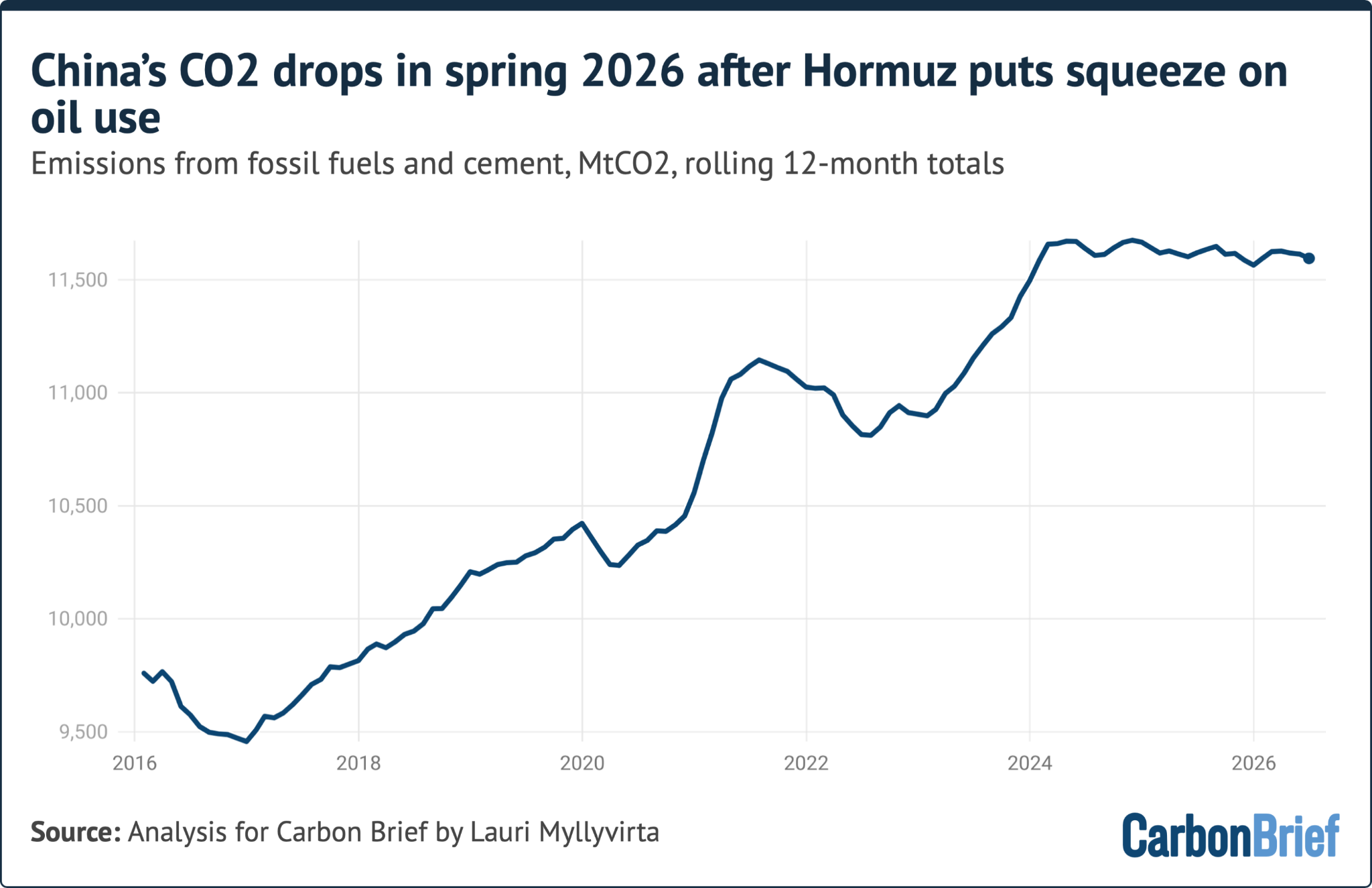
China’s carbon dioxide (CO2) emissions fell by 1% in the second quarter of 2026, according to new analysis for Carbon Brief. The country’s use of oil fell 9% overall and by 16% for transport, following disruptions to supply amid the strait of Hormuz crisis. This contributed to China’s CO2 emissions falling, despite a continued rebound of coal-fired power generation.
Spotlight
A brief history of electric vehicles
This week, Carbon Brief looks at the 200-year history that brought electric vehicles (EVs) from a niche technology to one that is dominating sales around the world.
1828: The “earliest” EV was developed in the 1820s by Hungarian Anyos Jedlik, who powered a model carriage with an electric motor.
1832: Scottish inventor Robert Anderson created an “electric carriage” just four years later. Over the next couple of decades, a number of inventors developed similar contraptions.
1859: The first lead-acid battery was invented by French physicist Gaston Planté. This provided a viable way to store electricity on board a vehicle for the first time.
1884: Thomas Parker – best known for electrifying the London Underground – built the first fully electric “production EV” in the UK, as well as a steam-powered generator to recharge it. This was a decade before the first petrol car was built in the UK.
According to National Grid, Parker “might well have been something of an early eco-warrior, as it’s believed his concern about smoke and pollution in London drove his interest in developing EVs”.
1890: The first EV in the US was created by US chemist William Morrison in Iowa. The six-passenger vehicle could reach a top speed of 14 miles per hour.
1900s: Around the turn of the century, EVs were making headway on both sides of the Atlantic. In London, changes to the “Red Flag Act” – which required any vehicle other than those that were horse-drawn to be preceded by a man showing a flag as a warning to pedestrians – led to the introduction of electric “Hummingbird” taxis designed by UK engineer Walter Bersey.
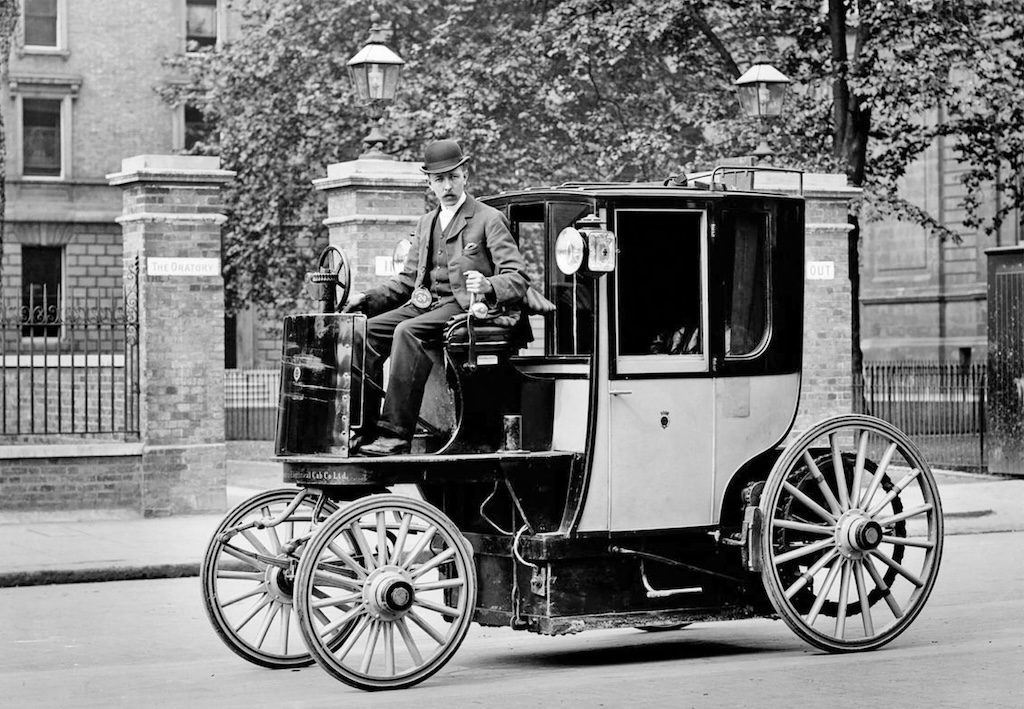
In New York City, a fleet of more than 60 electric taxis operated. By 1900, a third of all vehicles on the road in the US were electric.
1908-35: Despite progress, a combination of factors led to EVs all but disappearing by 1935.
This included Ford’s Model T car – the first mass-produced vehicle – being launched in 1908, the discovery of petroleum reserves in the US reducing fuel prices and the expansion of road networks, meaning people wanted to travel further and faster than an EV of the time could manage.
1976: Following oil shocks in the 1960s and 1970s sparking a renewed interest in EVs, in 1976 the US Congress passed an act authorising the country’s energy department to support research and development of the technology.
1991: The lithium-ion battery was commercialised by Japanese companies Sony and Asahi Kasei.
1996: US manufacturer General Motors released the EV1 – the “first mass-produced EV of the modern era”.
2008: The lithium-ion battery-powered Tesla Roadster went on sale. This was the first EV to travel more than 200 miles on a single charge.
2010: The Nissan Leaf – the world’s first mass-market EV – went on sale in the US and Japan.
2016: Global sales of EVs passed the one million mark in September 2016. By the end of 2016, there were two million electric cars on the road, as the pace of adoption grew.
2026: There are now nearly 80m electric cars in use globally. EVs are expected to reach 29% of sales worldwide in 2026. In Norway, they make up nearly all of new car sales.
In the UK, Carbon Brief analysis shows that the sale of EVs overtook the sale of petrol cars for the first time over a two-month period to May 2026.
According to research published by the University of Exeter earlier this year, nearly two centuries after the first EVs were developed, they are now reaching tipping points in Europe and China, causing an “irreversible shift” away from petrol and diesel vehicles.
Watch, read, listen
HEATWAVE ‘HYSTERIA’: Analysis in the Guardian looked at how “thousands of heat-related deaths in record-breaking temperatures [this summer in the UK] appeared to only intensify hosts’ climate denials” on right-wing news channels GB News and Talk TV.
ANDY’S IN-TRAY: On the BBC Rare Earth podcast, hosts Tom Heap and Helen Czerski discussed the “green in-tray” of UK prime minister Andy Burnham’s government, including North Sea oil and gas and the recent wildfires.
THE ‘MONSTER’: Novara Media interviewed climate scientist and Carbon Brief contributor Dr Zeke Hausfather about the rapidly intensifying “monster El Niño”.
Coming up
- 7-11 September: Climate Week, Baku, Azerbaijan
- 8-22 September: UN General Assembly, New York, US
- 10-11 September: Ocean and Seas Summit, Trabzon, Turkey
Pick of the jobs
- The New York Times, climate policy correspondent | Salary: $124,979.94-$160,000. Location: Washington DC
- Spotlight PA and Grist, environment reporter. Salary: $65,000-$75,000. Location: Pennsylvania (remote)
- UN, environmental lawyer/natural resource lawyer | Salary: Unknown. Location: Freetown, Sierra Leone (remote)
DeBriefed is edited by Daisy Dunne. Please send any tips or feedback to [email protected].
This is an online version of Carbon Brief’s weekly DeBriefed email newsletter. Subscribe for free here.