
DeBriefed 7 August 2026: Europe drought | Big oil’s ‘$93bn’ boon | Japan’s heat and earthquake ‘double disaster’
Welcome to Carbon Brief’s DeBriefed.
An essential guide to the week’s key developments relating to climate change.
Sign up below.
This week
Europe drought
NUCLEAR PROPORTIONS: On Monday, Romanian naval forces carried out a controlled underwater explosion to “redirect cooling water from the drought-stricken Danube river to the country’s last working nuclear reactor”, reported the Guardian. Neighbouring Hungary was “millimetres from a complete shut down” of its one nuclear power plant – responsible for some 40% of national power – on Tuesday, prime minister Peter Magyar posted on Twitter. In Slovakia, the low water levels forced the country’s biggest hydroelectric power plant to shut down seven of its eight turbines, said the Associated Press.
LOOKING WEST: In western Europe, the Rhine river hit its lowest point since records began 150 years ago, “threatening to disrupt a crucial route for transporting coal, fuel and industrial commodities across a large swath of the continent”, reported Bloomberg. Amid a slew of misleading claims, Carbon Brief explained the impact of heatwaves on different power sources.
EMPTY SHELVES: In the UK, the National Farmer’s Union warned that prolonged drought could cause shortages of some foods, reported BBC News. This came as the Met Office declared July in England and Wales the driest since records began in 1836, said Reuters.
Around the world
- KOREA RECORD: South Korea recorded a new top temperature of 42.5C, reported the Korea Times.
- HUNGER CRISIS: The current El Niño could push 50 million people into acute hunger before the end of next year, according to forecasting by the UN World Food Programme, covered by the Guardian.
- WIN BIG: Eight of the world’s largest oil companies made $93bn in profits amid the Iran war from April to June of this year, reported the Guardian.
- NDCS MISSING: About a quarter of the countries signed up to the Paris Agreement are still breaching its rules by failing to submit a new national climate plan, some 18 months after the official deadline, reported Climate Home News.
- CHINA SOLAR: China’s solar capacity is on track to surpass the country’s other sources of electricity this year, reported Bloomberg.
- REVERSE AGENDA: A federal appeals court said the US Environmental Protection Agency cannot “terminate” $20bn in clean-energy grants for non-profit groups, reported Reuters.
€3bn
The “economic toll” of European wildfires so far this year, according to an estimate by the Financial Times.
Latest climate research
- Sustained glacier loss, snow retreat and climatic warming are raising the risk of “post-earthquake cascading hazards” in the Himalayas | Communications Earth & Environment
- Concerns about climate change, economic crisis, democratic instability and geopolitical conflict “meaningfully shape” reported fertility intentions in four countries | Proceedings of the National Academy of Sciences
- Since 2018, vegetation loss in Europe has accelerated by 46% amid an increase in “natural disturbance activity” in temperate forests | Nature Geoscience
(For more, see Carbon Brief’s in-depth daily summaries of the top climate news stories on Monday, Tuesday, Wednesday, Thursday and Friday.)
Captured
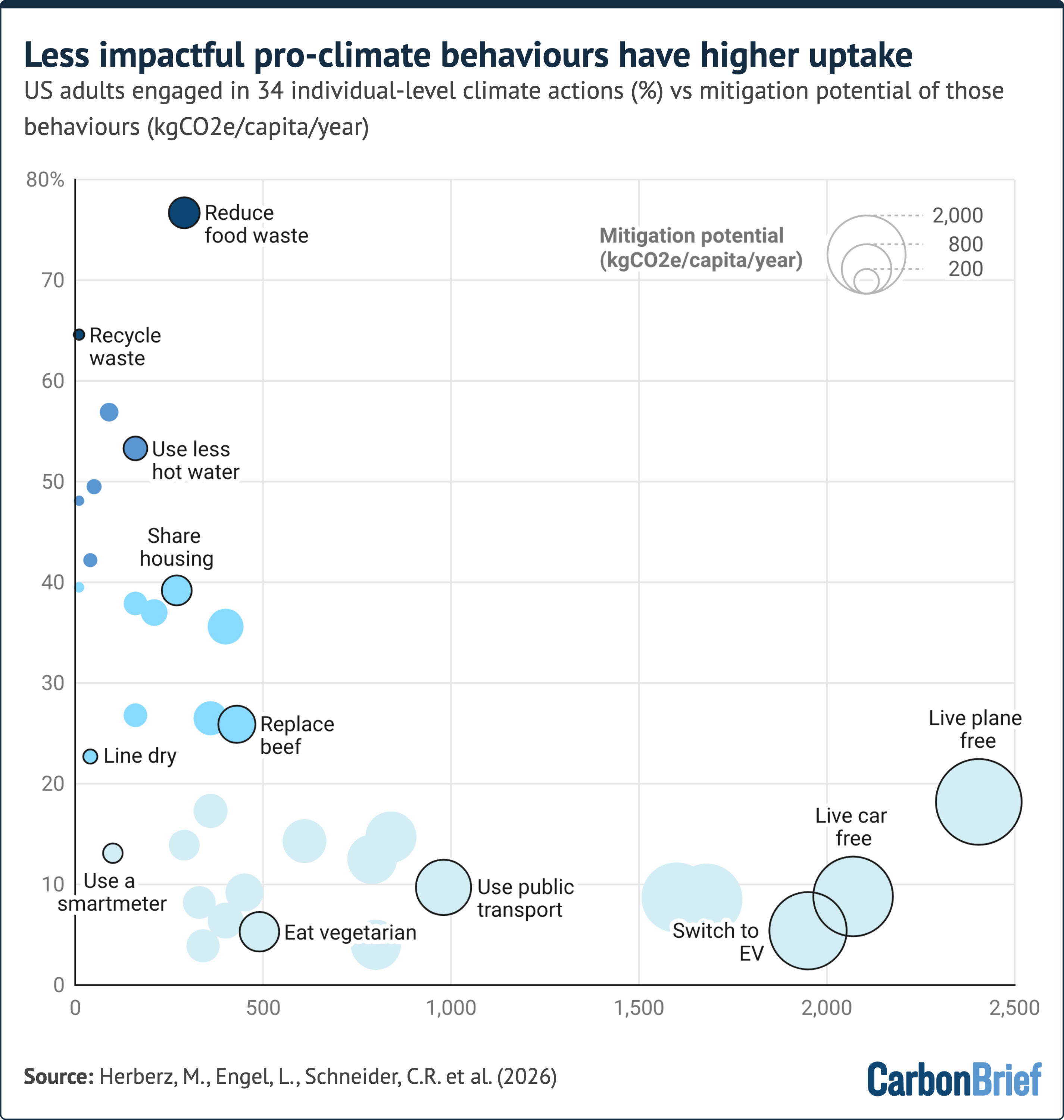
Most climate actions adopted by individuals are in the low-to-medium impact range, according to a new study in Nature Sustainability. The chart above shows the proportion of US adults, from a survey of around 3,000 people, that report partaking in various “pro-climate behaviours”. The size of the bubbles indicates how much CO2 each action could potentially save an individual in a year.
Spotlight
Japan reels from heatwave and earthquake ‘double-disaster’
This week, Carbon Brief reports on Japan’s ‘double-disaster’ of a concurrent earthquake and heatwave.
Just months after revealing a new word for days that reach over 40C (kokushobi; “cruelly hot day”), Japan experienced one of its worst heatwaves on record.
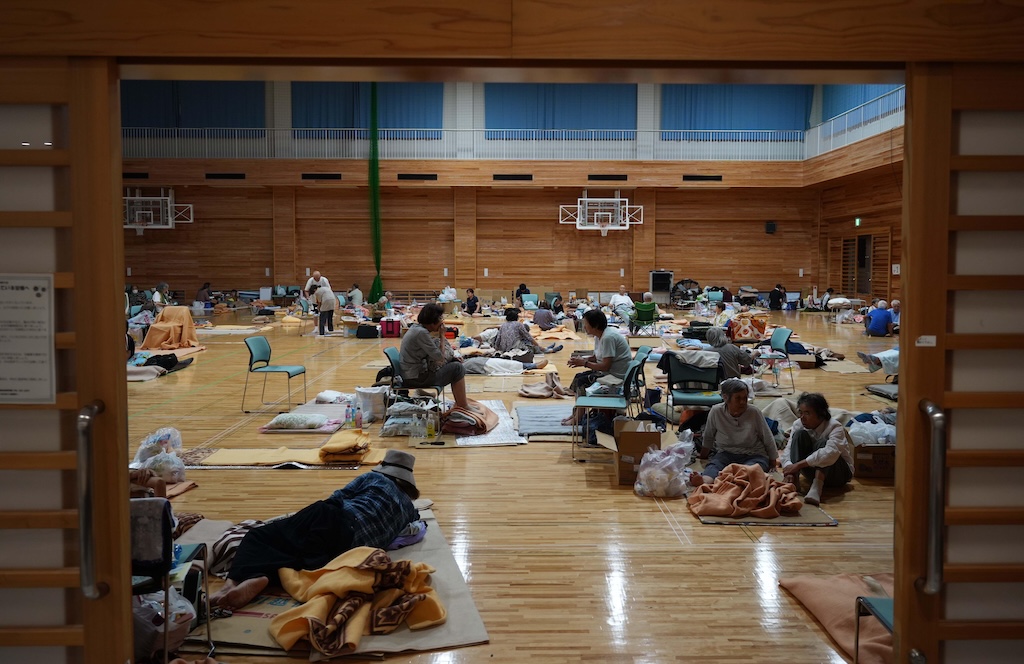
As hospitals and emergency services wrestled with heat-related illnesses, the southern prefecture of Kumamoto was hit by a magnitude 7.1 earthquake, leaving thousands without water or electricity.
The combination of the earthquake and intense heat was a “double-disaster”, Minoru Kihara, Japan’s chief cabinet secretary, said at a news conference.
He promised support to help the prefecture secure air-conditioning equipment for disaster relief.
Despite this, at least one heat-related death has been recorded in the earthquake’s aftermath, after a woman in her 70s died taking shelter in her car two days after the disaster.
‘It’s a killer’
Dr Andrew Mitchell is assistant professor of sociology at Kumamoto University. He founded the Kumamoto Earthquake Experience Project (KEEP) to advocate for disaster preparedness among foreign residents, after his experience of the Kumamoto earthquakes in 2016.
Last Tuesday afternoon, Mitchell was at home when he felt a jolt, accompanied by a loud noise.
“It sounds like the earth is tearing itself apart,” he told Carbon Brief.
Mitchell found himself serving as an informal touch point for foreign students navigating the disaster, including a mother concerned about evacuating with her child during the heatwave. He told Carbon Brief:
“This one girl especially who contacted me, she had a young child, so I think she was worried: ‘If I go to a park, there’s no aircon.’”
As extreme weather becomes more frequent in Japan, Mitchell worries about the multiplying impact on future natural disasters, he said:
“I’m very lucky. I live with my partner. She’s in her 30s. We don’t have children.
“But for those with children…the weather can cause a lot of problems in deciding how you can protect yourself.
“If the next earthquake happens during a major storm, during a typhoon, or again during a heatwave, where we’re having the hottest year in possibly decades, you’re creating the situation where, OK, I’ve got no idea if my building’s safe, but what’s the option?”
‘Unusual features’
Meanwhile, meteorologists in Japan are trying to unravel the exact conditions that prompted this heatwave to be so severe.
The planet is currently experiencing a strong El Niño, a natural weather event that can impact temperatures, rainfall and the risks of extremes globally.
“We used to observe a tendency for an El Niño event to bring Japan a cooler summer,” Prof Hisashi Nakamura, senior research fellow in global climate dynamics at the University of Tokyo, told Carbon Brief.
Historically, during El Niño conditions, warm surface waters near the Philippines shift eastwards across the Pacific, leaving cooler waters remaining around Japan and the western Pacific.
In recent years, however, ocean warming has kept convective activity “relatively high,” even during an El Niño year, Nakamura said.
This draws the subtropical jet stream – a fast flowing band of wind high in the atmosphere – north over Japan, submerging the country in hot tropical air and clear skies.
More research is needed to determine the exact cause for this breakdown in the traditional pattern.
“Under normal El Niño conditions, sea surface temperatures around Japan and the western Pacific tend to be lower than average,” Prof Yukiko Imada, associate professor of climate system research at the University of Tokyo, told Carbon Brief.
“It is still unclear whether these unusual features are a result of long-term global warming or simply reflect the unique characteristics of this particular El Niño event.”
Watch, read, listen
CARBON-CAPTURE SPRING: DeSmog covered the unusual alliances “springing up” to resist carbon capture and storage infrastructure in rural Canada and the US.
MOTHERLAND: Mothers from India, Kenya and the UK discussed raising children in a warming world, on the BBC Climate Question podcast.
BIG DATA: Carbon Brief contributor Dr Zeke Hausfather wrote on his Climate Brink substack about how AI “agents use about 600 times more energy than simple AI prompts”.
Coming up
- 4-12 August: Final week of the meeting of the subsidiary body on implementation of the UN Convention on Biological Diversity, Nairobi, Kenya
- 12 August: Parliamentary elections, Cook Islands
- 13 August: Presidential and parliamentary elections, Zambia
Pick of the jobs
- University of California, Berkeley, executive director for energy, climate and environment | Salary: $138,200-$271,200. Location: Berkeley, US
- World Wildlife Fund (WWF), senior director, critical minerals and community positive energy transition | Salary: $143,900-$206,900. Unknown. Location: Washington DC (hybrid)
- Loughborough University, professor of physical geography | Salary: Unknown. Location: Loughborough, UK
DeBriefed is edited by Daisy Dunne. Please send any tips or feedback to [email protected].
This is an online version of Carbon Brief’s weekly DeBriefed email newsletter. Subscribe for free here.