
DeBriefed 9 October 2026: ‘Scarily thin’ oil stockpiles | US supreme court case | UK Conservative ‘spreadsheet blunder’

Welcome to Carbon Brief’s DeBriefed, an essential guide to the week’s key developments relating to climate change.
In this issue…
- G7 countries agreed to speed the release of 100m barrels of oil reserves.
- An apparent error doubled the “cost of net-zero” in a UK Conservative party report.
- Carbon Brief explains the latest climate change lawsuit at the US supreme court.
- Key dates for next week and pick of the job vacancies.
This week
Strategic stockpiles dwindle
ACCELERATED: The International Energy Agency (IEA) said it would “accelerate the release” of oil reserves under a previously agreed plan to “tackle record fuel prices”, reported Reuters. Member states are “scheduled to assess and review the plans” next week, added the newswire.
PRESSURED RELEASE: The IEA announcement came after G7 countries agreed to release 100m barrels of oil from their strategic reserves over the next four months “following intense pressure from the Trump administration”, said Politico. This oil forms part of 400m of crude and refined products the IEA announced it would release earlier this year, rather than new commitments, as the Financial Times noted.
DWINDLING STOCKPILES: Meanwhile, Amin Nasser, Saudi Aramco’s chief executive, said that global oil stockpiles are “scarily thin”, according to the Financial Times. It added that Nasser said the ongoing war in the Middle East “had reduced oil supply from the region by ‘nearly 3bn barrels’”, while more than 1bn barrels have been drawn from the world’s reserves in attempts to “cushion the shortfall”.
Around the world
- EMISSIONS ACCOUNTING: Australia’s high court ruled that coal mines in New South Wales “must account for the emissions caused by the product when burnt overseas”, according to the Sydney Morning Herald.
- PACIFIC PRE-COP: At the pre-COP31 meeting in Fiji, Murat Kurum, president of the upcoming climate talks, said that the “1.5C goal…is a matter of survival”, adding that “we do not have a single minute, a single day to lose”, according to Reuters.
- DRY SPELL: India’s south-west monsoon season ended with the fourth-worst rainfall deficit since 1901, which has “raised the spectre of higher food prices…adding to concerns over inflation”, said the Business Standard.
- OFF TARGET: German government data showed the country had missed its €6bn climate-finance target for 2025, as a “budget crisis and the priorities of the new coalition government led to significant cuts”, according to Clean Energy Wire.
- RUNOFF: Neither far-right senator Flávio Bolsonaro nor current president Luiz Inácio Lula da Silva secured more than half of votes in the Brazilian election, reported Folha de S.Paulo. The candidates now face a runoff vote on 25 October.
- EV SURGE: Registrations for EVs accounted for “nearly a quarter of passenger car sales” in the Philippines this year, in response to a 68% spike in the price of petrol since the conflict in the Middle East began, said Reuters.
23 billion
Tonnes of CO2 avoided between 2006 and 2025 due to the growth of wind and solar power, reported Carbon Brief’s science contributor, Dr Zeke Hausfather, at his Climate Brink substack.
Latest climate research
- Land-use practices introduced by British colonists increased Australia’s vulnerability to climate change-driven wildfires | Nature
- A literature review on the impact of climate change on menstrual health and hygiene found that the “evidence base is fragmented”, adding that the topic should be integrated into “climate adaptation, disaster preparedness and humanitarian response frameworks” | PLOS Climate
- Emissions from peatland fires in northern North America and Eurasia are projected to increase by between one-third and one-half by the end of the century | Environmental Research Letters
(For more, see Carbon Brief’s in-depth daily summaries of the top climate news stories on Monday, Tuesday, Wednesday, Thursday and Friday.)
Captured
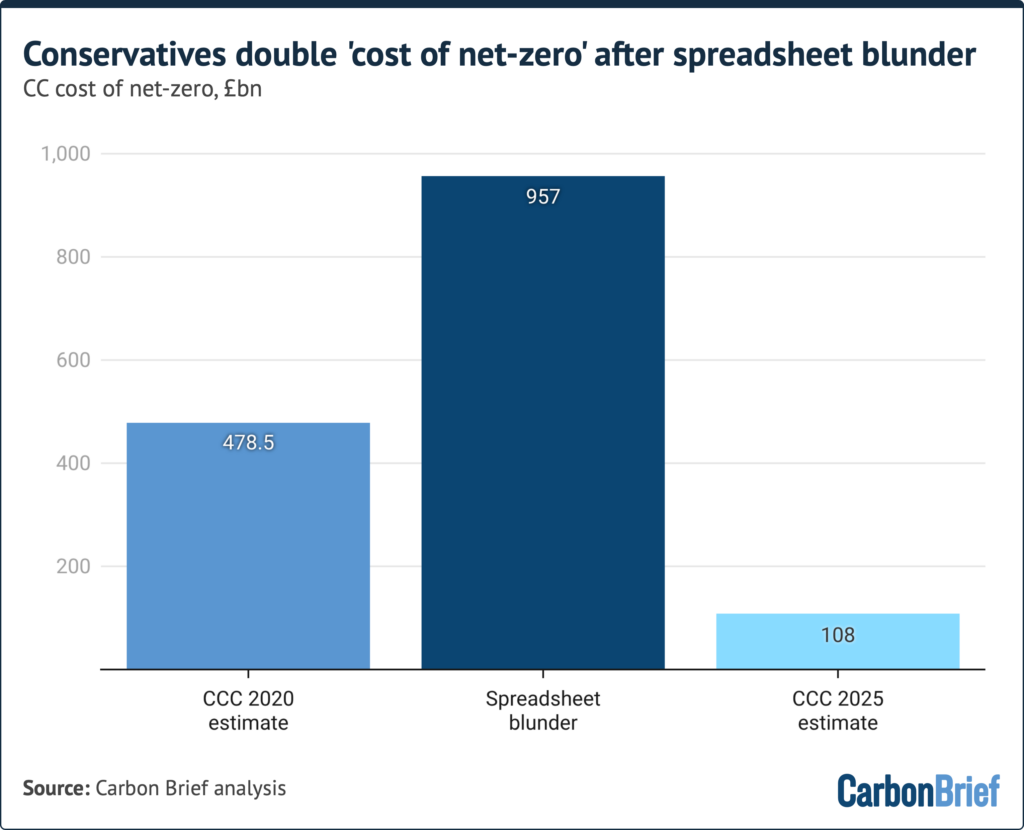
A booklet published by the UK’s Conservative party included a “cost of net-zero” that appears to have been doubled by a spreadsheet error, revealed a Carbon Brief factcheck. The document, dubbed the “Right Way”, claimed the government’s official adviser, the Climate Change Committee (CCC), had put the cost of net-zero at close to £1tn. However, the CCC’s 2020 estimate is exactly half the figure quoted – £478bn – and last year the committee published a revised estimate of £108bn, a drop driven by the falling cost of electric vehicles.
Spotlight
US supreme court hears climate case with potential ‘sweeping impact’
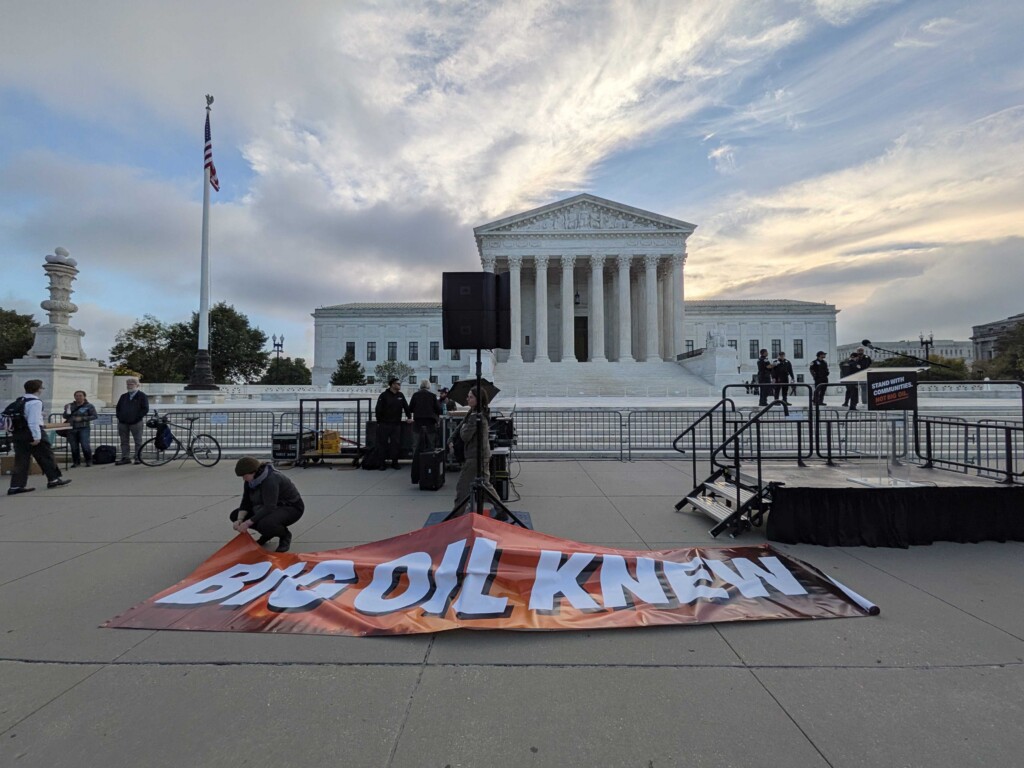
This week, Carbon Brief reports from the US supreme court, where the justices heard arguments on Monday in a major climate change liability case.
On Monday, 5 October, the US supreme court heard oral arguments in a climate change liability case that could have a “sweeping impact” on climate litigation in the US.
In Suncor Energy vs County Commissioners of Boulder County, the city of Boulder, Colorado, accused fossil-fuel companies of misleading their customers about the dangers of coal, oil and gas use.
If the companies’ appeal to the supreme court is successful, it will limit the ability of other localities to pursue climate-related damages in state courts across the US.
A final decision will be issued in the spring.
‘Sort of premature’
In 2018, Boulder filed a lawsuit in Colorado state court against Suncor Energy and Exxon Mobil, seeking damages for climate change-related harms, such as wildfires and extreme weather events.
Boulder argued that fossil-fuel companies had “misrepresent[ed] the dangers associated” with the use of their products and therefore contributed to “dangerous alterations in the climate”.
The defendants “have gone through all kinds of shenanigans” in an attempt to move the case from the Colorado state court to a federal one, Prof Alejandro Camacho of the University of California, Los Angeles School of Law told Carbon Brief. These were “pretty obviously delay tactics [or]…a way to stop the case from even being heard”, he added.
The Colorado state supreme court eventually ruled in May 2025 that neither federal regulations, such as the Clean Air Act, nor the US constitution, “preempted” or superseded Colorado state law – and that, therefore, the case could proceed.
However, before this could occur, the fossil-fuel companies appealed the decision to the federal supreme court. The court asked the parties to address both the preemption claims and a jurisdictional question – whether the Colorado court’s ruling was a “final judgment” and therefore could be appealed to the supreme court at this point.
Several justices during Monday’s hearing seemed sceptical on the latter point. Justice Ketanji Brown Jackson remarked that the day’s discussions made her “think that we’re really early in this case, that this is sort of premature from the standpoint of this court exercising its jurisdiction”.
On the preemption claims, “many of the justices were pushing back” against the idea that the constitution preempted state law, said Margaret Barry, climate litigation fellow at the Sabin Center for Climate Change Law. She told Carbon Brief that “there’s an easier road to a successful preemption argument under the Clean Air Act”, but it still was not clear whether that argument had sufficient support.
Pathways forward
Based on Monday’s arguments, the supreme court could rule in a number of ways.
The broadest ruling in favour of the fossil-fuel companies would say that all such climate-damage lawsuits in state courts are preempted by federal law. This would essentially put an end to this type of suit, because the supreme court has previously ruled that corporations cannot be held responsible for climate-liability claims under federal law, Camacho told Carbon Brief.
However, the court could rule that only some of Boulder’s claims – for example, those that said the companies’ production of fossil fuels had contributed to the climate-related harms the city faces – are preempted by federal law. This would mean that cases built on deception or other arguments would still be able to proceed in state courts.
It is also possible, given the recusal of Justice Samuel Alito, that the case will result in a 4-4 decision. If this were to happen, the Colorado supreme court’s decision would stand – meaning the case could then, potentially, proceed to trial – but it would not serve as a precedent for other cases on the federal level, Barry told Carbon Brief:
“We would have to wait another day for that [preemption] question to be resolved.”
Watch, read, listen
‘PATCHWORK’ POLICIES: Grist explored how a “patchwork” of heat policies across the US has left athletes vulnerable to severe injury – and even death.
MIDTERM THREAT: Data centres “have come to stand in for a broad range of apocalyptic threats” ahead of next month’s US midterm elections, said a column in the New Republic.
‘TWISTED’ NARRATIVE: The Heated podcast covered how the rightwing media ecosystem spread a “twisted” narrative about the RCP8.5 scenario.
Coming up
- 11-13 October: 17th Clean Energy Ministerial, Riyadh, Saudi Arabia
- 12-16 October: 65th session of the Intergovernmental Panel on Climate Change, Addis Ababa, Ethiopia
- 16 October: Leaders’ Summit on Biodiversity, Yerevan, Armenia
Pick of the jobs
- University College Dublin school of architecture, teaching fellow in environmental policy | Salary: €49,500. Location: Dublin
- WoMin, women’s climate justice lead | Salary: Unknown. Location: Remote within Francophone west Africa
- Ocean Conservancy, development senior writer | Salary: $110,000-120,000. Location: Washington DC or remote in select states
This issue of DeBriefed was edited by Molly Lempriere. Please send any tips or feedback to [email protected]
This is an online version of Carbon Brief’s weekly DeBriefed email newsletter. Subscribe for free here.