
Global extent of climate change is ‘unparalleled’ in past 2,000 years
Near, far
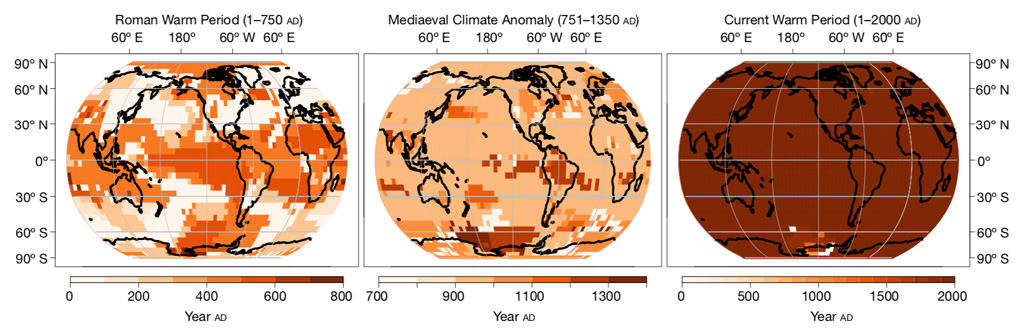
The impact of human-caused climate change can be felt almost everywhere on Earth. Average global temperatures have risen by around 1C since the start of the industrial era but some regions, such as the Arctic’s Svalbard, have already seen increases of up to 4C. Over the past few centuries, the world has seen multiple periods of unusually severe warming and cooling as a result of natural swings in the climate. One of the most well-known “warm” periods is the “Medieval Climate Anomaly”, which is commonly associated with elevated temperatures at around 800-1200AD. The mild conditions during this period may have helped the Vikings to conquer further north, research suggests. Another is the “Roman Warm Period” – which is associated with warmer than average temperatures in the first few centuries of the first millennium. Notable cool periods include the “Little Ice Age”, a period of colder than average temperatures and glacier advance between the 16th and mid-19th centuries, and the “Dark Ages Cold Period”, a cold snap that affected some regions from 400-765AD. Because these events happened before modern temperature records began, there is still uncertainty surrounding how extreme they were and in what exact years they occurred. Another outstanding question is to what extent these events were global – rather than regional. The new study builds on earlier work to address this question, says Dr Nathan Steiger, a study author and research scientist at the Lamont-Doherty Earth Observatory at Columbia University. He tells a press briefing:“What we show is that these periods aren’t as globally coherent as previously thought and that the contemporary warm period [modern-day climate change] stands in stark contrast to this.”
Decoded
To look back into past climates, the researchers used a vast range of “climate proxies” – biological or geochemical archives that contain embedded records of past temperature change. Examples of proxies include tree rings, glacier ice and ancient corals, explains Prof Scott St. George, an environmental scientist from the University of Minnesota, in a Nature News & Views article accompanying the new study. He writes:“Trees in cold Arctic or alpine forests have annual rings with widths and wood densities that reflect year-to-year variations in summer temperature. And because the chemical make-up of seawater depends on its temperature, massive corals build endoskeletons that contain a permanent geochemical record of past warming and cooling.”
The map below shows the locations of climate proxy records used in the study. Proxies include bivalve molluscs such as clams, oysters and mussels (purple dots); coral (orange dots); glacier ice (blue diamonds); hybrid – trees or boreholes (black stars); lake sediment (blue squares) and trees (green triangles).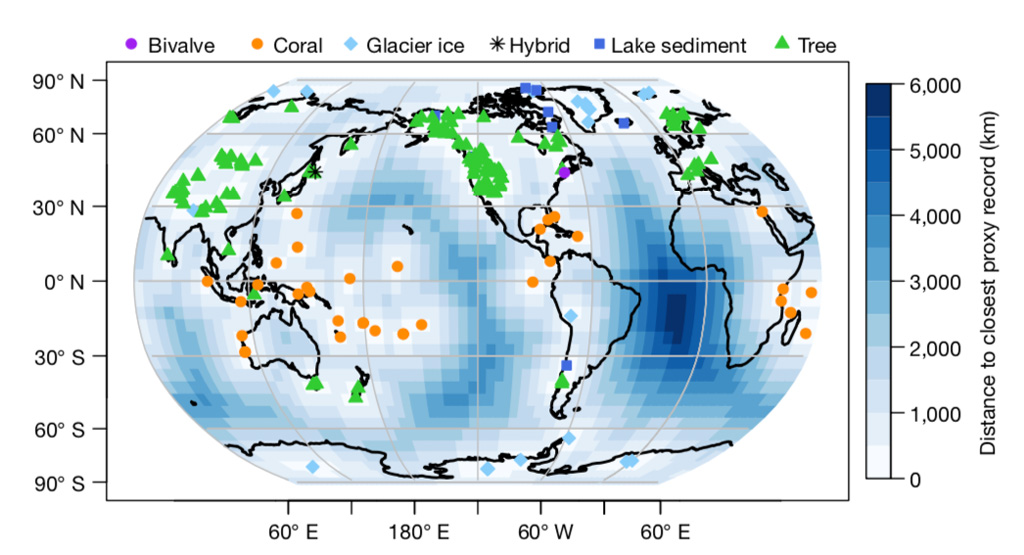
‘Yet another nail’
The findings reinforce the need to see past warming and cooling events with a “regional framing”, the authors write in their research paper. They conclude:“The results provide further evidence of the unprecedented nature of anthropogenic global warming in the context of the past 2,000 years.”
A second paper, published in Nature Geoscience by the same research group, looked at how the rate of warming and cooling on “multi-decadal timescales” has changed over the past 2,000 years. Lead author of both papers, Dr Raphael Neukom, a paleoclimate scientist from the University of Bern, tells the press briefing:“We find that the most dramatic warming over the past 2,000 years occurred during the second half of the 20th century, which highlights the extraordinary character of current climate change.”
The findings help to “confirm” earlier research that suggested that past episodes of warming and cooling were regional rather than global, says Prof Piers Forster, climate scientist and director of the Priestley International Centre for Climate at the University of Leeds, who was not involved in the study. He tells Carbon Brief:“Today’s human-induced warming signal is truly global in extent, whereas earlier events such as the Little Ice Age or Medieval Warm Period were only ever regional. The study puts these findings on a firm statistical footing and is yet another nail in the coffin of the theory that today’s warming signal could be a natural fluctuation.”
Article information
Neukom, R. et al. (2019) No evidence for globally coherent warm and cold periods over the preindustrial Common Era, Nature, https://nature.com/articles/s41586-019-1401-2
Neukom, R et al. (2019) Consistent multidecadal variability in global temperature reconstructions and simulations over the Common Era, Nature Geosciences, https://nature.com/articles/s41561-019-0400-0