
The Carbon Brief Interview: Tim Flannery
- Flannery on the need for negative emissions technologies: “We need to develop a series of new technologies that I call the “third way” technologies, that have the potential to draw carbon dioxide out of the atmosphere at the gigatonne scale.”
- On the scale of the challenge: “If we could cover 9% of the world’s oceans with seaweed farms you draw down the equivalent of all global emissions going up as of 2015.”
- On a global carbon price: “I do agree…that the deployment of a global carbon price at $100/tonne or thereabouts seems like a distant pipe-dream at the moment.”
- On the difference between the Copenhagen climate summit in 2009 and Paris COP21: “I think the world is now ready to take action in a way that it wasn’t five years ago.”
- On the level of hostility among some in Australia to action on climate: “I had to have federal police protection, and was abused in the street, and threatened at public meetings and all sorts of things.”
- On the public outrage when the Australian government ended funding for the Climate Commission: “I think there’s a lesson there for governments, particularly, that want to deprive their citizens of access to information.”
- On judging the new Australian prime minister’s views on climate change: “I think we are still all in a phase of suspended judgement.”
- On Australia’s reliance on coal: “We still have 76% of the nation’s electricity supply coming from the burning of coal, which seems paradoxical in a country as sunny and as windy as Australia.”
- On not breaching the 1.5C temperature limit: “Means a really rapid phase-out of coal and, indeed, fossil fuels. There’s no way around it, the [carbon] budget’s too limited to do anything else.”
- On the difference between 1.5C and 2C warming: “For me, a 1.5C world, while not ideal, is sort of manageable, a 2C world I think is on the threshold of real danger.”
- On the difference between nuclear power and renewables: “Increasingly, we’re seeing the capital markets favour renewables, just because they give you a much more secure return on your capital.”
- On the prospects of investing in gas: “There are some projections that the cost of electricity from wind will halve in the next five years, so I think that for gas it’s looking risky.”
- On the post-COP21 world: “I really do think we’ll see an acceleration of change from now on.”
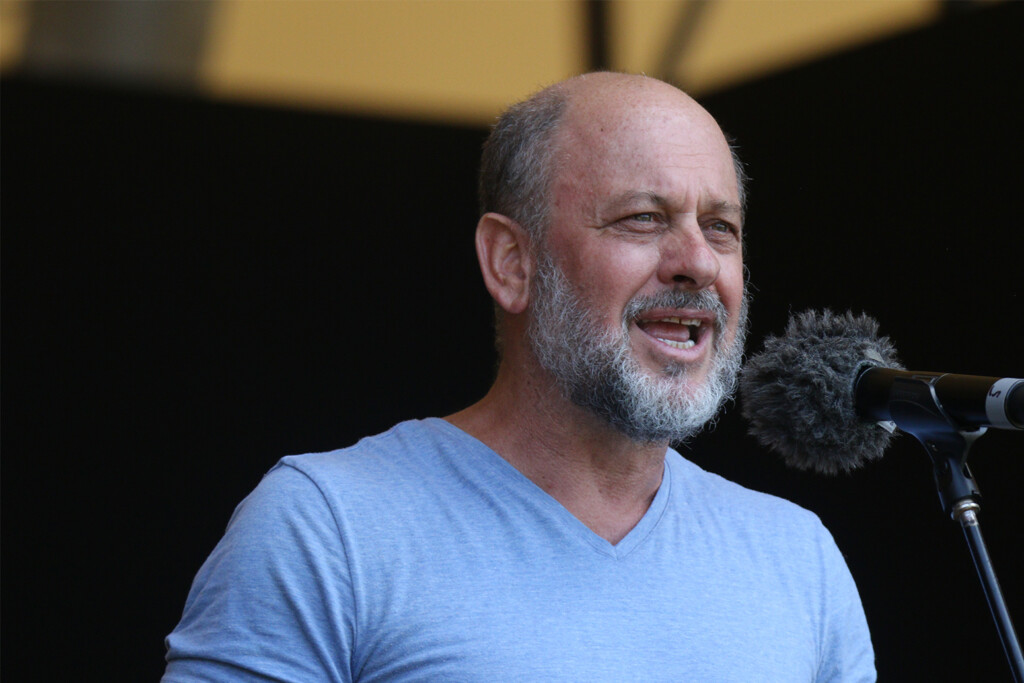
Main image: 29 Nov 2015, Sydney, Australia. Australian climate change protesters have held rallies nationally to show their support for the environment before Cop21, the UN Conference on Climate Change talks to be held in Paris later this week, with the intention of forming a legally binding agreement on climate change. Pictured: Tim Flannery. © Richard Milnes/Splash News/Corbis.
Videos by Rosamund Pearce for Carbon Brief.
Article information
The interview was conducted by Leo Hickman at the COP21 climate change conference in Paris on 11 December 2015.