
Surge in plant growth explains slower CO2 rise over past decade
“Carbon dioxide concentrations are increasing year-on-year without fail…This was a steady rise, rather than an acceleration, but, nevertheless, still an ongoing rise.”
In fact, we are already seeing a return to faster CO2 rise as ecosystems respond to the strong El Niño weather phenomenon in 2015/16, says Betts.
Rising CO2
Human activities, such as burning fossil fuels and making cement, release CO2 into the atmosphere. In the mid 1850s, before humans started industrialising, the concentration of CO2 in the atmosphere was around 280 parts per million (ppm). In 2016, for the first time, it stayed above 400ppm for the full year.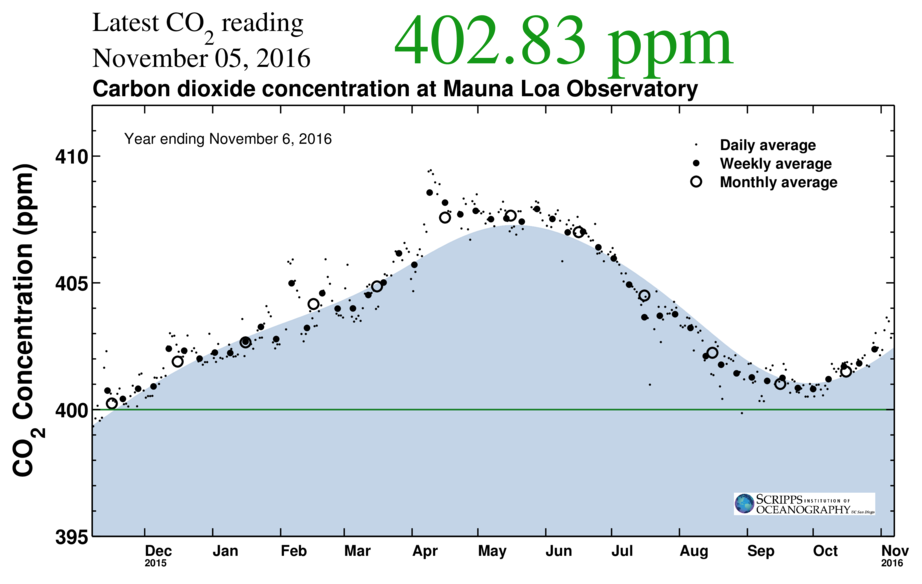
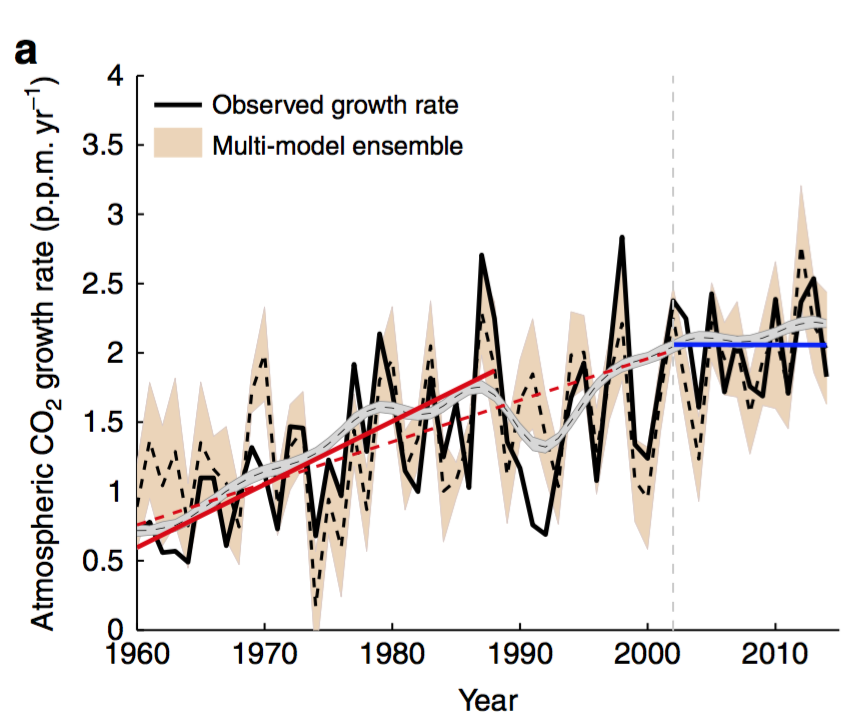
“CO2 concentrations in the atmosphere continue to rise. What we found is, they have risen steadily since the start of the century, instead of accelerating as they were previously.”
‘Greening’
Since the amount of CO2 human activity released to the atmosphere grew rapidly from 2000-2014, the authors had to look elsewhere for what could explain the slower CO2 growth rate. Keenan tells Carbon Brief:“This is interesting, as the amount of CO2 emitted by anthropogenic activities has increased quite a lot during that time period. This implies an unexpectedly large increase in one of the world’s carbon sinks.”
Keenan is referring to the amount of carbon stored by land plants. Plants convert sunlight, water and CO2 into glucose during a process known as photosynthesis, in order to grow. More CO2 in the air means plants can photosynthesise faster, as long as they’re not limited by water or nutrients.
This effect, known as CO2 fertilisation, is most evident at high latitudes and has been recognised in the scientific world for decades. But while the general principles are understood, less is known about how they will alter under future conditions that have not yet been experienced, says Betts.
Change of pace
As well as rising emissions between 2002-2014 boosting photosynthesis, something else was happening to further increase the amount of carbon stored in plants. To release energy from the glucose produced during photosynthesis, plant cells respire. This process produces CO2, but it is sensitive to temperature. During the first part of the 21st century, average global temperatures at Earth’s surface rose slower than in previous decades, slowing the pace of respiration. As the paper notes:“Satellite-driven estimates of the carbon cycle suggest that the slowdown in global warming led to a slowdown in temperature-driven ecosystem respiration of roughly 60%.”
The slowdown in respiration contributed to more CO2 staying locked up in plants rather than ending up in the atmosphere, though to a lesser extent than the CO2 fertilisation effect.
Interestingly, the authors of today’s study call the transition from an accelerated CO2 growth rate to a steady one a “pause”. But Prof Pierre Friedlingstein, professor of global carbon cycle modelling at the University of Exeter, finds the word choice “confusing and certainly not helpful”. He tells Carbon Brief:
“Atmospheric CO2 continue to increase, with average concentration being higher every single year. We passed the iconic 400ppm milestone this year…I think what they want to say is that this growth rate hasn’t been really increasing as fast as the anthropogenic emissions over the last 15 years.”
Reversal of fortunes
To put today’s study in wider context, it’s also important to look past the end of the study period. With the pace of CO2 rise picking up again in 2015/16 because of a very strong El Niño, the situation is already changing. El Niño is a periodic weather phenomenon in the tropical Pacific that affects temperature and rainfall patterns worldwide. During an El Niño event, CO2 tends to rise faster because warm, dry conditions on tropical land areas weaken the carbon sink. Prof Corinne Le Quéré, director of the Tyndall Centre at the University of East Anglia, sums up today’s study:“The new study shows a bigger sink on land during 2002-2014. It seems this could be already reversing with the big El Niño of 2015-2016 triggering a smaller sink.”
Looking further ahead, scientists warn that as temperatures continue to rise, the delicate balance of how trees use CO2 could be upset, potentially reducing their capacity to buffer rising CO2 levels. As Betts writes in his Carbon Brief guest post:
“Crucially, the warmer the world becomes, the more difficult it could be to prevent further warming, as our CO2 emissions could have proportionally larger impacts, and natural carbon sinks could become less effective.”
Or, as Prof Dave Reay, chair in carbon management at the University of Edinburgh, puts it:
“The land and oceans have been bailing us out of dangerous climate change for decades, but as temperatures rise and rainfall patterns change they will inevitably falter.”
Today’s study highlights the need to protect natural vegetation so it can continue to do the important job of absorbing our carbon emissions, say the authors. However, while humanity has so far been buffered from the full impact of our carbon emissions due to the natural carbon sinks on land and ocean, we should not assume that this will continue at the same level indefinitely, they warn.
Article information
Keenan, T. et al. (2016) Recent pause in the growth rate of atmospheric CO2 due to enhanced terrestrial carbon uptake. Nature Communications DOI: 10.1038/ncomms13428