
Melting Antarctic ice could slow global temperature rise, study says
Adding Antarctic meltwater to climate models
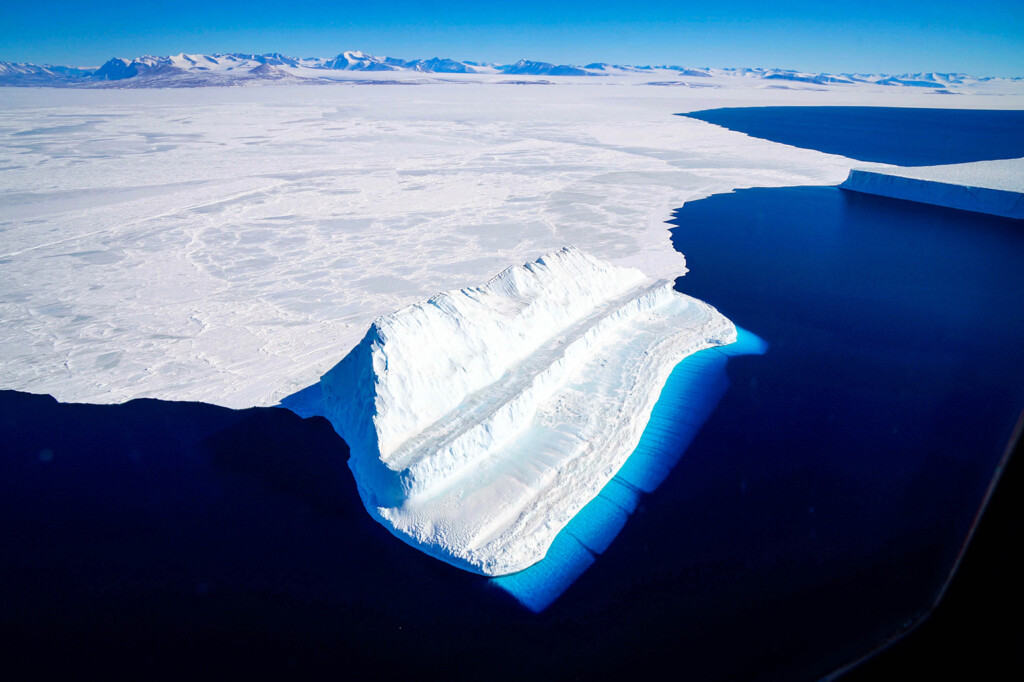
While climate models seek to include various different elements of the Earth’s systems, many are still limited in their modeling of changes in global ice sheets. While models include the role of ice melt on global sea level rise, they generally do not include the impact of the effect of meltwater from ice sheets and ice shelves on the climate The broader climate impacts of ice-sheet and ice-shelf melt are not included in the current generation of climate models – CMIP5 – and are not expected to be accounted for in the upcoming CMIP6 models either. Researchers can include meltwater in climate models by effectively adding projected meltwater to the ocean around ice sheets and see what happens, a practice referred to in the modelling community as “hosing experiments”. While prior studies have added ice-sheet melt from Greenland to global climate models, the new study is the first to apply a similar approach to the Antarctic ice sheet.
Slower temperature rise
The authors found that including Antarctic meltwater in the model simulations had a surprisingly large impact on both global and regional temperature changes. Global temperatures are lowered by around 0.4C in the latter half of the 21st century compared with model runs where meltwater is not included. The figure below shows the regional temperature effects of the inclusion of meltwater in the top panel – and the effect on global average surface temperatures in the bottom panel.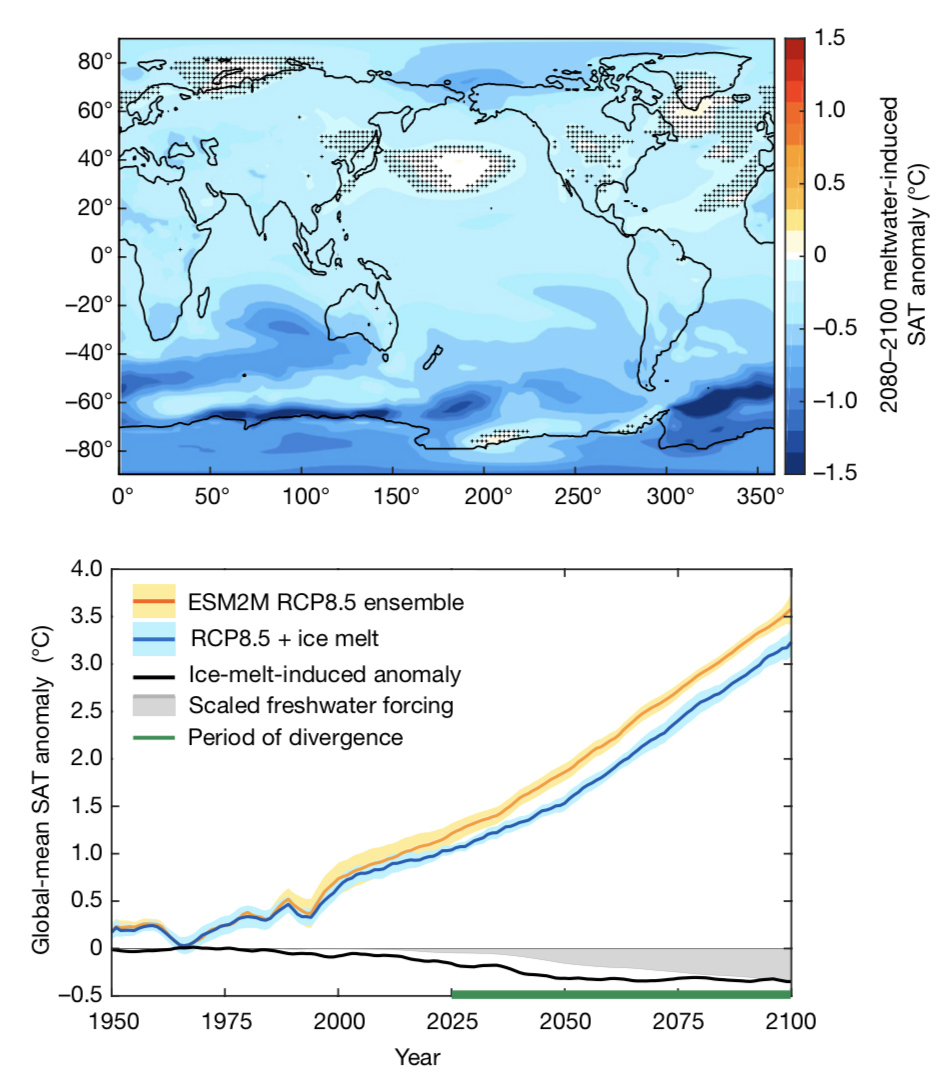
Rainfall patterns
The findings also suggest that the added meltwater will have a large influence on global rainfall patterns. This happens because the influx of cold meltwater into the Southern Ocean has a knock-on impact of shifting the Inter-Tropical Convergence Zone (ITCZ), a huge belt of low pressure that encircles the Earth near the equator. A shift of the ITCZ to the north means areas just to the south of the equator would experience a reduction in rainfall, while areas just to the north would see increases. The changes in regional and global average rainfall due to the addition of Antarctic meltwater are shown below. The top part shows a map of projected changes in rainfall, with orange and red areas seeing a decrease in rainfall while blue areas see an increase. The bottom part shows changes in global average precipitation, with model runs including Antarctic meltwater in blue and those not including Antarctic meltwater in orange.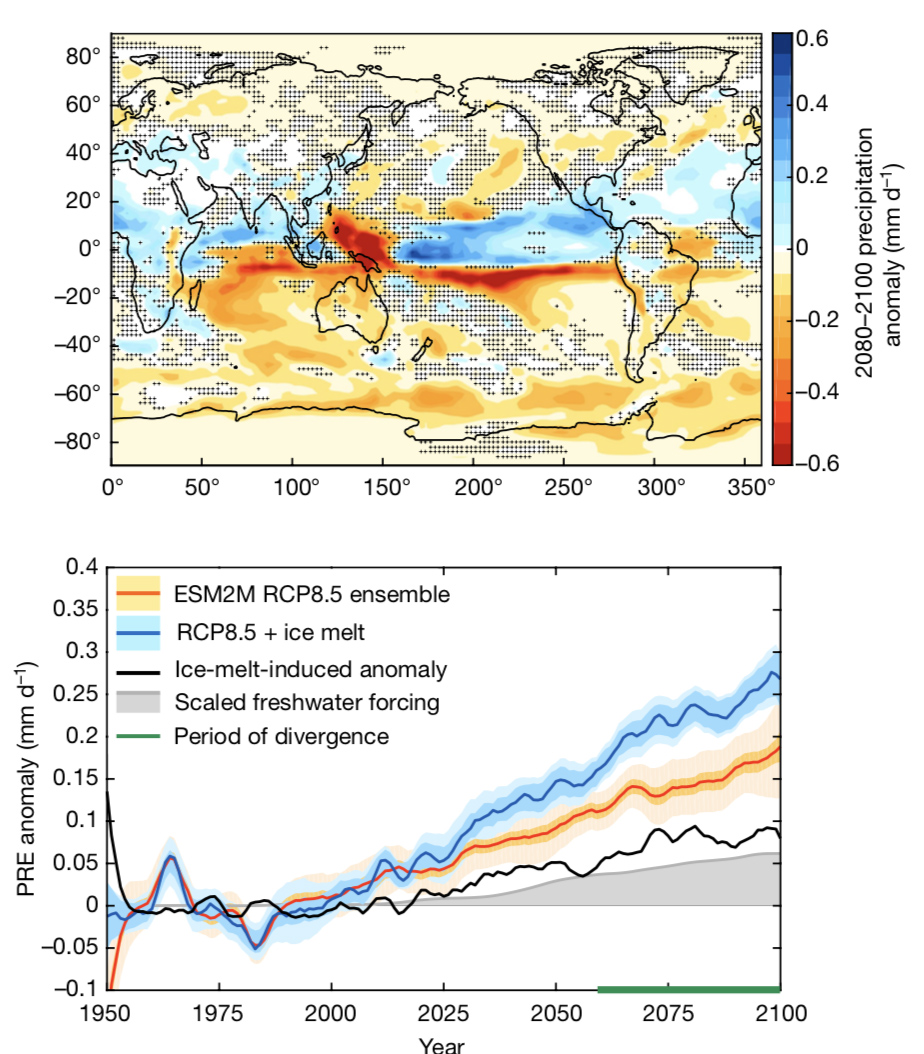
Faster melting ice sheets, but more sea ice
The study also explains how adding large amounts of freshwater to the ocean by melting Antarctic ice sheets leads to somewhat unusual effects. Water from melted ice is quite cold and, because freshwater is less dense than saltwater, it accumulates on the surface. This has the effect of reducing the mixing between deeper, warmer waters with cooler surface waters around the coast of Antarctica, leading to surface cooling and warming of water below the surface. The mechanisms at work are shown in the diagram below, where the solid black lines represent the normal mixing of ocean water around the coast of Antarctic and the dashed black lines show the new flow when ice melt is added. The left panel shows conditions without substantial meltwater additions, while the right panel shows what happens when large amounts of Antarctic meltwater are added.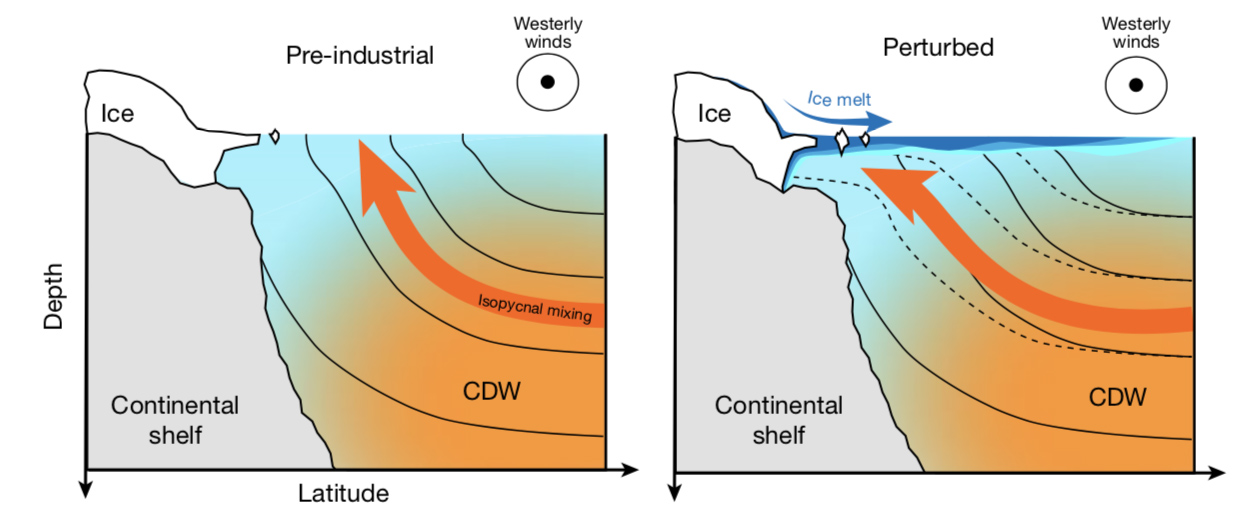
“The Southern Ocean is a complex system and many ice-sheet-related feedbacks need to be accounted for…Global coupled models such as ESM2M are useful tools for identifying and quantifying the potential of this feedback by modelling the temperature response of the Southern Ocean to meltwater discharge…however, they lack high-resolution continental-shelf and ice-shelf-cavity dynamics. Consequently, global coupled model simulations need to be complemented with regional ice-sheet studies to fully constrain the magnitude of the ice-loss feedback.”
Urge for caution
The impacts of Antarctic meltwater on global temperatures and rainfall were surprisingly large, according to the study’s authors. In a press release accompanying the paper, co-author Prof Joellen Russell of the University of Arizona, called their results “the first new identified feedback on climate in 20 years”. Climate scientists who were not involved in the study tell Carbon Brief that while the results are intriguing, they should be treated with caution until they can be supported by other studies. Dr Kate Marvel, a climate modeller at NASA GISS, tells Carbon Brief that she is somewhat sceptical, as the paper presents a “study that relies on a single model which may or may not be a credible representation of reality”. She continues:“It would, however, surprise me if a large influx of Antarctic meltwater had no climate impact and I think this study is useful in noting that this could potentially be an important factor in future climate. I do worry about [the media] acting as if melting Antarctica is going to mitigate climate change because the paper notes it could delay exceeding 1.5C or 2C targets by a decade. We don’t get this extra time for free!
This could have massive implications for rainfall patterns globally – the paper suggests it drags the tropical rain band into the northern hemisphere, which is really unfortunate if you live in one of the regions left behind and rely on that rainfall. Moreover, it will probably make southern hemisphere droughts even worse. These effects seem plausible, but more than that, it’s important to note that climate change is about so much more than global average temperature.”
Dr Kevin Trenberth, a climate scientist at the National Center for Atmospheric Research (NCAR), shares similar concerns. He suggests that climate models have challenges in simulating the region around Antarctica. In models of the region, “the clouds are poor, the heat budget is quite wrong, and the westerlies are not right”. This means that models may miss some important factors when trying to assess changes. Trenberth suggests that he would have liked to see more of an assessment of the uncertainties in Antarctic ice melt. Because the paper is predicated on a high-end scenario for Antarctic ice melt, scenarios with lower melt would have correspondingly lower climate impacts. There is significant uncertainty on the magnitude of future ice melt and sea level rise from Antarctica, and this is an area of active scientific research. Finally, Prof Michael Mann at Penn State University tells Carbon Brief that while the study is interesting, it would provide a more complete picture of the impacts of meltwater in a warming world if it took Greenland ice sheets into account, as well as Antarctica. Greenland melt has a big impact on ocean circulation, and would produce its own changes in temperature and rainfall that may counterbalance some of those from Antarctica. In the paper, Bronselaer and his colleagues acknowledge the limitations of relying on only one climate model. They suggest that the simulations done in the paper should be run across multiple climate models as part of the Southern Ocean Modelling Intercomparison Project (SOMIP) to ensure that results are not model-dependent. They add that “the effects of meltwater from the Greenland ice sheet have so far not been considered and could lead to further changes in simulated future climate”. Future work could look at the climate impacts of meltwater from both Greenland and Antarctica in the same coupled climate models.Article information
Bronselaer, B. et al. (2018) Change in future climate due to Antarctic meltwater, Nature, doi:s41586-018-0712-z