
DeBriefed 14 August 2026: Record ocean heat | UK EV rollback could cost ‘£3bn’ | Saving ‘green spaces’ from drought

Welcome to Carbon Brief’s DeBriefed.
An essential guide to the week’s key developments relating to climate change.
Sign up below.
This week
More fires, more records
JULY RECORDS: Global ocean temperatures reached a July high, with average sea-surface temperatures outside polar regions hitting 20.96C, reported BBC News. It also marked the US’s hottest-ever month, with temperatures exceeding the 20th century average by 1.8C, according to the Guardian. Meanwhile, western Europe saw its hottest June-July period as “climate change fuels an historic summer of heat, drought and wildfires across the region”, reported Agence France-Presse.
‘OUT OF CONTROL’: Canada’s federal government announced “urgent assistance” to British Columbia after “unprecedented” fires forced 22,000 people to flee, reported the Guardian. Meanwhile, wildfires forced Indonesian authorities to close Mount Bromo national park on Java island, an “active volcano and popular tourist destination”, according to Reuters. Elsewhere, Spain – where 244,000 hectares of land have burned so far this year – battled a large fire in the south-west under “hot and windy” conditions, said Reuters.
UK HEATWAVE: The UK battled wildfires and a train derailment on its hottest day of the year yesterday, with temperatures reaching 38.1C, according to BBC News. The UK’s Met Office warned that the country is headed for its hottest summer on record, said the Press Association. Prime minister Andy Burnham held the UK government’s second emergency meeting this year on drought and wildfires, reported Bloomberg.
Around the world
- STRONGEST EL NIÑO: The National Oceanic and Atmospheric Administration (NOAA) has forecast a 70% chance that the building “super El Niño” will be the “strongest such event on record”, said CNN.
- ASIAN FLOODS: Typhoon Dolphin, China’s strongest typhoon this year, has “battered” Beijing with climate-linked “intense rain”, reported Reuters. Meanwhile, flooding in India’s Assam state has killed at least 100 people, said the Associated Press.
- NUCLEAR SHUTDOWN: Romania shut down its only nuclear power plant due to low water levels on the drought-hit Danube river, reported Politico.
- CHINA COAL: China unveiled its 15th five-year plan for a “modern” coal industry by 2030, according to state news agency Xinhua. Carbon Brief took an in-depth look at the plan.
2.5 billion tonnes
The potential extra coal supply each year from new coal mines proposed around the world in 2025, according to a new report by the Global Energy Monitor (GEM) covered by the Guardian.
Latest climate research
- Analysis of 3,500 forest fires in Canada and the western US reveals that the fastest fires burn “outsized” areas and lead to reduced capacity for ecosystem recovery | Science Advances
- Upgrading infrastructure in Brazil’s informal settlements is associated with lower heatwave mortality rates | npj Urban Sustainability
- Methane emissions in Siberia increased by 5% per year over 2010-23, due to a combination of wildfires and permafrost thaw | Science
(For more, see Carbon Brief’s in-depth daily summaries of the top climate news stories on Monday, Tuesday, Wednesday, Thursday and Friday.)
Captured
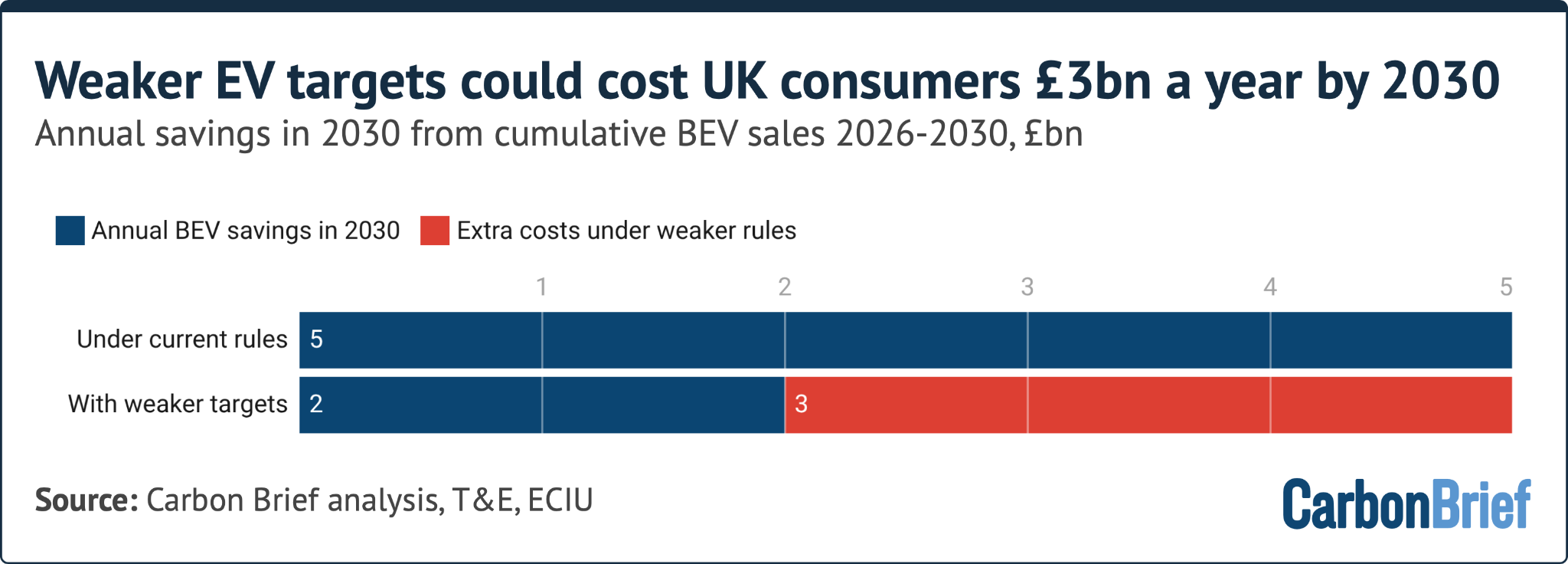
After years of fierce lobbying by parts of the car industry, media reports suggest that electric vehicle (EV) targets could be “watered down” in an upcoming UK government consultation. Carbon Brief analysis – based on modelling from advocacy group Transport & Environment and the Energy and Climate Intelligence Unit thinktank – found that weaker targets could cost UK consumers up to £3bn a year by 2030.
Spotlight
Saving ‘green spaces’ from drought
This week, Carbon Brief reports on the challenges of maintaining green spaces during the ongoing drought in England.
On Monday, drought was declared across three-quarters of England, following unprecedented heatwaves and a record-dry July.
Amid the drought, new research by the National Lottery Heritage Fund and Historic England found that climate change is posing an “existential threat” to the UK’s green spaces.
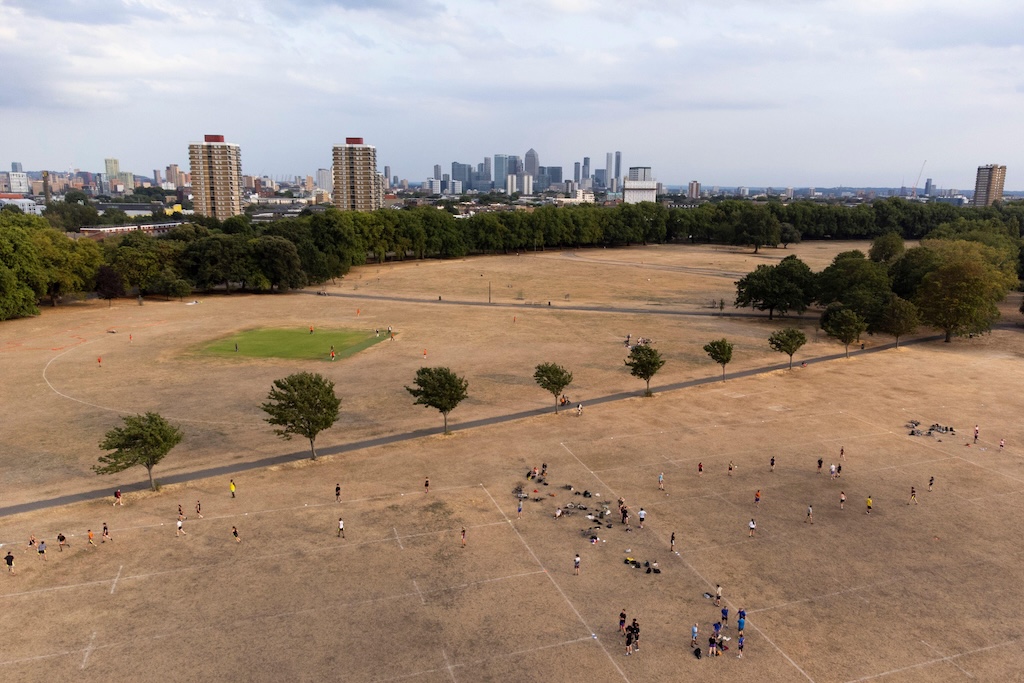
Scenes of scorched grass in green spaces up and down the country suggest this “threat” is becoming a very visible reality.
Green spaces – ranging from public playgrounds to woodlands and local nature reserves – play a crucial role in providing people with a place to relax, unwind and shelter from hot weather.
This is particularly important in the UK’s cities. In London, 21% of households lack access to a garden or balcony – with the figure even higher for people from Black, Asian or ethnic-minority backgrounds.
One area where people are highly reliant on their green spaces is Tower Hamlets in east London. This is where Marshall Savage is environmental coordinator for the local council, overseeing maintenance of the borough’s parks during this year’s record drought conditions.
‘Really different’
Savage told Carbon Brief that park maintenance during summer typically involves routine tasks, such as “high-frequency turf mowing, flower-bed care, scheduled prunings and a few ornamental jobs here and there”.
However, they continued, “the past two years have been really different” and “more extreme compared to other years.”
During this year’s extreme heat and drought conditions, operational priorities have shifted towards crisis mitigation, Savage explained.
Routine mowing has been suspended to protect dormant grass from root damage.
Dried soils are raising the risk of flooding once rain eventually falls, Savage said. “You’re going to see the rain just flowing off…drains getting blocked,” they added.
Working conditions for park rangers are also tougher under prolonged heat exposure.
Measures have been introduced to improve staff welfare, Savage said, including allowing staff to start shifts earlier in the day. “Even then [it’s] hard because we’re starting off around 20-21C,” they added.
Local people have also been avoiding visiting parks during the day, when temperatures are at their hottest. “You’re seeing later evenings,” said Savage, but “between 12pm to 4pm, [the parks are] much more empty”.
‘Autumn already’
Preserving wildlife – such as “floral beddings and young green trees” – is another priority during the heat, Savage noted:
“We water [plants] in the morning. But the heat gets quite extreme quite quickly, so all that water is evaporating again.”
Savage told Carbon Brief that the council aims to reserve “at least 10%” of all parks for biodiversity, often in the form of “meadows” with flowers to attract pollinators.
But, in the drought conditions, a lot of meadows are “withering out”, they said, leading to a “whole lot less bees”.
These meadows can also become a “tinderbox”, said Savage. To reduce wildfire risk, the council cuts back vegetation to create “firebreaks” and clears buffers around the fenceline of the parks. “It’s to lower the risk, but it doesn’t take away the risk,” they added.
Another task falling to park rangers is to gather up the leaves being dropped by drought-stressed trees, Savage added:
“It’s insane, the amount of leaves they’re picking up…It feels like it’s autumn already.”
Watch, read, listen
SCEPTIC ZEALOTS: In a frontpage comment piece in the Financial Times, associate editor Pilita Clark argued that it “requires dedicated ideological belief to argue against the scientific evidence that net-zero is needed”.
CLIMATE MIGRATION: A new environmental series from the Rest is Politics podcast fronted by former UK Green MP Caroline Lucas examined why climate migration is “more complicated” than people think.
MINERAL BOOST: Politico reported on how Trump’s push for critical mineral dominance could inadvertently provide a boost for US electric vehicles.
Coming up
- 8-19 August: Scientific Committee on Antarctic Research open conference, Oslo, Norway
- 17-28 August: UN Convention to Combat Desertification COP17 summit, Ulaanbaatar, Mongolia
Pick of the jobs
- The Conversation Canada, indigenous affairs editor-in-residence | Salary: CA$2,520/month (part-time). Location: Remote (Canada)
- Centre for Research on Energy and Clean Air, China industry analyst | Salary: Unknown. Location: Remote
- Marine Conservation Society, communications and campaigns manager | Salary: £30,000-£35,000. Location: Remote (UK)
DeBriefed is edited by Daisy Dunne. Please send any tips or feedback to [email protected].
This is an online version of Carbon Brief’s weekly DeBriefed email newsletter. Subscribe for free here.