UK aviation emissions to be 50% higher than thought by 2050, government admits
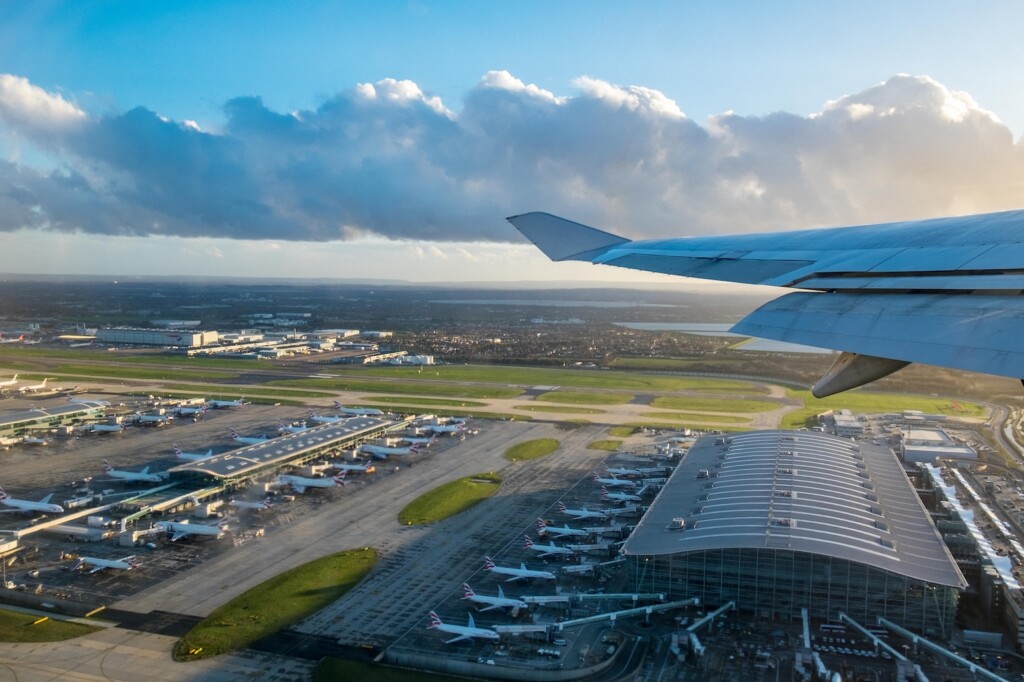
The UK government has slashed its hopes for electric planes and “sustainable aviation fuels” (SAFs), ahead of giving the green light to a third runway at Heathrow.
An “ambitious” rollout of new technologies and efficiency upgrades will only cut flight emissions by a quarter over the next two decades, according to forecasts quietly released in June.
This would leave aviation emissions in 2050 nearly 50% higher than expected under the “jet-zero” strategy, launched by the previous Conservative government in 2022.
The Labour government has signalled its support for a contentious third runway at Heathrow airport, with a final planning decision expected by 2029.
Ministers have justified this expansion by citing the rollout of clean-aviation technologies.
Yet, the updated forecasts suggest that rising flight numbers and a reduced role for “techno-fixes” will leave aviation emissions stubbornly high in 2050 – the UK’s legal target for net-zero.
If this is to be compatible with UK climate goals, then these higher emissions from flights in 2050 would need to be taken out of the atmosphere using costly and largely unproven “carbon dioxide removal” technologies – or by planting gigantic new forests.
Emissions up
The previous government’s “jet-zero” strategy committed the UK to a “high ambition” pathway that would have seen aviation emissions peak at 38.2m tonnes of carbon dioxide equivalent (MtCO2e) in 2019 and drop to 19.3MtCO2e in 2050.
At the time, the Conservative government said this “clear goal” was achievable, alongside airport expansion and rising flight numbers.
Its strategy relied heavily on the extensive use of early-stage technologies, such as SAFs and battery-powered planes, as well as wider fuel-efficiency improvements.
In public statements, Labour has broadly continued this approach, backing new airport runways while supporting SAFs as a way to curb aviation emissions.
However, the government’s latest forecast, quietly published ahead of the formal approval of a new runway at Heathrow, sets far lower expectations for these technologies.
Its “technology development” pathway, with “ambitious carbon abatement measures”, only sees emissions drop to 28.1MtCO2e in 2050. As the chart below shows, this is around 9MtCO2e higher than the jet-zero strategy’s stated goal – a roughly 50% increase.
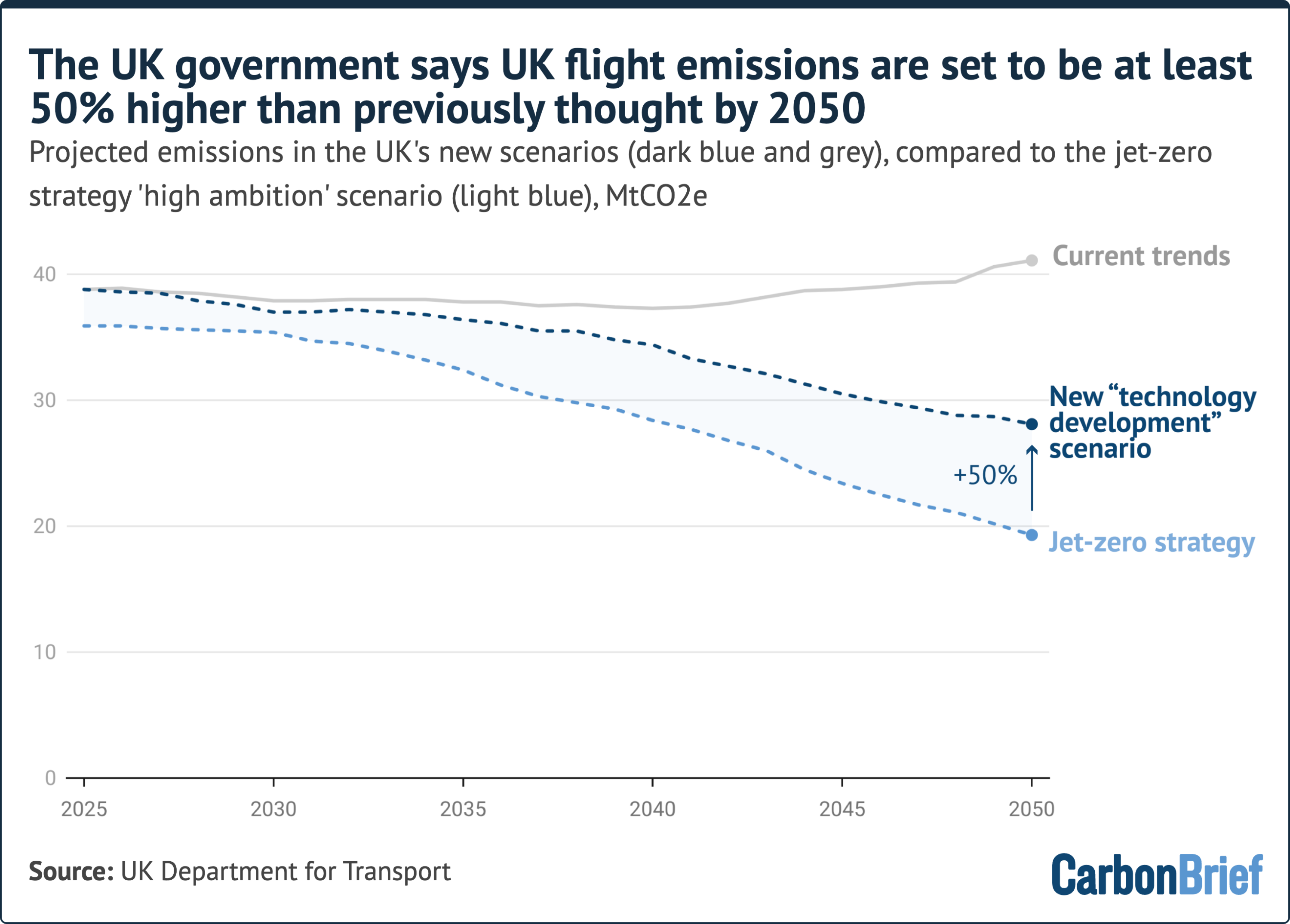
The shift is down to much lower expectations for SAF uptake, fuel-efficiency improvements and the roll-out of battery-powered planes, as well as lower international carbon prices.
The government now expects SAFs to make up 30% of aviation fuel by 2050, rather than 50%. It also concedes that SAFs will save less carbon over their lifecycle than previously thought.
SAFs have faced considerable criticism, due to limited supplies and uncertainty around the extent to which they cut emissions. Even meeting the UK’s relatively modest goal of 22% SAF uptake by 2040 would require enormous – potentially unattainable – volumes of waste products, which are currently the main source of the fuel.
For its new forecasts, the government commissioned a separate analysis of likely aircraft fuel-efficiency improvements over the next few decades. This analysis, from the Aviation Impact Accelerator, yielded “less optimistic” projections than earlier work.
Fuel-efficiency improvements have therefore been revised downward from 2% per year in the “jet-zero” strategy to 1.3% in the new “technology development” scenario.
There is also a reduced role for battery-powered planes, with only some of the smallest zero-emissions aircraft expected to be in use by 2035.
Crucially, even making the more limited emissions cuts in the new “technology development” pathway would require greater efforts to decarbonise the aviation sector.
If the UK fails to implement new policies or innovations, while flight numbers continue to rise, then aviation emissions would be even higher in 2050 than they are today.
This is illustrated by the pink “current trends” pathway in the chart above, in which emissions increase to 41.1MtCO2e by 2050.
This is roughly double the amount targeted by the jet-zero strategy and recommended by government climate advisors, the Climate Change Committee (CCC).
Budget ‘busting’
The new forecasts all account for the growth of several UK airports, including “planned Heathrow expansion”. Overall, passenger numbers would be at least 50% higher by 2050.
In contrast, the CCC and other experts have advised that the rise in passenger numbers may need to be limited, in order to keep emissions down.
In order to meet the UK’s net-zero target, any aviation emissions that remain in 2050 would need to be offset by planting many thousands of hectares of new forest, or by relying on costly and largely unproven CO2 removal technologies.
Tim Johnson, director at the Aviation Environment Federation (AEF), says the new forecasts present “a more honest and realistic vision of what’s possible in the next 24 years”. However, he tells Carbon Brief:
“Less reliance on cleaner technology and fuels reopens the debate about the role and scale of greenhouse gas removals and ways to tackle the projected 50% growth in demand for air travel.”
AEF calculations, based on government data and shared with Carbon Brief, suggest that emissions from the third runway at Heathrow would initially be relatively modest, reaching 3.5MtCO2e per year in 2050. Its emissions would then be expected to rise significantly beyond the legal 2050 net-zero deadline.
Previously, the Labour government has explicitly cited SAFs and other new technologies as part of its justification for expanding Heathrow airport.
Dr Lois Pennington, a research associate at the University of Manchester who has analysed Heathrow’s emissions impact, says the government’s new forecast shows “we are projected to be well over aviation’s share of the carbon budget even before a third runway is considered”.
She tells Carbon Brief:
“For Heathrow, it means expansion can no longer be waved through on the promise of technology, and any approvals will be in the full knowledge that it will bust our legally binding carbon budgets.”