
DeBriefed 11 September 2026: World’s joint-hottest month | Heat stalls UK surgeries | Indonesia fires

Welcome to Carbon Brief’s DeBriefed.
An essential guide to the week’s key developments relating to climate change.
Sign up below.
This week
Hottest August
JOINT-HOTTEST: August of this year tied with July 2023 as the hottest month ever recorded globally, reported BBC News. It said that the record, announced by the EU’s Copernicus climate-change service, was driven by a combination of climate change and the “rising influence” of El Niño. It continued that temperatures for the month were 1.65C above pre-industrial levels.
OCEAN HEAT: The update from Copernicus also revealed that average global sea temperature reached 21.07C in August, reported the Financial Times. The newspaper added that provisional data from the US National Oceanic and Atmospheric Administration showed that this week marked 100 consecutive days of record ocean warming since early June.
Around the world
- FLOOD BILL: Nepal’s disaster management chief told Reuters the country will ask wealthier countries and global agencies to contribute $5bn to rebuilding the country in the wake of the deadly floods. Nepal will position the sum as a “climate-justice issue”, according to the newswire.
- WIN-WIN: A UN Environment Programme report – covered by the Financial Times – found that tackling air pollution and climate change together would boost global GDP by 2.8% by 2035.
- RIFT: Climate Home News reported on splits within Climate Action Network International – which it dubs the “world’s most influential coalition of climate NGOs” – over how to respond to attacks on climate science at international UN and Intergovernmental Panel on Climate Change (IPCC) talks.
- OIL DOWN: Reuters covered data from China’s state oil-and-gas company Sinopec that revealed the nation’s oil demand fell 8.9% in 2026.
- COAL UP: The International Energy Agency forecast that global coal demand would rise by 1.2% this year due to the Iran crisis, according to Reuters.
1,000
The number of hospital operations across England and Wales cancelled due to heat during the UK’s May and June heatwaves, according to a new Carbon Brief analysis based on freedom of information requests to 140 NHS trusts.
Latest climate research
- More than a quarter of emergency department visits for heat-related illness between April and October in the US over 2018-25 can be attributed to climate change | Climatic Change
- Large-scale wetland restoration would increase methane emissions – but would also increase soil-carbon storage and prevent emissions from drained soils, leading to an overall reduction in global greenhouse gas emissions | Earth’s Future
- “Warming-induced” emissions of greenhouse gases from natural sources – including permafrost, wetlands and wildfires – could amplify global temperature rise by 20-30% | Environmental Research Letters
(For more, see Carbon Brief’s in-depth daily summaries of the top climate news stories on Monday, Tuesday, Wednesday, Thursday and Friday.)
Captured
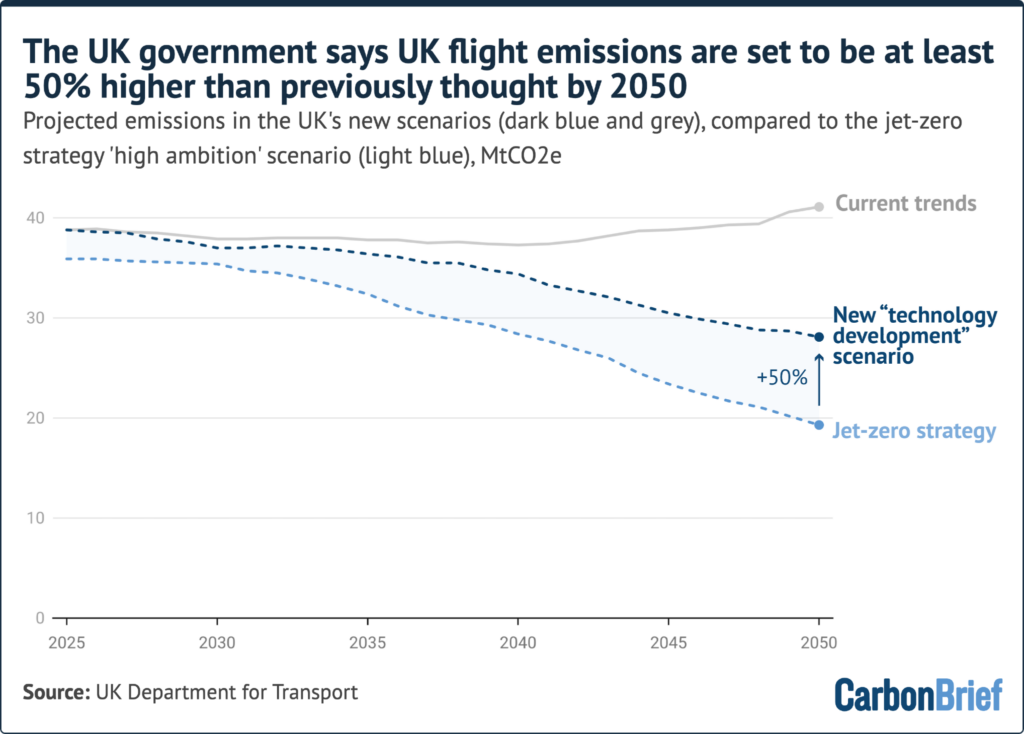
A new Carbon Brief analysis explored how the UK government has quietly revised its plans for decarbonising aviation. An “ambitious” rollout of new technologies and efficiency upgrades will only cut flight emissions by a quarter over the next two decades, according to forecasts released in June. This would leave UK aviation emissions in 2050 nearly 50% higher than expected under the previous Conservative government’s “jet-zero” strategy.
Spotlight
El Niño-fuelled fires in Indonesia
Carbon Brief speaks to peatland and fire experts about the drivers and emissions of the ongoing wildfires in Indonesia.
Wildfires currently burning large swathes of land in Indonesia are on track to produce emissions on a par with the country’s most-intense fire season this century, according to experts.
Data from the Global Fire Emissions Database reveals that, as of 7 September, fires in Indonesia had produced 76m tonnes of carbon (MtC) in 2026.
This puts 2026 on the same trajectory as 2015, when fires burned 2.6m hectares of land across the country and generated a total of 333MtC.
Dr Guido van der Werf, a researcher at Wageningen University in the Netherlands, told Carbon Brief that the fires in Indonesia are “more or less on track” to reach levels seen 11 years ago.
Parts of the country – including the eastern province of Papua – are “burning more than they’ve ever burned”, he said.

Indonesia is no stranger to emissions-intensive fires. Research has estimated that the record 1997 fire season generated carbon emissions equivalent to 13-40% of all global fossil-fuel emissions that year.
Meanwhile, a separate study that looked at carbon dioxide (CO2) emissions from the 2015 fires in south-east Asia – which primarily burned Indonesia – found they were greater than the total of the EU’s fossil-fuel emissions that year. The “severe haze” from the fires has been linked to more than 100,000 premature deaths across the region.
El Niño influence
As in 2015 and in 1997, this year’s Indonesian fires come during an El Niño year.
The naturally occurring climate phenomenon, linked to ocean temperatures in the Pacific, periodically drives up temperatures and dries out land in Indonesia – creating the conditions for fires so immense that they imprint on global emissions.
Scientists are projecting that this year’s El Niño – which started in June and is expected to last into 2027 – will be one of the most intense on record.
Dr Nisa Novita, strategic lead for peatland at Indonesia environmental NGO Yayasan Konservasi Alam Nusantara, told Carbon Brief that El Niño “does not directly cause most fires”, but acts as a “major amplifier by creating hotter and drier conditions, making fires easier to ignite, spread faster and much harder to control”.
Studies have shown that fires in Indonesia often occur where there has been significant land clearance and peatland drainage for agriculture and palm-oil plantations. These practices create a dry landscape that is highly flammable during times of drought.
Van der Werf said the scale of this year’s fires – and whether they will end up being more intense than 2015 – will depend on the length of this year’s El Niño event, as well as the effectiveness of recent peatland conservation efforts.
Novita explained that Indonesia’s fires are heavily emissions-intensive due to its large tropical peatland ecosystem:
“When peatlands are degraded and drained due to canal development for agriculture, the water table drops, making the peat dry and highly flammable especially during dry seasons or El Niño events, like now.
“Unlike fires in dry ecosystems, peat fires can smolder underground, so the soil itself becomes readily available fuel.”
Extensive peatland restoration efforts in Indonesia in recent years have been credited with reducing the number of fires during the 2019 El Niño.
An extended version of this article is on Carbon Brief’s website.
Watch, read, listen
‘MAKE THE FUND WORK’: Drilled interviewed Nepalese climate negotiator Raju Pandit Chhetri about the country’s demands for loss-and-damage financing and climate justice.
‘WRECKED PROGRESS’: Climate Home News unpacked Palestine’s latest climate plan, which sets out how Israel’s bombing of Gaza has left millions more vulnerable to heatwaves, drought and disease.
‘POINTLESS OBSTRUCTION’: In the Financial Times, associate editor and columnist Pilita Clark argued a failure by countries to agree on the timeline of the upcoming IPCC reports would be a “historic climate rupture”.
Coming up
- 13 September: Parliamentary elections, Sweden
- 15-16 September: 71st session of the IPCC bureau, Geneva
Pick of the jobs
- Oxfam, advocacy and campaigns officer – climate justice | Salary: ₱56,093-₱61,702. Location: Manila, Philippines
- Devex, development finance correspondent | Salary: Unknown. Location: Europe, North Africa or Middle East (Remote)
- Climate Analytics, science synthesis and capacity building | Salary: €311-€343 daily. Location: Port of Spain, Trinidad and Tobago
DeBriefed is edited by Daisy Dunne. Please send any tips or feedback to [email protected].
This is an online version of Carbon Brief’s weekly DeBriefed email newsletter. Subscribe for free here.