
Cited 15 September 2026: Temperature ‘overshoot’ | World’s warmest month | ‘Catastrophic’ 1877-78 El Niño

This is an online version of Carbon Brief’s fortnightly email newsletter, Cited, an essential guide to new climate research.
Sign up below.
In the news
OVERSHOOT OUTLOOK: A report from the UN Environment Programme (UNEP) warned that global warming is certain to breach the Paris 1.5C limit and stressed the importance of limiting “overshoot” and eventually bringing global temperatures back down, reported the New York Times. The report stated that “even temporary exceedance of 1.5C will leave irreversible losses”, noted Euractiv. The outlet quoted UNEP director Inger Andersen, who reiterated that the 1.5C limit “is still the goal…but now, we need to approach it differently – from above”. Andersen said the path outlined in the report implied “rapid and deep cuts” to emissions and pursuing “net-negative emissions”, the outlet added.
REPORT ROW: There is “growing unease” with how Climate Action Network-International (CAN-International), the world’s “most influential” coalition of climate NGOs, is navigating a rift between governments involving the Intergovernmental Panel of Climate Change (IPCC), reported Climate Home News. Some climate activists are “increasingly disappointed by CAN’s silence” in a standoff over whether the IPCC’s forthcoming assessment report should be finished in time to inform the next UN global stocktake, the outlet said. The pushback has come from China, Kenya, India, Russia and Saudi Arabia, it added. The “unprecedented stand-off” will come to a head at an IPCC meeting in Addis Ababa in October, wrote Financial Times business columnist Pilita Clark.
ASSESSMENT AMENDMENT: The Trump administration is seeking to revise the fifth US national climate assessment, published in 2023, to “recast worst-case climate scenarios as implausible”, reported the Los Angeles Times. In a notice of a “proposed amendment”, the US Global Change Research Program said it “would clarify the interpretation and federal use” of scenarios of very high emissions, such as RCP8.5. The authors of the report were not consulted, noted the newspaper. Writing on the Climate Brink substack, climate scientist Prof Andrew Dessler outlined why removing RCP8.5 from the assessment “would be a serious mistake”. In other news, the next US “Arctic report card” will go ahead with support from the American Geophysical Union following the loss of government funding.
Research picks
Extreme heat
- In southern Europe, heat-related mortality events of the scale seen in 2022 are, on average, 26 times more likely than in a pre-industrial climate | Nature Health
- More than one-quarter of emergency department visits for heat-related illness between April and October in the US over 2018-25 are attributable to climate change | Climatic Change
- Hot summers with individual heatwaves in late summer and early autumn “might pose the largest risk” for permafrost warming and thawing in the Swiss Alps | Environmental Research: Climate
Africa
- Rainfall variability can “reduce average economic wellbeing and worsen inequality” among livestock herders in southern Africa’s rangelands | Nature Sustainability
- A review of climate attribution studies in east Africa over 2013-24 found that “more than half…detect a clear anthropogenic [human-caused] influence” | WIREs Climate Change
- Projections of both climate-driven increases and decreases in reservoir inflow at basins across Africa highlight “heightened vulnerability, as well as contrasting opportunities” for hydropower | PLOS Climate
Food production
- The yield increases from irrigation in US farming result in “emissions benefits” of avoided land-use change, outweighing on-farm irrigation emissions by a factor of 363 | Proceedings of the National Academy of Sciences
- A “systematic review” of climate impacts on inland aquaculture identified 53 potential adaptation options, but “uptake is limited by persistent barriers” | Nature Food
- Extreme rainfall may represent an “underappreciated risk” for cocoa production across the tropics as the climate warms | Proceedings of the National Academy of Sciences
Please send upcoming climate research and preprints to [email protected]
Captured
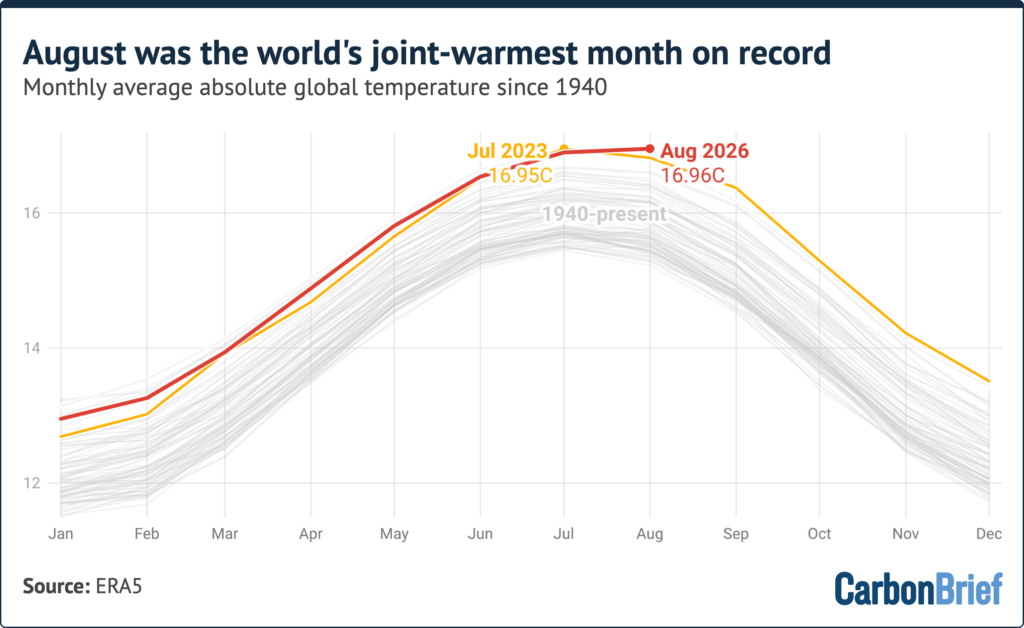
August 2026 was the joint-warmest month ever recorded globally in the ERA5 reanalysis dataset, according to the EU’s Copernicus Climate Change Service. With a recorded average temperature of 16.96C – or 1.65C above pre-industrial levels – the month was in a statistical tie with July 2023, it noted. In its coverage, BBC News said that the record “was driven by a combination of climate change and the rising influence of El Niño, pushing heat into the atmosphere across the Pacific”.
54%
The percentage of UK adults who say they trust climate scientists, from a YouGov survey of more than 4,000 people for the Policy Institute at King’s College London and Sense about Science. This is lower than the 63% score for scientists in general. Climate scientists also “draw the most active suspicion”, the report says, with 30% of respondents saying they’re suspicious or cynical about climate scientists, including 12% who “strongly feel this way”.
Spotlight
The ‘most catastrophic’ climate event on record
In 1877-78, a severe El Niño event contributed to a devastating famine, killing tens of millions of people. As the world faces an El Niño event that is expected to be the strongest on record, Carbon Brief’s Ayesha Tandon unpacks the similarities and differences between the two events.
The El Niño of 1877-78 holds the record for the “most catastrophic climate event globally, from a mortality perspective”, Dr Samantha Burgess, deputy director of the EU’s Copernicus Climate Change Service, told Carbon Brief.
The event was a key driver of a string of back-to-back droughts over 1875-78, which caused widespread crop failures across Asia, Africa and Brazil, resulting in a devastating famine that killed more than 50 million people.
El Niño is the warm phase of a recurring climate pattern in the tropical Pacific, which temporarily raises global temperatures. Among its many impacts across the world, it typically brings very wet conditions to the west coast of South America and leaves south-east Asia unusually dry.
Scientists typically quantify the strength of the event using the “Niño3.4 anomaly”, which measures how much sea surface temperatures in a rectangular section of the central Pacific are warmer than average.
Estimates suggest that the 1877-78 event had an Nino3.4 anomaly of 2.73C, making it the strongest event on record at the time. Since then, only the El Niño of 2015-16 has recorded a similar strength.
However, a so-called “super El Niño” is currently brewing in the Pacific. Forecasts suggest that the Nino3.4 anomaly could exceed 2.9C this year, marking the strongest event ever recorded. Scientists have projected that it could push global temperatures to a new record high.
Burgess said that this year’s El Niño will not drive a famine comparable with that of 1877-78 because there is “more resilience built into the [global] system”. For example, she said that global food systems are more “globally connected”, meaning that countries facing food insecurity can receive supplies from other parts of the world.
She also noted the damages in 1877-78 were exacerbated by geopolitics, with colonial powers at the time doing little to alleviate famine in poorer countries.
However, Burgess warned that “there are still going to be impacts across the tropics and across some of the least-developed countries” from the current El Niño event. It is important, she said, to “make sure that everyone has enough food, rather than just shunting it all to the [global] north and west”.
Advances in ocean monitoring
Sea surface temperature observations in the 1870s were “very limited”, according to Burgess. As a result, scientists often turn to the global temperature record to study the 1877-78 El Niño event.
(Although some ships collected Pacific temperature data over 1877-78, much of this information has not been digitised and is “still on paper in various libraries and archives around the world”, Burgess said. These observations, she continued, could help scientists to understand more about how the event unfolded.)
Burgess said scientists today have a “much better forecasting ability” for ocean temperatures and are able to monitor sea surface temperatures in the Pacific Ocean using ships, buoys and satellites.
She continued that “being able to predict and forecast and unpack the implications [of this year’s El Niño] will be helpful to make sure we don’t have [1877-78’s] devastating consequences”.
However, Burgess cautioned that the systems that scientists use to monitor the world’s oceans are often “an afterthought of investment, rather than a priority to benefit humanity”, noting that some funders are withdrawing money from ocean observations.
She stressed the importance of ongoing efforts to maintain and improve monitoring and forecasting systems, noting that weather predictions and forecasts can help experts “mitigate the damage [of El Niño] as much as possible”.
Preprints to watch
Carbon Brief’s pick of new papers under review
- Climate change is “likely to decrease” the suitable habitat for red pandas in eastern Nepal | Journal of Regional Environmental Change
- The long-established practise of using “design floods” in hazard assessments is “both fragile and ambiguous” | npj Natural Hazards
- Researchers have developed a new long-term wintertime snow-depth dataset on Arctic sea ice for 1978-2025 | Earth System Science Data
Noticeboard
- 15-16 September: 71st session of the IPCC bureau, Geneva
- 20-27 September: Climate Week NYC, New York City
- 24 September: Postdoc position on forest floor modelling at the University of Freiburg | Salary: €66,000+. Location: Freiburg, Germany
- 25 September: Registration closes for review experts for working group one of the IPCC’s seventh assessment cycle
- 28 September: Research software engineer – AI twins for climate at CSC’s digital twin technologies group | Salary: Unknown. Location: Espoo, Finland (hybrid)
- 30 September: PhD research fellow in climate data analysis and machine learning emulation of hydrological models at the University of Bergen | Salary: NOK 593,700. Location: Bergen, Norway
- 1 October: Postdoctoral fellow in marine cloud brightening at Stockholm University | Salary: Unknown. Location: Stockholm, Sweden
- 4 October: Carbon project officer at the Woodland Trust | Salary: £30,824. Location: Grantham, UK (hybrid)
This edition of Cited was written by Robert McSweeney and Ayesha Tandon. It was edited by Cecilia Keating. Please send tips, feedback and upcoming climate research to [email protected].