
Cited 18 August 2026: Arctic report card axed | Heat records broken | Drought and yellow fever

This is an online version of Carbon Brief’s fortnightly email newsletter, Cited, an essential guide to new climate research.
Sign up below.
In the news
ARCTIC REPORT AXED: The Trump administration pulled funding for a report that has tracked changes to the Arctic every year for two decades, reported the Guardian. The peer-reviewed report, published by the National Oceanographic and Atmospheric Administration (NOAA), has documented “crucial changes across the Arctic’s atmosphere, oceans, cryosphere and tundra”, the newspaper said. The New York Times added that NOAA’s communications director did not provide a reason for withdrawing funding, but clarified that “all data historically contributed by NOAA to the product will continue to be collected and will remain publicly available”.
JUDGES MANUAL: The New York Times reported that the National Academies of Sciences, Engineering and Medicine removed a chapter on climate science from a reference manual for US judges. According to the newspaper, the manual “is intended to help judges understand science and technology that might come up in cases”. It continued that the “now-deleted chapter was the manual’s first foray into climate science”. The move, it explained, followed “an outcry from critics on the right, including president Trump”.
RECORDS BROKEN: Europe continued to experience extreme weather, including heat alerts across Spain, wildfires in Belgium and record-low river levels in the Rhine and Danube. BBC News reported that the world’s oceans hit their hottest-ever temperatures for July. Nature reported that, according to a rapid attribution tool by Climate Central, climate change “made the high temperatures in many parts of the ocean dozens of times more likely”. Separately, the Guardian reported that July was the warmest month ever recorded in the US. It said that scientists had “made clear” that the heat was “being amplified by the human-caused climate crisis”.
Research picks
Oceans
- The Atlantic Meridional Overturning Circulation will remain stable under up to 5.5C of warming if atmospheric CO2 levels increase slowly, but will collapse at “substantially lower” warming levels if CO2 increases quickly | Nature Climate Change
- Co-occurring marine heatwaves and ocean acidification extremes are happening “more frequently than would be expected by chance”, particularly in low- to mid-latitudes | AGU Advances
- The Arctic Ocean experiences not only the “greatest acidification” as atmospheric CO2 rises, but also the “most delayed benefits” from negative emissions, compared other oceans | Nature Climate Change
Snow and ice
- Since the 1850s, “snow-eater heatwaves” in the western US have increased in area and frequency, while their duration has shortened and their timing has shifted to earlier in the season | Science Advances
- The historical climate information stored in glacier ice is being lost as the ice melts, with glaciers in Europe and Africa facing the largest archive losses and Asian glaciers facing more moderate losses | Communications Earth & Environment
- The Antarctic peninsula may face more “glacier surges” as the planet warms | The Cryosphere
Forests
- Analysis of 3,500 forest fires in Canada and the western US reveals that the fastest fires burn “outsized” areas and lead to reduced capacity for ecosystem recovery | Science Advances
- Since 2018, aboveground biomass loss in Europe has accelerated by 46% amid an increase in “natural disturbance activity” in temperate forests | Nature Geoscience
- The impact of climatic variables – including temperature, rainfall and storms – on tropical-forest biomass depends on where the forest is located | Nature
Captured
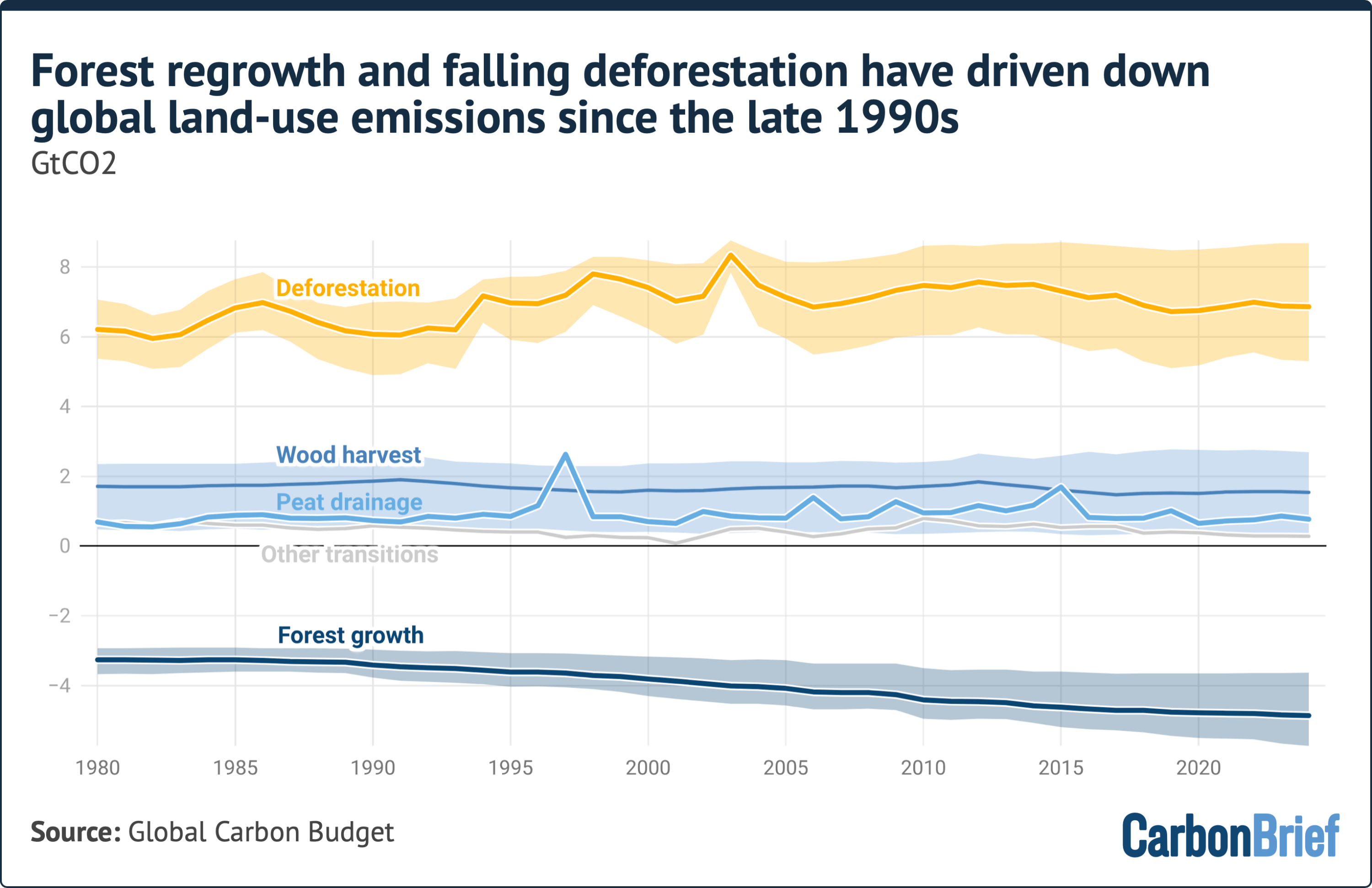
Forest regrowth, combined with falling deforestation, have helped drive down global land-use emissions by around a third this century, according to an analysis published by Carbon Brief. The article – illustrated by six charts – looked at the countries and drivers behind the falling land-use emissions in the 21st century.
200 hours
The increase in global hourly heat extremes per summer for every extra 0.5C warming, according to research published in Nature Climate Change.
Spotlight
Drought linked to ‘unprecedented’ yellow fever outbreak
New research published in Science Advances finds that an “unprecedented” 2017-18 outbreak of yellow fever in Brazil was driven, in part, by a “once-in-a-century” drought.
Carbon Brief speaks to Dr Jamie Caldwell, associate research scholar at Princeton University and lead author of the study, about the findings.
Carbon Brief: How is yellow fever virus transmitted?
Dr Jamie Caldwell: Yellow fever is transmitted by mosquitoes. So, mosquitoes have to bite an infected host, which could be a non-human primate [such as a marmoset or howler monkey] or a human. And when that infectious mosquito bites its next host, it can transmit the virus. So [the virus] is sort of a hitchhiker.
CB: What were the main findings of your study?
JC: We looked at a once-in-a-century yellow fever outbreak that happened in an urban area of Brazil [Minas Gerais]. It was really surprising that it also coincided with the once-in-a-century drought, so our question was: “Is there any relationship between the two?”
We hypothesised that the drought caused forest mosquitoes and non-human primates to move towards the cities in search of water. We also hypothesised that mosquitoes would be biting more frequently to avoid dehydration.
[Our modelling study] gave us pretty compelling evidence that the drought was driving how the outbreak unfolded.
Of course, there are a lot of other reasons why the outbreak happened. There was land-use change, climate change and vaccination rates, for example. All of those factors had to coincide – not just drought.
CB: Your study describes these findings as “counterintuitive”. Why is this?
JC: In the vector-borne disease world, everybody studies the effects of rainfall and temperature on mosquitoes. Rainfall is very obvious, because mosquitoes need fresh water to breed and to complete most of their life cycle. So, because of that, it’s very intuitive that when you have more precipitation, you’d have more mosquitoes and more mosquito-borne diseases.
Now, when you work in the field in certain places, anecdotally, there’s a relationship between drought and mosquito-borne disease, but there’s not much quantitative evidence. Drought doesn’t have that nice timeline, because drought can build up over months or years when all these other factors are changing. So, to tie those two together is really hard.
CB: What does this mean for people living in a warming climate?
JC: Conditions that we currently consider to be a “once-in-a-century drought” are expected to occur more frequently over the next 80 years. If forest species do not adapt by finding alternative water sources, this could lead to more frequent interactions between these species and humans in cities located close to dense forests.
CB: What should policymakers and healthcare workers take away from this study?
JC: From my standpoint, it makes me really optimistic. Because usually, when you have really heavy rainfall or flooding, you don’t have much lead time and it’s really hard to predict in advance. But drought, because it builds so slowly, actually gives public health officials and policymakers a lot of time to think about some sort of intervention [such as a vaccination programme]. And meteorologists are already monitoring drought.
Preprints to watch
Carbon Brief’s pick of new papers under review
- Arctic maritime operations have more than doubled over 2015-21 as a result of melting ice in the region | Nature portfolio
- The Earth system’s “resistance” to CO2 emissions can be used as a metric to assess climate and carbon feedbacks | Geophysical Research Letters
- By 2100, economic damage to property in western North America due to flooding will be twice as high under a high-emissions scenario than one with rapid emissions cuts and negative emissions | Earth’s Future
Noticeboard
- 3 September: Application deadline for postdoc in air-sea-ice interactions at Uppsala University | Salary: Unknown. Location: Uppsala, Sweden
- 9 September: Application deadline for a researcher on global modelling of nature restoration at the PBL Netherlands Environmental Assessment Agency | Salary: €3,496-6,275 monthly. Location: The Hague, Netherlands
- 9 September: Application deadline for coordinator of the Oxford Climate Research Network (part time) | Salary: £35,681-38,366 (pro rata). Location: Oxford, UK
- 11 September: Conference registration opens for the Overshoot Conference, Bangkok, Thailand
- 13 September: Application deadline for senior scientist in land-atmosphere composition interactions at the European Centre for Medium-Range Weather Forecasts | Salary: £94,251 or €113,224. Location: Reading, UK or Bonn, Germany
- 17-18 September: Cambridge Conference on Catastrophic Risk, Cambridge, UK
- 25 September: Registration closes for review experts for working group one of the IPCC’s seventh assessment cycle
This edition of Cited was written by Ayesha Tandon and edited by Cecilia Keating. Please send tips, feedback and upcoming climate research to [email protected].