
China Briefing 17 September 2026: EV five-year plan | BRICS summit | Clean-energy investment drop
Welcome to Carbon Brief’s China Briefing.
China Briefing handpicks and explains the most important climate and energy stories from China over the past fortnight. Subscribe for free here.
Snapshot
- EV five-year plan published.
- Xi said the global south “must improve global climate governance”.
- Carbon-market allocation plan issued.
- Carbon Brief examines why cleantech investment has fallen.
- New science on link between temperature and crime, and aircraft payload.
Key developments
Xi’s speech at BRICS
SUMMIT STATEMENT: Chinese president Xi Jinping said at the BRICS summit in Delhi that global south countries “must improve global climate governance” and promote “full and effective implementation of the Paris Agreement”, said state news agency Xinhua. [BRICS is a grouping of countries including Brazil, Russia, India, China and South Africa.] According to the transcript, Xi also proposed greater cooperation on five areas, including “trade and investment”. The joint statement published at the summit recognises the “need to promote just, orderly, equitable and inclusive energy transitions and reduce [greenhouse gas] emissions in line with our climate goals”. But it also notes that “fossil fuels will still play an important role in the world’s energy mix”.
OTHER MEETINGS: Meanwhile, a meeting of APEC energy ministers – representing 21 economies across the Asia-Pacific – in Beijing resulted in a joint statement saying “[both] conventional and zero- and low-emission energy sources” provide “energy security” and “strong and sustainable economic growth”. It added that “each economy will choose an energy system mix consistent with its domestic priorities”. Separately, Chinese environment minister Huang Runqiu said at the Kunming dialogue, which discusses progress on the Kunming-Montreal global biodiversity framework, that countries must “strengthen resolve for action” on biodiversity, reported Earth Negotiations Bulletin.
EV five-year plan
SALES TARGET: China aims for “70% of new cars” to be electric vehicles [EV], plug-in hybrids or hydrogen fuel-cell vehicles by 2030, according to a new five-year plan for smart new-energy vehicles (NEVs), reported Bloomberg. It added that the plan also calls for “40% of new commercial vehicles sales” to be NEVs. A representative of Sinopec Economics and Development Research Institute, a thinktank attached to one of China’s largest oil companies, told Reuters that NEVs could comprise 75-80% of new domestic car sales by 2030, up from 65% currently. [See Captured below.]
MARKET ‘LEAD’: “Policy targets for NEV market share have lagged market developments for several years,” Anders Hove, senior research fellow at the Oxford Institute for Energy Studies, told Carbon Brief. He added that this was a signal of the government’s “desire to allow the market to take the lead” in determining the future trajectory of the industry. The plan also included calls to “curb overinvestment” and encourage “industry consolidation”.
COST CLAMPDOWN: Meanwhile, the government also issued a notice on “low-price disorderly competition” that includes pledges to scrutinise reported costs in sectors such as EVs, said the Hong Kong-based South China Morning Post. Carmakers are also being encouraged to “pay suppliers faster”, as part of ongoing efforts to combat the “price war” in the industry, said Bloomberg. Approvals for planned new battery manufacturing capacity have also been “suspended”, reported Cailianshe.
More sectoral plans
CLEANTECH MANUFACTURING: A new five-year plan covering advanced electronics manufacturing called for consolidating China’s lead in batteries and solar, reported BJX News. The power-news outlet added that the plan also called for developing “next-generation” technologies, such as space-based solar and solid-state batteries.
EMISSIONS ACCOUNTING: A five-year plan on statistics reform and development was also released, reported financial newspaper Securities Times. It said the plan set goals including: improving carbon-emissions accounting; energy and emissions reporting; and links between energy and emissions data.
OTHER PLANS: State broadcaster CCTV News said that an information and communications sector five-year plan set out several targets for the industry’s “green development”. A five-year plan for culture and tourism development also called for “greening” the sector, said state news agency Xinhua. A five-year “implementation plan” for coordinating the “digital and green transition” encouraged computing facilities to meet provincial renewable-energy consumption quotas by 2030, reported BJX News.
More China news
- CARBON ALLOWANCES: China has issued new carbon-market allocation plans for the power sector for 2025 and 2026, as well as for steel, cement and aluminium in 2026, according to the People’s Daily.
- POWER ‘PUSHBACK’: ClearBlue Markets’ principal analyst Qin Yan wrote on Bluesky that the carbon-market plans only tightened coal-power benchmarks by 0.1%, following “pushback from the power industry”.
- FLOODED CITY: Torrential rain from Typhoon Saudel flooded Putian city in Fujian province, breaking daily precipitation records, reported state broadcaster CGTN.
- DISRUPTIVE RAINS: Over 42,000 people were evacuated as heavy rains in south China’s Hainan province triggered flooding, said state-run newspaper China Daily. In Jiangxi province, the death toll from rain-fuelled mud- and landslides has risen to 16, said the Associated Press, citing state media.
- EXPORT SURGE: China’s electric-vehicle (EV) exports jumped 155% year-on-year, while domestic sales shrunk by 10%, according to Reuters.
- ‘DANGEROUS DEPENDENCIES’: European Commission president Ursula von der Leyen said in her state of the union address that the EU has “dangerous dependencies” on China for materials such as critical minerals. She added that the EU must “double down on our affordable, homegrown, clean energy”.
Captured
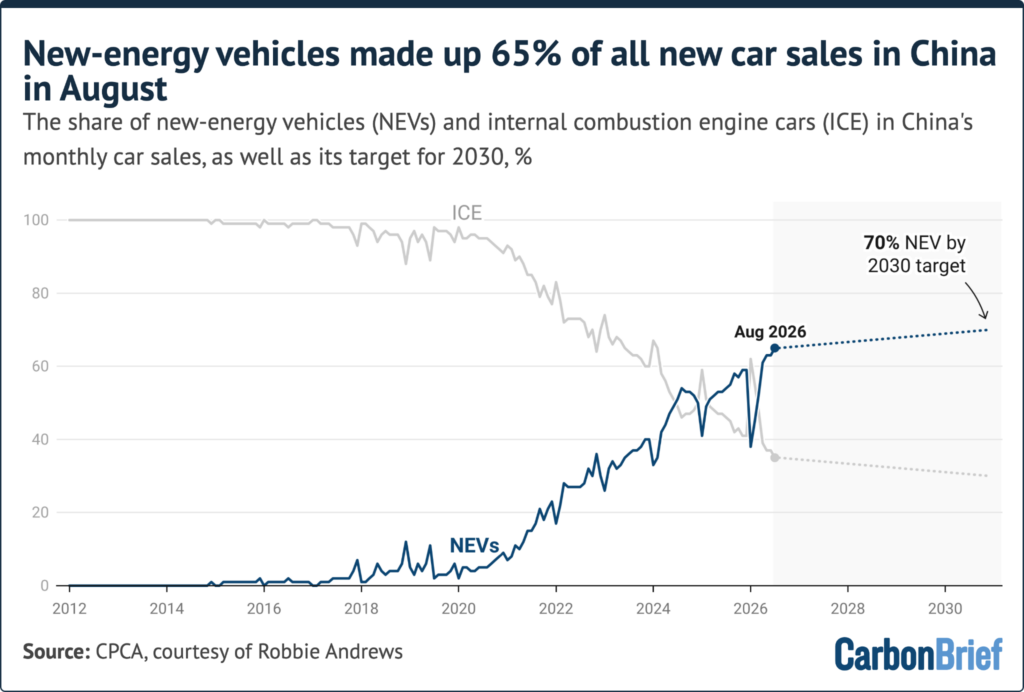
Sales of new-energy vehicles (battery EVs and plug-in hybrid EVs) accounted for 65% of the total vehicle sales in China in August 2026, according to data from the China Passenger Car Association, courtesy of Robbie Andrew.
Spotlight
Why China’s clean-energy investment is falling
In this issue, Carbon Brief looks at Rhodium Group findings that China’s investment in clean energy fell in the first half of 2026, driven by changes in the domestic policy landscape.
China invested $294bn in clean energy in the first half of 2026, a 36% decrease year-on-year, according to research firm the Rhodium Group.
Its figures include the manufacturing and deployment of clean-energy technologies, as well as decarbonisation of industry.
Investment fell 49% to $141bn in the first three months of the year, compared to the last quarter of 2025. It then rose slightly to $153bn in the second quarter.
As a result, Rhodium found that China’s share of global cleantech investment also fell from 52% in the fourth quarter of 2025 to 39% in the second quarter this year.
Nevertheless, the country remained the world’s largest investor in the energy transition by far in the first half of the year. It outspent the next-largest investor – the EU – by $100bn.
China’s investment decline comes after several years of expansion. Its investment in clean energy rose from $185bn in 2019 to $725bn in 2023, $844bn in 2024 and $906bn in 2025, according to Rhodium figures.
Sectoral shifts
By sector, investment in electric vehicles (EVs) fell to $136bn in the first half of 2026, roughly 26% below the same period in 2025, according to the data.
This was caused by a decline in purchases of electric cars and vans – so-called light-duty EVs – which make up the vast majority of all EV sales.
By contrast, purchases of medium- and heavy-duty EVs, such as buses and trucks, “moved in the opposite direction”, said the report, rising 64% from the first half of 2025.
Alfredo Rivera, associate director at the Rhodium Group and one of the authors of the report, told Carbon Brief that the divergence reflected “different stages of market development and different demand drivers”.
He explained that the economics of medium- and heavy-duty EVs have been improved by falling battery costs, expanding charging and battery-swapping networks, as well as government support for replacing older commercial vehicles.
Meanwhile, in the clean-electricity generation and storage sector, investment dropped by 43% to $134bn in the first half of 2026.
Solar remained the largest segment, but saw investment fall 66% year-on-year to $54bn, while wind fell 26% to $31bn.
Investment in the manufacturing of clean-energy technologies and the decarbonisation of industry also decreased by 41% year-on-year to $24bn in the first half of 2026, continuing a decline from a 2023 peak.
Policy drivers
Rhodium linked the decline in investment – particularly the 49% drop in the first quarter – to the timing of changes in domestic policy.
For example, a 2025 policy on shifting China’s power markets towards market-based pricing drove a rush of solar installation in the second quarter of last year.
This pushed forward the completion of solar projects that could otherwise have come online in 2026, making this year’s additions look small by comparison. Nevertheless, installations so far this year remain comparable to 2023 levels.
Similarly, EV purchases increased in the final quarter of 2025 ahead of changes to purchase-tax incentives, which came into force in January. This leads to a decline in investments in EVs – particularly light-duty EVs.
Prof Christoph Nedopil at the University of Queensland, who was not involved in the research, told Carbon Brief that quarterly figures can reflect policy and geopolitical factors that bring investment forward or cause it to be delayed.
However, he noted, they “should not be over-interpreted as long-term trends”. He added: “Looking at the annual trends, the numbers suggest continued strong [cleantech] manufacturing investment growth across China and the world.”
Watch, read, listen
YEAR IN REVIEW: An Ember launch event unpacked the findings from its new report on China’s energy transition progress.
HORMUZ RESPONSE: The Energy Policy Now podcast examined how the Hormuz crisis is testing China’s energy security strategy.
MONEY MATTERS: Bloomberg’s Zero podcast discussed how China became a “green-finance superpower”.
FOSSIL TRANSITION: NGO Germanwatch featured China’s starting points and trends in a paper on transitioning away from fossil fuels through renewables-based electrification.
5 billion
China’s expected coal demand during 2026, in tonnes, according to the latest International Energy Agency forecast. This would be a 1% rise on 2025 levels.
New science
- Temperature anomalies, droughts and extreme heat events are associated with increases in reported crimes in China | Communications Earth & Environment
- Aircraft taking off from humid coastal airports such as Xiamen in China face an increasing “payload penalty” as the world warms | Climatic Change
China Briefing is written by Lekai Liu and Anika Patel. It is edited by Anika Patel and Simon Evans.
Please send tips and feedback to [email protected]