World falling short on 22 of 23 nature targets for 2030, says draft UN report
The global goal to halt and reverse nature loss by 2030 “will not be achieved” unless action by countries “accelerates rapidly”, says a draft UN report.
Countries are falling short on 22 of the 23 targets for 2030 they set under the Kunming-Montreal Global Biodiversity Framework (GBF), the “Paris Agreement for nature”.
That is according to a draft version of a global report prepared by the UN Convention on Biological Diversity (CBD), published on 26 July.
The report will be finalised ahead of the next nature summit, COP17, taking place in Armenia in October of this year.
The second draft of the global report has undergone “peer review”, but will still be subject to “technical edits” before being formally published ahead of COP17.
The final version will inform a global review of countries’ progress towards meeting the world’s 2030 nature goals, which will take place in Armenia.
Below, Carbon Brief explains why the report has been produced and what it says about countries’ progress in areas such as restoring ecosystems and raising funds for biodiversity.
Global report
In Montreal, Canada, in 2022, nearly every country in the world agreed to the GBF. The overall “mission” of the framework is to halt and reverse biodiversity loss by 2030. Its “vision” is to bring the world into “harmony with nature” by 2050.
The GBF includes a list of 23 targets for 2030. They cover an expansive range of topics, from restoring ecosystems, to addressing pollution and providing developing nations with finance to help cover the costs of protecting nature.
As part of the GBF and its underlying documents, countries agreed to a schedule for monitoring their progress towards achieving the 2030 targets.
This included the preparation of a “global report” of progress coordinated by the CBD, which will inform a “global review” undertaken by countries at COP17.
The global report draws on countries’ national reports, which were due to be submitted to the UN in February of this year. It also draws on countries’ national nature plans, known as “national biodiversity strategies and action plans” (NBSAPS) and national targets, which were both due in 2024.
Not all countries have met the call to publish these documents and targets. According to the UN, 45% of countries published NBSAPs in time to be considered for the report, 83% had submitted at least one national target and 66% had produced their new national report.
The first draft of the global report was published on 29 June 2026. This draft was subject to a “peer review process”, which invited countries and observers, such as NGOs and businesses, to submit comments on all aspects of the report.
The second draft, which has been revised based on the peer review, was published on Sunday 26 July. (This was just ahead of COP17 preparatory talks being held in Nairobi from 27 July to 1 August.)
A final version of the global report will be formally published ahead of COP17, which will take place from 19-30 October.
Overall findings
The second draft of the global report says that the GBF has led to “unprecedented” interest in tackling biodiversity loss, but adds:
“However, unless collective implementation accelerates rapidly, the 2030 targets and mission will not be achieved.”
It says that countries have taken some action to address all 23 targets, but that “no target presents a fully positive picture”.
(The first draft has slightly softer language. It “concludes that the world is not yet on track to collectively meet the global ambitions that the parties to the convention set when they adopted the framework”.)
The report identifies “two distinct gaps in progress”, relating to ambition and implementation.
First, that the national targets and plans submitted by countries “do not yet fully reflect the scope and level of ambition” of the global targets in the GBF.
Second, countries are not taking sufficient action to achieve their targets, according to the report.
It adds that progress is “particularly lagging” for addressing the “indirect drivers of biodiversity loss”, such as harmful business practices and government subsidies promoting them.
In addition, countries are showing “consistent gaps” in making progress on taking action to protect “marine, coastal and inland water ecosystems”.
The report produces a “scorecard” assessing countries’ progress towards meeting each of the 23 targets of the GBF.
The scorecard includes an “overall score” of between 0 and 1 for each target. This is calculated by considering countries’ self-reported progress in their plans and targets, as well as an assessment of progress based on a set of agreed indicators.
The results are split into four categories: 0-0.25 is red, 0.25-0.5 is orange, 0.5-0.75 is yellow and 0.75-1 is green.
The report gives a “green” score for just one target, indicating overall positive progress. This is target 8, on “minimising” the impact of climate change on biodiversity, including through mitigation and adaptation.
Elsewhere, the draft says that countries have “reported gaps in the scale and timely provision” of “financial resources, capacity-building and development, technical and scientific cooperation, access to and transfer of technology, and knowledge sharing”. It adds:
“These barriers can result in uneven capacities and cause specific technical and financial constraints for all parties, but particularly for developing-country parties. It is likely these constraints are even more pressing for least developed countries and small island developing states.”
Protecting and restoring nature
Target 3 of the GBF is for countries to protect “30% of Earth’s land and sea for nature” by the end of the decade.
This commitment – referred to as “30 by 30” – is widely considered the flagship target of the agreement.
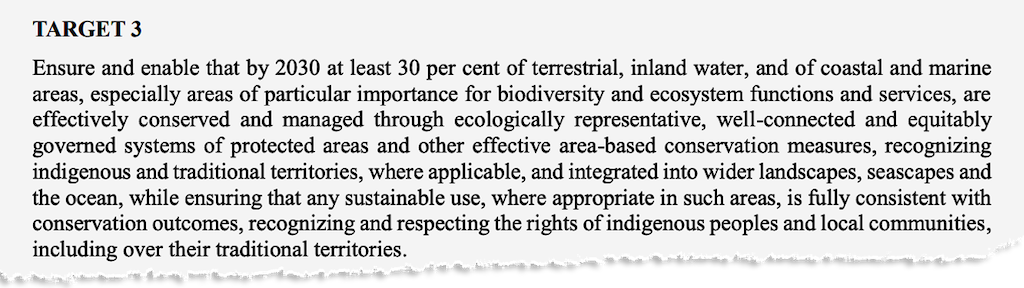
The report says that countries are making “progress in expanding and managing protected areas, especially for marine and coastal areas”. But it adds that “current ambition and implementation remain insufficient to fully achieve all aspects of the target”.
It continues that, according to countries’ available national targets, “monitoring and reporting of some elements of the target remains low”. This includes “those relating to equitable governance of protected areas” and “recognition of Indigenous and local territories”.
The report adds that countries “face significant challenges in implementation, particularly related to lack of finance and capacity”.
(An investigation by Carbon Brief and the Guardian in 2025 revealed that more than half of nations that have submitted UN biodiversity plans do not commit to “30 by 30” within their borders.)
Another conservation measure included in the GBF is target 2, which aims to ensure that at least 30% of land and sea areas are under restoration by 2030.

The report says that “restoration efforts are expanding”. However, it says that “current commitments to restore areas and implementation of those commitments remain below the level required” to achieve target 2.
It adds that countries’ national targets are “generally well aligned with target 2”, but that “addressing the effectiveness of restoration efforts is often absent”.
Moreover, the report adds that monitoring of progress is “constrained by inconsistent definitions and monitoring approaches for ecosystem degradation and restoration”.
Another “major barrier” is a lack of available finance for developing countries looking to restore ecosystems, it says.
Climate and biodiversity links
Target 8 of the GBF is the only one to specifically address climate change, one of the major drivers of biodiversity loss.
It says countries should “minimise the impact of climate change” on biodiversity through mitigation and adaptation, including “nature-based solutions” and “ecosystem-based approaches”.

Target 8 was the only one to achieve a “green” marking in the report’s scorecard of progress (see: Overall findings).
The report says that actions to make biodiversity more resilient against climate change are “progressing”. Yet “implementation remains constrained by data gaps, limited means of implementation and the need for stronger coherence between biodiversity, climate and disaster risk reduction planning”.
It continues that countries’ national targets “generally” show “good alignment” with target 8, across “all elements apart from efforts to minimise the impacts of ocean acidification”.
It adds that the deployment of nature-based solutions and ecosystem restoration is not yet at a “sufficient scale”.
Subsidies
Overall progress is “insufficient” on target 18, which calls on countries to identify subsidies and other incentives that are harmful for biodiversity by 2025, says the GBF report.
It also outlines that nations should “eliminate, phase out or reform” these subsidies in a “proportionate” way, reducing them by at least $500bn per year by 2030.
Countries should first target the “most harmful” incentives, while simultaneously scaling up positive incentives for nature, it adds.

The report finds that countries have made some progress in assessing, compiling inventories and commissioning studies on harmful subsidies.
But issues remain, such as incomplete data and the lack of agreed definitions on which subsidies are deemed “harmful”.
Several national reports also note “entrenched interests and political barriers to subsidy reform”, says the report.
Only one-quarter of countries’ national targets that are “highly aligned” with target 18 are “on track” to be met, it finds. Most show “insufficient progress”.
It notes that 38% of countries have addressed the 2025 aim to identify harmful subsidies in their national targets “to some extent”.
Countries’ national reports do not “provide a sufficient basis to determine” whether this goal was met, says the report, but available evidence “suggests” that it was not.
Recent analysis by Carbon Brief found that just 16% of the 134 national reports submitted so far appear to meet the aim.
The report outlines that half of countries have set national targets addressing plans to eliminate, phase out or reform harmful incentives. Almost 60% mention scaling up positive incentives, it adds.
Just 27%, however, address the issue of reducing subsidies by at least $500bn annually by 2030. Also, only 5% set quantitative national targets to reduce subsidies.
There are two headline “indicators” to measure progress on target 18. The first shows that 30% of countries have outlined information on their nature-positive incentives.
The second indicator shows that 22 countries submitted the value of their biodiversity-harmful subsidies, which amounted to a total of $268bn spent on harmful subsidies over 2022 to 2025 – averaging $67bn each year.
Carbon Brief’s analysis had identified an estimated $270bn each year, based on a wider list of submissions from 32 countries. (More countries submitted national reports since the CBD’s deadline to be included in the global report in February.)
All of these figures remain well below the estimated trillions of US dollars spent annually.
The report notes that different methodologies could lead to global subsidy estimate “inconsistencies”, meaning that reported values are likely “underestimates”.
The amount of positive incentives in place is also likely underestimated, it adds.
The report says that harmful subsidies may have declined by around 20% in recent years, based on figures consistently reported by a minority of countries over 2022-24.
Despite this, the total value of subsidies “remains higher than the resources that parties reported mobilising for biodiversity”. (See: Mobilising finance.)
Mobilising finance
Overall progress on raising biodiversity finance has been “insufficient”, according to the report.
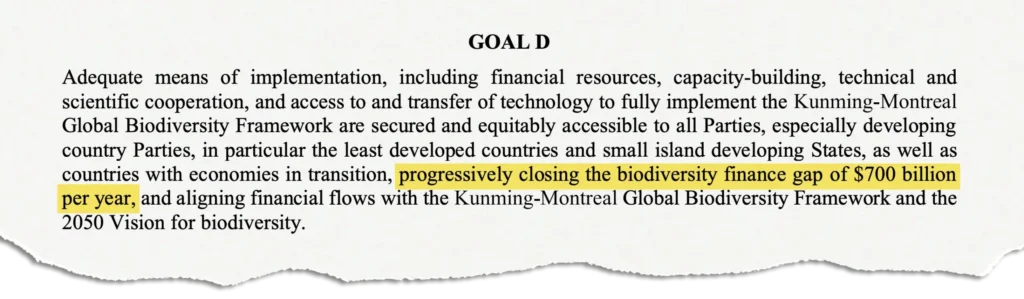
Goal D of the GBF, shown below, states that countries must close a $700bn biodiversity gap by 2030 through ending harmful subsidies ($500bn per year) and mobilising resources from the global north to south ($200bn per year).
This target aims to raise “at least $200bn per year” by 2030 from “all sources”, including domestic, international, public and private funding.
In all, countries reported raising a cumulative total of $186.4bn over four years, according to the report.
While it adds that it “is still too early to conclude”, the report states that the total finance mobilised so far “falls far short” of what is needed to close the biodiversity finance gap.
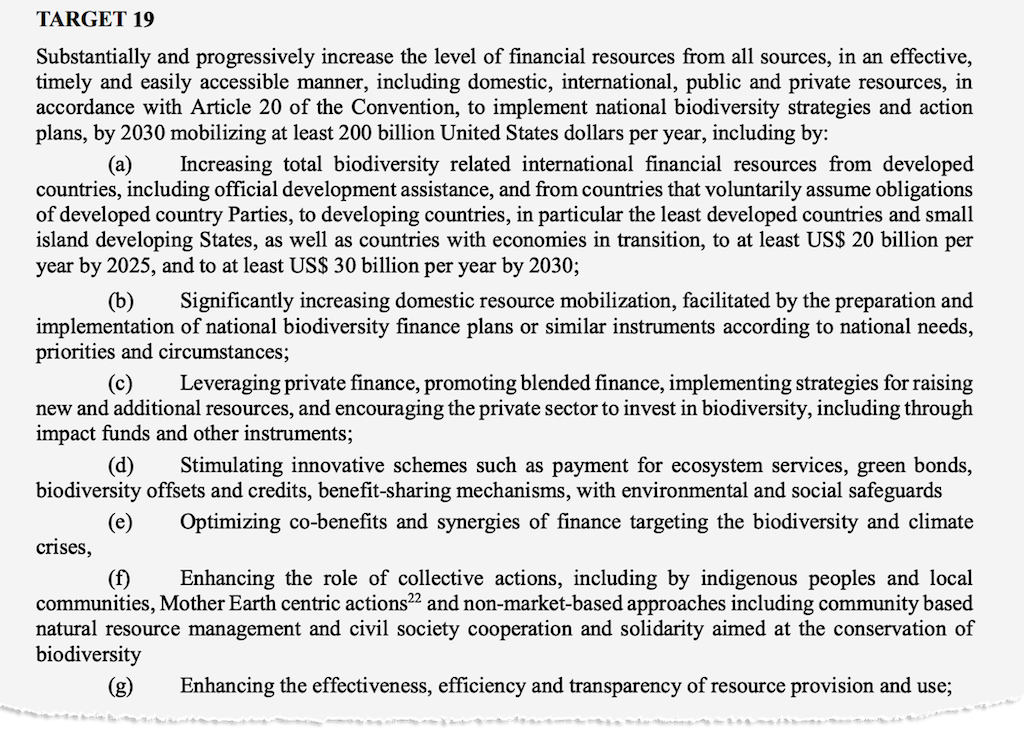
Target 19, shown below, states that developed countries and others should boost finance for nature to “at least $20bn” per year by 2025 and “at least $30bn” by 2030. This falls to developed countries and others that “voluntarily assume” the obligation of contributing.
However, the report suggests that the milestone of raising “at least $20bn per year by 2025” was “likely not achieved”.
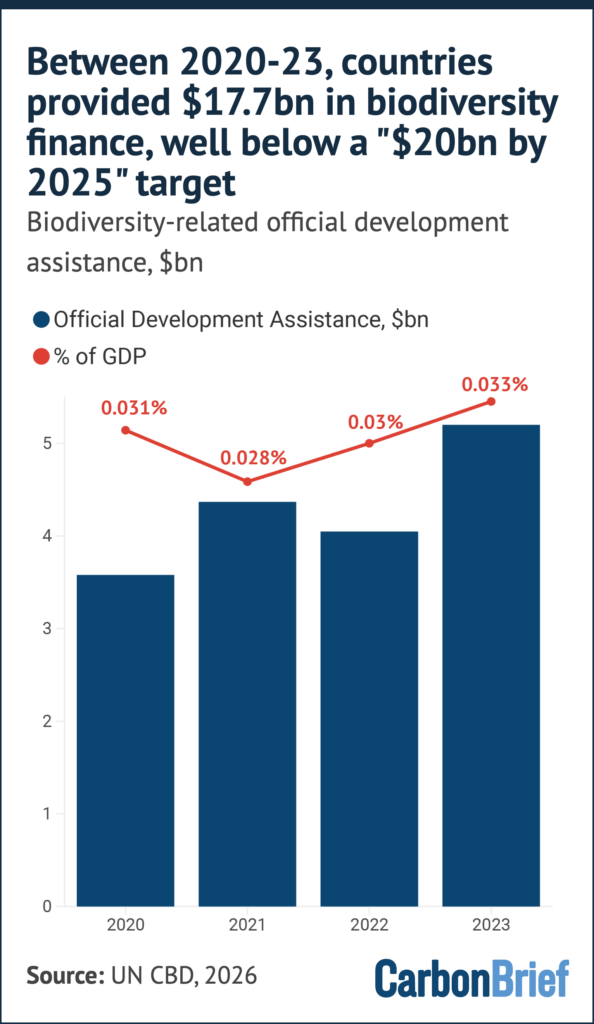
Between 2020 and 2023, reporting countries cumulatively raised just $17.7bn in international public funding for biodiversity, according to the report.
This amounts to an average of $4.4bn per year between 2020-23, with the total touching its highest at $5.2bn in 2023.
The report cautions that this figure “should be read as a minimum”, as it does not account for all potential flows of biodiversity finance.
Both estimates “fall below the $20bn milestone”, although the report adds that a “definitive assessment will only be possible” once data for 2024 and 2025 are included.
An earlier draft of the report included language noting that biodiversity-related “official development assistance” remains “well below the agreed 2025 milestone”. This was cut from the summary in this latest iteration of the report.
References to the OECD reporting a “shortfall in funding” and projecting “a decrease for 2024 and 2025” – suggesting the $20bn target was “unlikely to be met” – were also removed from the latest draft.
The chart below shows how international public funding for biodiversity has varied from 2020 to 2023, according to the report.
By comparison, domestic spending makes the largest cumulative contribution to biodiversity finance, at ($135.9bn) over the four years. However, spending has “declined” as a share of GDP. It also notes that spending varies “greatly”, from 0.1% to 2.7% of GDP.
According to the report, many countries highlighted that national budget allocations for biodiversity are “far too low” and that biodiversity “frequently loses out to competing development priorities”, including “defence, food security and infrastructure”.
At COP15 in Montreal, the EU and several other countries pushed for the inclusion of “all sources” of finance in the final text – including private finance and “innovative” schemes.
Private and “innovative” biodiversity finance – which spans a plethora of sources such biodiversity offsets and debt-for-nature swaps – was eventually included in target 19.
The report, however, notes that private finance “peaked in 2021 and fell afterwards” and “remains particularly undeveloped”, with a cumulative total of $32.7bn between 2020-23.
At the same time, the report notes that only 26% of all countries had reported data on private biodiversity finance, making it harder to assess funding declines in 2022 and 2023.
Genetic resources
The report finds there has been limited progress on sharing genetic biodiversity data.
”Digital sequence information” (DSI) refers to genetic data derived from biodiversity, which is often sourced from species in biodiversity-rich developing countries.
These countries have long called for an international mechanism to ensure that the benefits of DSI are shared fairly with the people living where the resources were “discovered”, including Indigenous communities.
At COP16, countries agreed to the first-ever global fund, called the Cali Fund, for companies profiting from genetic data to contribute to conservation goals on a voluntary basis.
However, experts have cautioned that much rests on whether countries develop strong national laws to support the COP16 agreement. This could include incentivising companies in their regions to contribute to the fund.
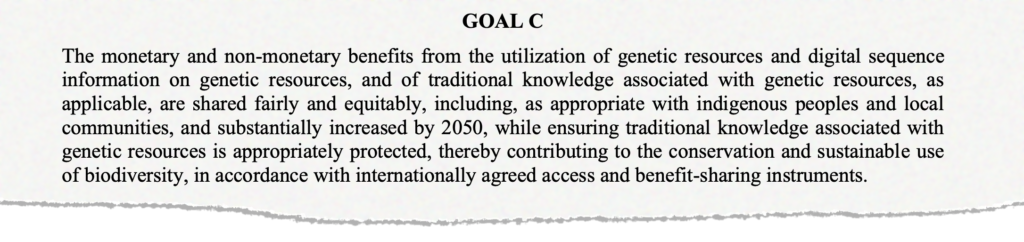
In the GBF, target 13 and goal C address elements of DSI, including the sharing of benefits from genetic resources and their digital derivatives.
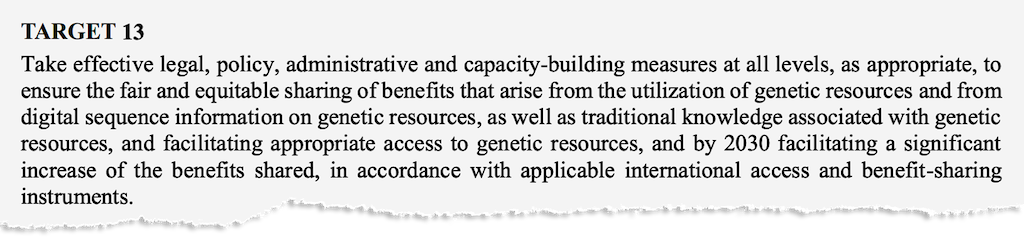
According to the report, 79% of countries submitted national targets that address legal, policy and administrative measures to enable benefit-sharing from DSI. Some 71% included measures to facilitate access to genetic resources.
The report finds that the “strongest progress” has been in developing laws and policies, which are now at an intermediate stage.
The “most fundamental regulatory barrier”, according to many countries cited, is the lack of a “dedicated” national framework to enable access to genetic resources and share benefits with communities.
This would involve enacting laws compatible with the GBF, setting up digital registries to catalogue and trace genetic resources, as well as implementing tracking systems to monitor how they are used. It would also include a financial mechanism to pay communities for the use of their traditional knowledge.
Progress in monitoring monetary and non-monetary benefits from DSI is “much weaker” and is “particularly limited” for measures related to the Cali fund.
According to the report, most parties have “no monitoring systems [for evaluating benefits from genetic resources] in place, or [are] still developing them”. It says they add that the benefits from genetic resources are hard to track “across borders and along value chains through to the final product”.
For those that have tracked benefits, it says that countries reported a cumulative $6.9m in receipts from the use of genetic resources between 2022 and 2025. It adds that “several parties reported that they had received no monetary benefits” to date.
Countries also reported more than 960 non-monetary benefits, ranging from technical training to research participation. The report cautions that these “fluctuated over time rather than increasing consistently, and cannot be seen as indicative of global benefit-sharing”.
In December 2025, Carbon Brief reported that the Cali fund had received only one contribution of $1,000 as an “icebreaker”. No other major companies have stepped up to fill the fund.
Meanwhile, the report states that the formal protection of traditional knowledge held by Indigenous peoples and local communities remained “underdeveloped”.
It says that a “significant number” of countries raised concerns about gaps in recognition of Indigenous peoples’ rights and dedicated registries to document their traditional knowledge.
The report says it is not yet possible to assess progress towards goal C:
“To date it is not possible to comment on whether benefits are being shared fairly and equitably nor on the role played by traditional knowledge and Indigenous peoples and local communities. Therefore, progress towards goal C cannot yet be assessed.”
Pollution
Target 7 of the GBF focuses on tackling pollution from pesticides, chemicals, plastic and other sources.
It calls for countries to reduce pollution risks and negative impacts “from all sources” to “levels that are not harmful” to biodiversity and ecosystems by 2030.
It also aims to reduce excess nutrients in the environment and overall risks from pesticides and hazardous chemicals by “at least half”.
The draft report finds that there is no significant change or insufficient progress on 60% of national targets categorised as being highly aligned with target 7. Only one-third of these national targets (35%) are on track to be achieved by 2030.
On average, it says countries have addressed around half of the various elements of target 7 “to some extent” in their national targets.
The most frequently-mentioned aspect of the target – addressed by 72% of countries – refers to reducing pollution from all sources by 2030.
One headline indicator related to target 7 focuses on the concentration of pesticides in the environment.
Just five countries out of 125 submitted estimates on this, according to the report. It says only one country has met the aim of halving the overall risk from pesticides on a national basis so far.
Measures to address plastic pollution are the most frequently reported actions by countries in relation to this target, including bans on single-use bags and straws.
A number of countries in Europe and Asia have also implemented measures to reduce nutrient losses from fertilisers and slurry.
A “major challenge” for countries in advancing pollution aims is “effectively and fairly considering and managing impacts on food security and livelihoods”, according to the report.
Several countries point to a lack of national funding to implement measures towards achieving this target.
Some developing countries also list poor wastewater-treatment infrastructure as a “persistent challenge” on this issue.
Invasive species
Invasive alien species refers to those that have moved to and become established in a region outside their natural habitat, as a result of human activities. This has negative impacts for local biodiversity and ecosystems.
Target 6 of the GBF calls for countries to, among other things, reduce the rates of introduction and establishment of invasive alien species by 50% by 2030.
The draft report says countries are “taking action” on this target, but progress is “difficult to assess”.
Two-thirds of national targets aligned with target 6 show “no significant progress or insufficient progress”, it finds. Fewer than one-third are on track to be achieved by 2030 and just 1% of these national targets have already been achieved.
But most countries have made progress in putting in place measures to manage invasive species – mostly focusing on reducing the introduction rate and impact of species.
Countries have addressed around half of the different elements of the invasive species target “to some extent” in their national targets, finds the report.
But fewer than one-third (30%) have set national targets that put a numeric goal on reducing invasive species.
Island biosecurity programmes and measures to intercept invasive species at country borders are among the actions countries have put in place to tackle the issue.
The report lists some barriers countries say stand in the way of achieving the target. These include a lack of baseline data from which to measure a 50% reduction rate, poor early-detection systems and a lack of funding for long-term reduction efforts.
Some countries also cite capacity and technical challenges in monitoring invasive species, according to the report.
They say many of these species “go unnoticed for years before impacts become apparent”, it adds, with countries arguing that setting a specific reduction target is “challenging”.