
‘Cali Fund’ aiming to raise billions for nature receives first donation – of just $1,000
A major biodiversity fund – which could, in theory, generate billions of dollars annually for conservation – received its first donation of just $1,000 in November.
The Cali Fund was created under the UN Convention on Biological Diversity (CBD) at the COP16 nature negotiations in Cali, Colombia, last year.
On 19 November, nine months after the fund officially launched, UK start-up TierraViva AI put forward the first contribution.
The $1,000 payment is an “ice-breaker”, the company’s chief executive tells Carbon Brief, aimed at encouraging others “who may be hesitating” to pay in.
The fund is designed to be a way for companies that rely on nature’s genetic resources to share some of their earnings with the developing, biodiverse countries where many of the original resources are found.
Companies use genetic data from these materials to develop products, such as vaccines and skin cream.
One expert describes the $1,000 as a good “first step”, but says it is “time for larger actors to step forward”. Another says it “squarely points the finger to the profit-making enterprises that are not contributing”.
The CBD is “pleased” about the first payment, a spokesperson tells Carbon Brief, adding that “many discussions” are ongoing about future donations.
Funding biodiversity action
Companies all around the world use genetic materials from plants, animals, bacteria and fungi often found in biodiversity-rich, global south countries to develop their products.
There are existing rules in place to secure consent and ensure compensation if companies or researchers travel to a country to physically gather these materials.
Today, however, much of this information is available in online databases – with few rules in place around access. This genetic data is known as digital sequence information (DSI).
The Cali Fund is part of an effort to close this loophole.
The COP16 agreement on the creation of the fund outlined that large companies in several sectors, including pharmaceutical, cosmetic, biotechnology, agribusiness and technology, “should” contribute a cut of the money they earn from the use of these materials. (See: Carbon Brief’s infographic on DSI.)
The money is intended to fund biodiversity action, with 50% of resources going to Indigenous peoples and local communities who protect vast swathes of the world’s nature and biodiversity.
These contributions, however, are voluntary.
The fund officially launched at the resumed COP16 negotiations in Rome in February 2025, where a spokesperson for the CBD said that first contributions could be announced in spring.
However, Carbon Brief reported in August that the fund was still empty.
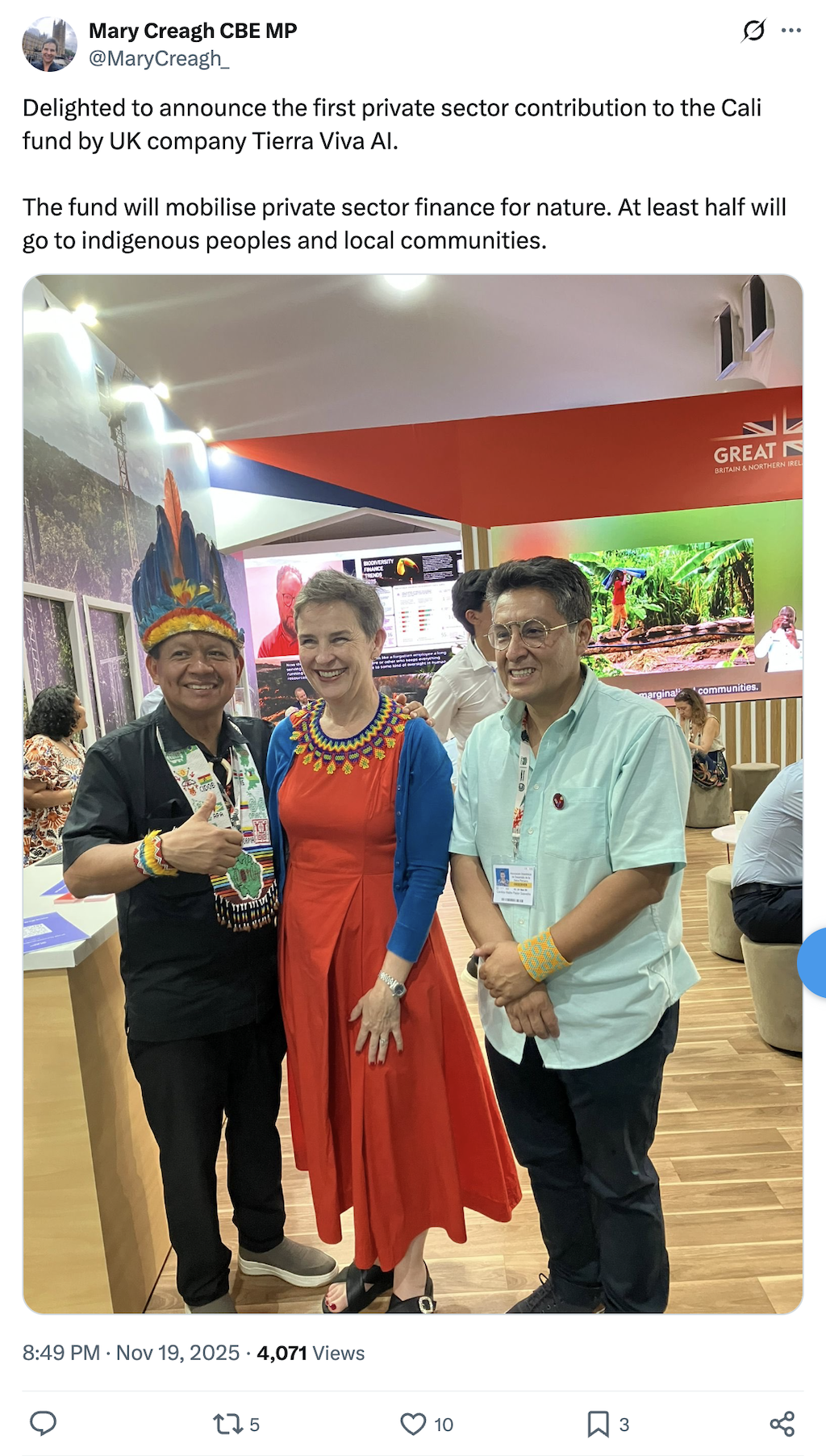
On 19 November, the first contribution was announced during the COP30 UN climate summit. At $1,000, the amount was significantly lower than the potential millions that larger companies could pay in.
A UK government press release described it as a “major milestone” that will “pav[e] the way for others to do the same and mobilise private sector finance for nature at scale”.
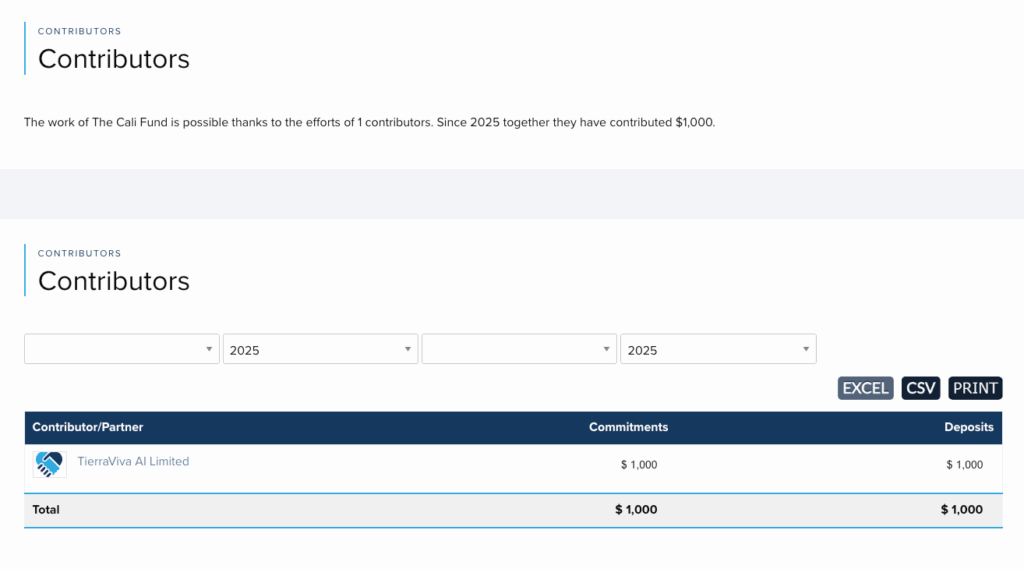
The payment was an “expression of our commitment to the objectives of the Cali Fund”, TierraViva AI chief executive Dr Paul Oldham wrote in a letter to the executive secretary of the CBD, Astrid Schomaker.
The $1,000 is an “initial contribution”, Oldham said, and the company plans to give more “as our business grows”. Based in the UK with a team of programmers in Nairobi, TierraViva AI was set up in 2023 and uses AI to support conservation.
An anthropologist who worked on Indigenous peoples’ rights in the Amazon, Oldham’s research helped inform the list of sectors most likely to “directly or indirectly benefit from the use of DSI”, including “generative biology” and AI companies.
Oldham noted in a speech at the sidelines of COP30 that although the company’s earnings are not large enough to meet the contribution thresholds set out in the Cali Fund agreement, its contribution showed that companies “of any size” can pay in.
He tells Carbon Brief that while “some” companies “are not serious about contributing and are seeking to delay” paying into the fund, others have different concerns, including the “need for a level playing field” and positive incentives to contribute:
“This will be hard-earned company money, so it’s reasonable enough to imagine that one of the first questions companies will want an answer to is: ‘well, what is this actually going to be spent on?’ And: ‘what is the benefit of this to us’, which is likely to vary by sector.
“In my view, the best way forward would be for companies that can to make contributions. That would give everybody, including governments, confidence that there might be constructive ways to address difficult topics.”
Future contributions
A spokesperson for the CBD tells Carbon Brief:
“We are pleased that the Cali Fund is not only ‘open for business’, but that this first contribution also demonstrates it is fully operational. We thank and congratulate TierraViva AI for being the first company to step up.”
“Many discussions” are ongoing around future donations to the fund, the spokesperson says, and the CBD is “hopeful that further announcements can be made soon”, ahead of the next UN biodiversity summit, COP17, in October 2026.
Asked whether the CBD was expecting more contributions at this stage, the spokesperson says the fund was set up in “very short order” and that the first payment shows that companies are “able to contribute”.
US biotechnology company Ginkgo Bioworks was the first to pledge to contribute to the fund earlier this year, but has so far not put forward any money. The company did not respond to Carbon Brief’s request for comment.
Carbon Brief reported earlier this year that at least two companies were contacted by a UK department with opportunities to be involved in the Cali Fund before its launch in February, but no company took up on the offer.
The first contribution coming from a “startup that has just begun operations squarely points the finger to the profit-making enterprises that are not contributing”, Dr Siva Thambisetty, associate professor of law at the London School of Economics, tells Carbon Brief. Thambisetty adds:
“Strident cries of lack of legal certainty, unfairness or stacking obligations [combining responsibilities from different agreements and laws] would be more credible if industry organisations encouraged large firms that use DSI to begin contributing, instead of denying the last 20 years of multilateral [negotiations] that have led to this point.”
Dr June Rubis – Indigenous peoples and local communities (IPLC) lead from Asia on the Cali Fund’s steering committee – welcomes TierraViva AI’s “first step”, but tells Carbon Brief that the “real test lies ahead” and that it is “now time for larger actors to step forward”.
She says the Cali Fund offers “clarity” on how the private sector can directly increase support to UN-backed funds at a time when “states are retreating” from their climate and biodiversity finance obligations:
“It’s not a voluntary offsetting scheme or a…risky or fringe fund; it’s a multilateral mechanism designed to meet the highest fiduciary and equity standards. We invite companies to see this not as philanthropy, but as participation in a globally endorsed system where trust is institutionalised, benefits are traceable and equity is operationalised.
“Contributing to the Cali Fund isn’t just ethical, it’s strategic. [But] It’s about more than funding: it’s about trust, power-sharing and making sure IPLCs are part of the decisions, not just the outcomes.”