
Billions to face 'deadly threshold' of heat extremes by 2100, finds study

Lethal threshold
Recent decades have seen some stark examples of how devastating heatwaves can be. For example, summer heat extremes caused more than 70,000 deaths across Europe in 2003, close to 11,000 in Moscow in 2010 (from both heat and air pollution), and around 740 in Chicago in 1995. The new study, published today in Nature Climate Change, suggests that the number of people at risk from such deadly heat extremes will rise in future. The researchers trawled through the peer-reviewed literature for studies published between 1980 and 2014 about heat-related deaths. This turned up 911 papers that covered almost 2,000 case studies from around the world. Of these case studies, 783 focused on specific heatwave events in specific cities. Using weather data, the researchers compared the conditions during those 783 events against those during other heatwaves in the same cities that didn’t cause deaths. On this basis, they found that the combination of average daily temperature and humidity were the best way to differentiate between lethal and non-lethal events. Co-author Dr Iain Caldwell, from the University of Hawai’i at Mānoa, explains to Carbon Brief:“We were able to identify a threshold in temperature and humidity, above which conditions have become lethal in the past – we call this threshold the ‘deadly threshold’ in our paper.”
You can see this in the chart below. The black crosses identify the reported temperature and humidity of lethal heat extremes, while the coloured hexagons show the conditions during non-lethal heatwaves. The red line indicates the “deadly” threshold above which all events caused deaths.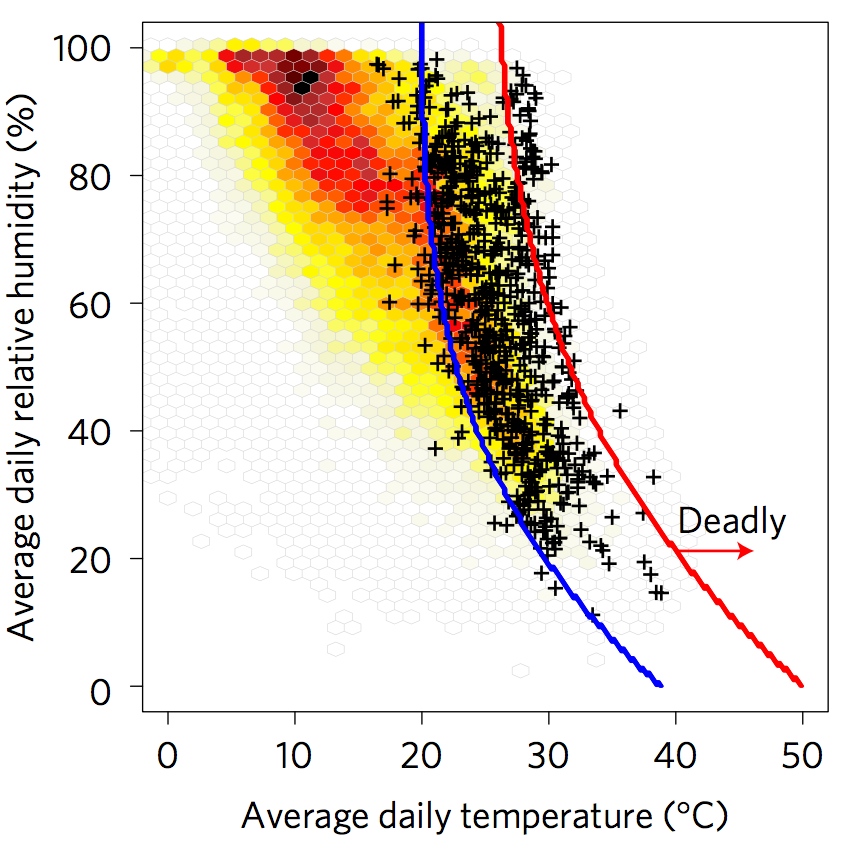
Deadly conditions
[contentbox id=”17002″] In the current climate, around 30% of the world’s population get 20 or more days per year above the “deadly” threshold. This percentage is increasing as global temperatures rise, the researchers say, and will rise further through the century – depending on how successfully we cut our carbon emissions. For example, under the RCP8.5 scenario where emissions aren’t curbed, as much as 74% of the global population could be exposed to at least 20 days of deadly heat extremes a year by the end of the century.
“The study is important because it shows additional strong evidence that climate change, if unmitigated, will result in an increase deadly conditions to humans.”
The researchers produced an interactive map of their results, for both the past and the future (see below). You can toggle between different decades and different emissions scenarios in the top right-hand corner. You can also watch a timelapse animation of the changing risk from 1950 to 2100 by clicking on the play icon in the bottom left-hand corner. The shading indicates the scale of the risk of deadly heat days, from low (yellow) to high (red). Clicking on a location will give you a specific projection for the number of days above the deadly threshold. The results suggest that tropical countries are likely to be worst affected by deadly extreme heat in the future. The findings were less conclusive for large regions of the world – shaded white – where either there wasn’t sufficient data (e.g. North Africa), or the results had high uncertainty (e.g. much of the mid-latitudes). Despite these gaps in the results, this doesn’t mean these regions aren’t at risk. One example is Western Europe, notes Caldwell:“Based on the fact that there have already been severe lethal heat events in Europe in the recent past, I personally believe that the risk in these areas remains high. Fortunately, researchers in Western Europe seem to be developing early warning systems that should warn people when conditions are likely to become deadly.”
Research challenges
As global temperatures rise, research on heatwaves and health are likely to become ever more pertinent. Yet, as scientists not involved in the study point out to Carbon Brief, there are some challenges that these sort of studies need to overcome. One is that the bulk of the peer-reviewed literature on heat-related deaths refers to extreme heat in developed countries – particularly Europe and North America. You can see this in the map from the study below.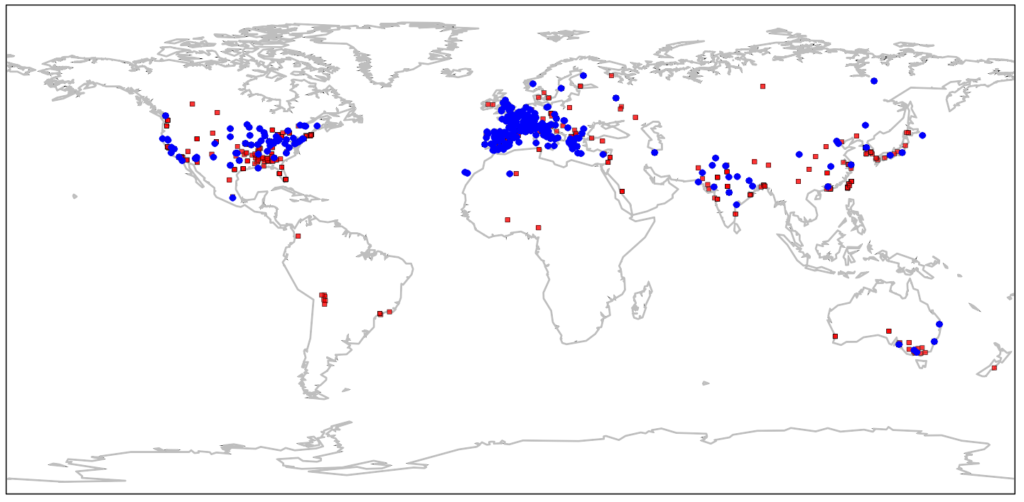
“We know these relationships are highly city-dependent, changing due to local infrastructure, economy and lifestyle, amongst other things. Cities in Africa face very different challenges to those in Europe, and what is classed as deadly heat in one, may not be the same as in another.”
So, an increase in heatwaves will impact cities in European differently from those in Africa, says Mitchell. African cities may fare better in some ways, he adds, but worse in others:“You have two competing effects in Africa. The study might overestimate heatwave risks because African cities are already used to higher heat extremes. But the study might underestimate heatwave risks, because African cities have less capacity to adapt to increases and to forecast them accurately.”
The study did have some studies outside the mid-latitudes, notes Caldwell, such as in southern India and southern China. And the temperature-humidity threshold was surprisingly consistent across different latitudes, he adds:“Of course, it would be more ideal to have incorporated data for more tropical areas but we had trouble finding such data. Hopefully this will prompt others to remedy this by collecting more data for those regions.”
A second challenge is that the risks posed to health by heatwaves depend on socio-economic factors as well as the climate, says Prof Kristie Ebi, a professor in the department of global health at the University of Washington. These include, for example, the extent that people are exposed to heat extremes, how vulnerable they are, and whether they are able to prepare and manage for heatwaves. In fact, there is evidence that in some parts of the world people are already adapting to worsening heat extremes, says Ebi:“There is growing literature that sensitivity to heatwaves has declined over recent decades, presumably because of some degree of acclimatisation to ever higher temperatures, increasing access to air conditioning and cooling centers, better understanding and communication of the risks of high ambient temperatures, and changing infrastructure to reduce urban heat islands.”
Including projections of recent and future changes in exposure and vulnerability would have been a helpful addition to the new study, Ebi adds.Article information
Mora, C. et al. (2017) Global risk of deadly heat, Nature Climate Change, doi:10.1038/nclimate3322