
China Briefing 23 July 2026: 15th five-year plan for renewables | Record power demand | Hainan’s petrol-car ban
Welcome to Carbon Brief’s China Briefing.
China Briefing handpicks and explains the most important climate and energy stories from China over the past fortnight. Subscribe for free here.
Key developments
New five-year plans published
RENEWABLES PLAN: China published its 15th five-year plan for the development of renewable energy, reported energy news outlet International Energy Net. According to the outlet, targets in the plan include that, by 2030, renewable power capacity will reach 3,500 gigawatts (GW), of which wind and solar will comprise 2,800GW. The full text of the plan also sets wind and solar projects a target for the share of their output that should be guaranteed, for example through on-site energy storage. It also said that non-electricity use of renewable energy, such as through “green hydrogen” production or “wind and solar heating”, should “increase by 1.5 times compared to 2025”. Bloomberg noted that the plan set a 2030 target for renewable power use to rise to 1.8bn tonnes of standard coal, “up from 1.18bn tonnes in 2025”. It added that China has “already set 2030 targets for renewables capacity and for non-fossil fuel share of total energy consumption”.
OTHER FIVE-YEAR PLANS: China’s new five-year plan for consumption called for “promoting green consumption”, expanding supply of new-energy vehicles (NEVs) and “developing green supply chains”, reported IdeaCarbon. The government also published a five-year plan for “ecological and environmental monitoring”, which called for strengthening “greenhouse gas monitoring capacity” and monitoring climate- change impacts and risks, reported BJX News. China’s 15th five-year plan for national health encourages adopting “health adaptation measures” in response to climate change, said business news outlet 21st Century Business Herald. A five-year plan for forestry and grassland conservation aims to increase forest coverage to 25.8% by 2030, said Xinhua.
THREE-YEAR PLAN: The National Energy Administration published an action plan for “energy conservation and carbon reduction” in the energy sector 2026-2028, according to International Energy Net. It reported that, according to the plan, a key target is for China to increase the “share of non-fossil energy consumption” by “approximately one percentage point annually”. The outlet added that the plan also focuses on boosting low-carbon power consumption, through programmes such as “direct” low-carbon power connections and “smart microgrids”. It also stated that China will aim to raise the average efficiency of existing coal-fired power plants “by 15 percentage points”, reported state news agency Xinhua.
Peak power demand
POWER HIGH: China saw a series of record-high peaks in power demand in July, culminating in a load of 1,551GW, reported industry news outlet China Power News. It added that the government anticipates that peak electricity load “could exceed 1,600GW in the event of widespread extreme heat”. The main driver for the high demand came from industry, stated BJX News. It added that power demand for electric vehicle (EV) charging and battery-swapping – which grew 57% year-on-year – was also a significant factor, as were “high temperatures”. [China’s recent five-year plan for a new-type energy system aims for electricity to reach 35% of final energy consumption by 2035, which could create even higher demand peaks in future.]
‘SLOWEST’ COAL RISE: Thermal power generation rose 0.5% year-on-year in June, while solar generation rose 14.2% and wind fell 5.6%, according to China Power News. It added that, in June, China’s coal mining output declined to “380m tonnes, down 9.7%” from the previous year. The data shows China’s thermal generation grew at its “slowest pace this year”, said Bloomberg. Meanwhile, total capacity for wind and solar had climbed 19% and 16% year-on-year, respectively, by the end of June, said BJX News. [A total of 14GW of wind and 12GW of solar were added in June, according to Carbon Brief calculations.]
ENERGY SECURITY CONTRACTS: Meanwhile, the government published draft regulations on issuing “medium- and long-term [MLT] power contracts for energy security”, reported energy news outlet International Energy Net. It added that the rules cover contracts for power, as well as coal and gas supply. The proposal, which may change before it is finalised, “does not fundamentally change” China’s MLT contract regime, Gao Chi, senior associate at the Regulatory Assistance Project, told Carbon Brief. He added that it may “entrench” inflexibility in China’s power system, which has been a “major contributor to China’s high renewable curtailment rates”.
More China news
- ‘NEW THREE’ SURGE: China’s exports of electric vehicles, lithium-ion batteries and solar cells from January to June 2026 “surged 52% from a year earlier” to $118bn, reported finance outlet Caixin. Wind-turbine exports grew 36% during this period, said state-run newspaper China Daily.
- FLOOD FUNDS: Northern China received 229mm of rainfall from 1 April to 12 July, 23% higher than the long-term average, according to China Daily. State-run Economic Daily said that temperatures hit 50C in north-western Xinjiang province.
- FACTORY EMISSIONS: The government published the requirements facilities must meet to qualify as “national-level zero-carbon factories”, said International Energy Net. Maximum carbon emissions per unit of consumed energy must be 1.8 tonnes of carbon dioxide per tonne of standard coal, with an “aim” of 0.2 tonnes, it added.
- TAX BREAK ENDS: China will levy a consumption tax on some previously exempted batteries and solar cells, said Reuters, though newer technologies remain exempt.
- MINERAL GOVERNANCE: China urged countries to strengthen a system for governing “critical minerals in the context of the energy transition”, reported Xinhua.
- RURAL REVOLUTION: China plans to establish microgrids in rural areas by 2028 to provide “secure systems for supply of clean energy”, said International Energy Net.
Captured
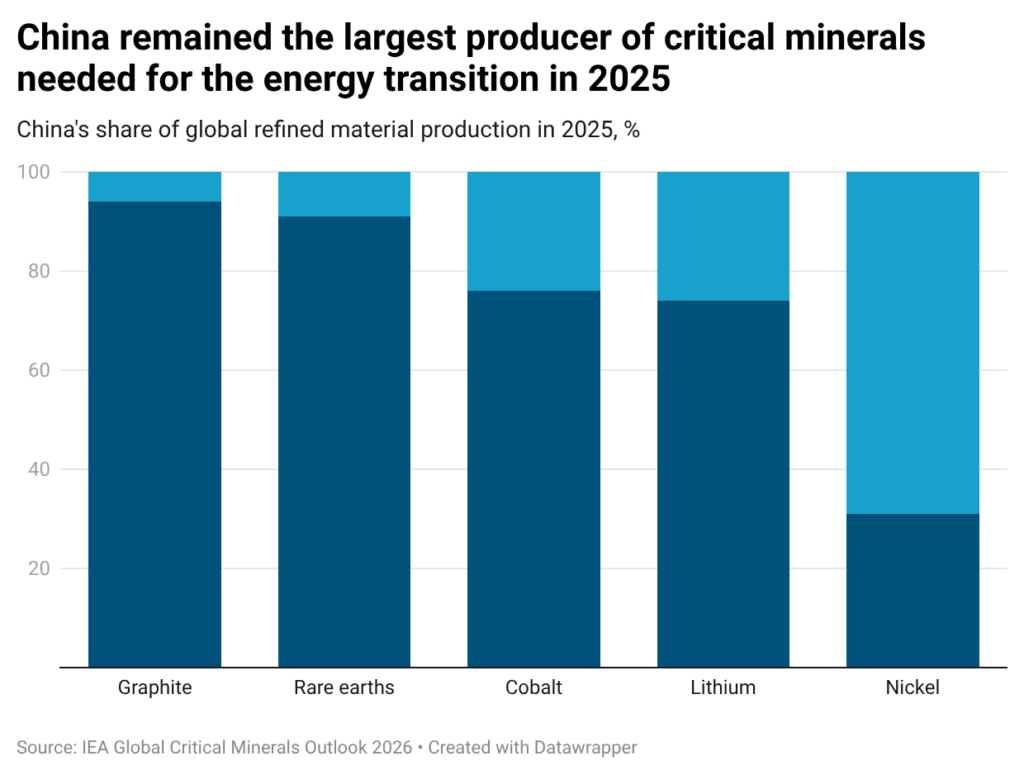
China remained the world’s largest producer of several refined critical minerals needed for the energy transition in 2025, according to a new report by the International Energy Agency.
Spotlight
Why Hainan is China’s first province to ban petrol cars
China’s southern province of Hainan will ban sales of new fossil-fuel cars from 2030, according to a new policy document, making it China’s first province to do so.
In this issue, Carbon Brief examines how Hainan made the ban possible and whether more provinces will follow.
Long time coming
Earlier this month, the provincial government of Hainan finalised a target to ban sales of new fossil-fuel cars from 2030, in its provincial-level five-year plan.
The ban has been eight years in the making. It was first mentioned in a 2018 central-level plan for the island province’s development, then further developed by subsequent provincial-level policies.
By 2030, all new public and commercial vehicles must run on “clean energy” by 2030 – with some exceptions – and all new private cars must be new-energy vehicles (NEVs).
NEVs are expected to make up 45% of the island’s vehicle fleet by 2030, with Hainan also maintaining at least one charging point for every 2.5 NEVs.
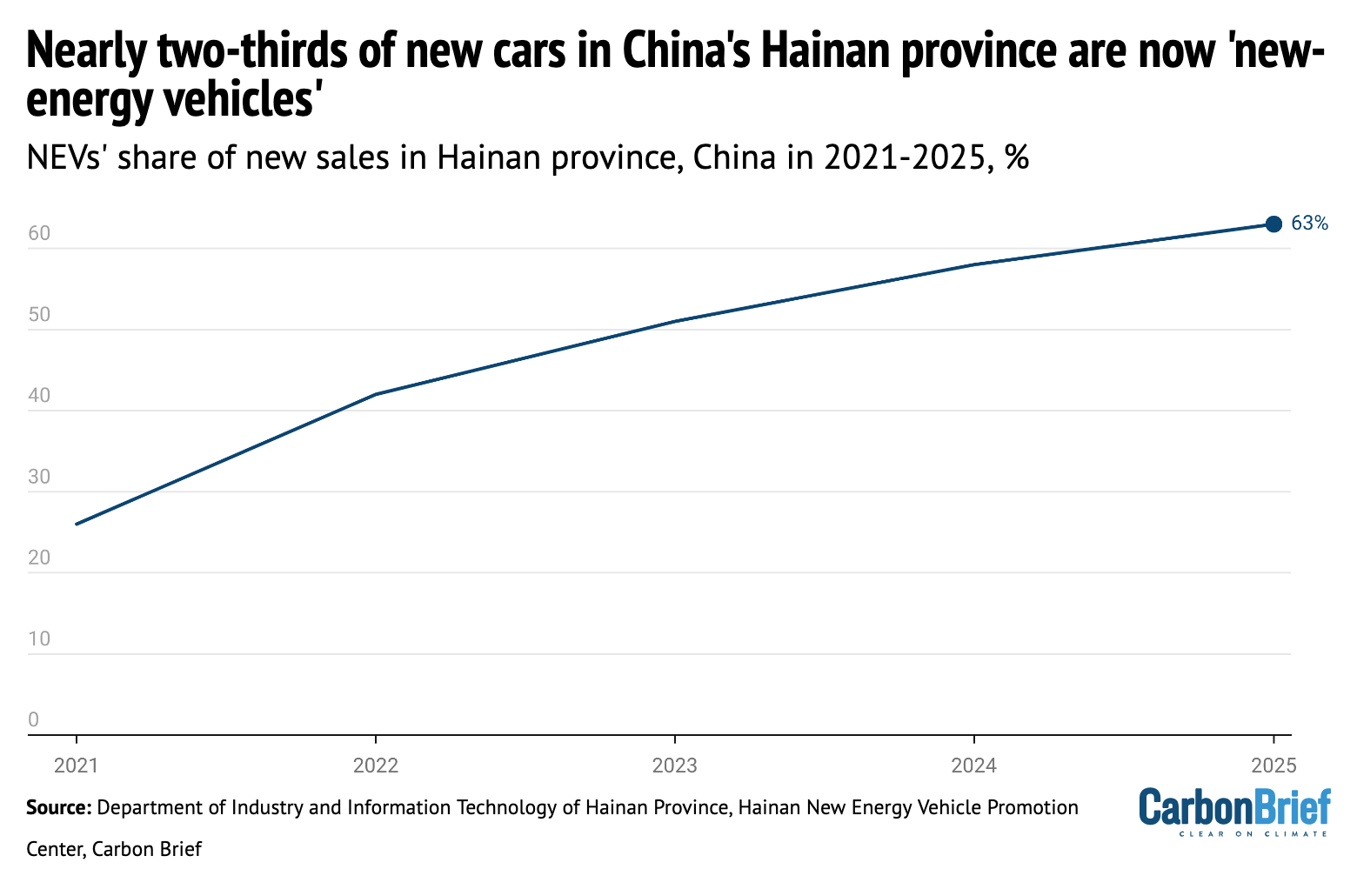
As of last year, more than six of every ten new cars sold were already NEVs, according to current affairs outlet Beijing News. It added that NEVs made up 23% of Hainan’s total fleet at the end of last November, with relatively expensive fuel prices and widespread charging infrastructure increasing residents’ willingness to buy the cars.
Advantageous conditions
Tu Le, founder and managing director of consultancy Sino Auto Insights, told Carbon Brief that “it’s not that big of a stretch” for Hainan to meet the 2030 target, pointing to already-high NEV uptake.
Its tropical climate provides one advantage for encouraging further adoption, Pan Helin, a member of the Ministry of Industry and Information Technology’s expert committee on information and communication economy, told finance newspaper International Finance News.
The warm winters help limit capacity losses seen by batteries in northern provinces, he said.
Its small size is another, being well-suited to current NEV ranges, Yuan Shuai, deputy director of investment at the China City Development Academy, told local newspaper Chutian Metropolis Daily.
Hainan has enabled extensive charging coverage, with all townships having built charging infrastructure.
Cost considerations also favour NEVs, said Zhang Xiang, a visiting professor at Hainan Vocational University of Science and Technology. Transport policies, he noted, mean fuel prices are frequently more than one yuan ($0.15) per litre more expensive than in other provinces.
Blueprint or unique case?
Hainan’s plan has prompted discussion over whether other provinces will follow.
News outlets have pointed to regions with similarly high NEV uptake, such as Shanghai and Guangdong, as the next potential adopters of a fossil-fuel car ban.
Zhejiang-based local news outlet Tide News cited experts as saying Zhejiang and other economically-developed provinces could adopt “similar” policies.
In comments under the article, some people expressed support for the ban, saying “fossil-fuel cars will inevitably exit the market sooner or later”, while others raised practical concerns, such as whether petrol stations would still be available.
Le does not believe that China’s central government will enact a nationwide ban on fossil-fuel cars.
He told Carbon Brief that a similar ban in other provinces would require the availability of adequate charging infrastructure and “affordable” vehicles.
This is echoed by China Passenger Car Association secretary-general Cui Dongshu, who told finance news outlet Hexun Net that the pilot is not the beginning of a nationwide “one-size-fits-all” approach.
Instead, Cui foresees that other provinces will maintain normal sales channels for fossil-fuel cars, while emission standards and trade-in incentives drive a gradual transition to a more electrified fleet.
This spotlight is by freelance China analyst Lekai Liu for Carbon Brief.
Watch, read, listen
CLIMATE LEADER?: The China Global South Project examined how climate leadership “may increasingly become an extension” of China’s global strategy.
‘CHINA SHOCK 2.0’: The China in Context podcast discussed the current state of the EU’s response to “China Shock 2.0” and the “chances of finding a solution”.
INDUSTRIAL UPGRADE: Caixin interviewed Energy Foundation China head Zou Ji on the “technological pathways” China should take to decarbonise its industry.
VALUE CHAINS: The Institute of Development Studies held an event on Chinese mining of critical minerals in global south countries and how developing countries could respond.
27
The number of new ultra-high voltage direct current lines China needs by 2030 to support its clean-energy “megabases”, according to a new report by thinktank Global Energy Monitor.
15
The number state-owned grid company State Grid plans to actually build by 2030.
New science
- Future pollen seasons in Beijing could occur earlier in spring and later in autumn due to climate change | Advances in Climate Change Research
Recently published on WeChat
China Briefing is written by Anika Patel, with contributions from Lekai Liu and Jess Milligan. It is edited by Simon Evans. Please send tips and feedback to [email protected]