
China Briefing 3 September 2026: Glacier collapse | COP33 ‘hosting’ rumours | Oil plummet cuts emissions
Welcome to Carbon Brief’s China Briefing.
China Briefing handpicks and explains the most important climate and energy stories from China over the past fortnight. Subscribe for free here.
Key developments
Glacier collapse
‘TSUNAMI-LIKE’ FLOOD: A “devastating…glacial flood” on the Nepal-China border in late August has now killed more than 1,000 people, with thousands more missing, reported Le Monde. A “tsunami-like wall of water” swept away “entire villages”, said the Singapore-based broadcaster Channel News Asia. The latest reported death toll in Tibet stands at 21 dead and 541 missing, said state news agency Xinhua. Chinese president Xi Jinping urged “all-out efforts” for search and rescue, reported Bloomberg. It added that a meeting of China’s politburo ordered “faster surveys of glaciers and glacial lakes” across the Tibetan Plateau, as well as “stronger monitoring and early-warning systems”. The flood was caused by a glacier collapse, reported Xinhua, citing local authorities in Tibet. The authorities added that this was the “result of glacier instability under the long-term effects of climate warming”.
SOUTHERN TYPHOONS: Typhoon Narra caused record-breaking flooding in southern China’s Guangxi province in late August, with 54,000 people evacuated, said Reuters. Xinhua reported that two people in Hunan died due to heavy rains caused by Typhoon Saudel. In a separate report, it said the same typhoon saw more than 80,000 people in Fujian evacuated following its third landfall. In a commentary for state broadcaster CGTN, Institute of Atmospheric Physics professor Wei Ke wrote that four typhoons were present off China’s coastline during this time, marking an “unusually active” period. He added that global warming is creating “more frequent and intense” typhoons. Meanwhile, Chinese authorities have updated the death toll from 39 to 159 from July’s Typhoon Maysak, reported the Hong Kong-based South China Morning Post. Meanwhile, provinces across the country have seen heavy rainfall, with some rivers reaching record-high levels, said Xinhua.
Rumoured COP bid
COP HOST?: China may be “considering a proposal” to host COP33 in 2028, reported Bloomberg. It added that deliberations are currently “at an early stage”. In comments to journalists, Chinese foreign ministry spokesperson Lin Jian said he had no knowledge of such plans, said local news outlet Beijing News. Belinda Schaepe, China team lead at the Centre for Research on Energy and Clean Air (CREA), told the Jolt that COP33 is particularly significant due to expected discussions around the second “global stocktake”, which could give China an opportunity to display climate leadership and “step up” ambition on its international climate pledge.
PACIFIC PARLEY: Chinese environment minister Huang Runqiu met with his Australian counterpart Chris Bowen on 27 August, according to a statement from Australia’s Department of Climate Change, Energy, the Environment and Water. It said the two “agreed to work together” on COP31 to “support global emissions reduction goals” and create “trade and economic opportunities” from the global energy transition. Huang also travelled to New Zealand, where he discussed “expectations for the outcomes” of COP31 with climate change minister Simon Watts, said a readout from China’s Ministry of Ecology and Environment. China is also currently attending the Pacific Island Forum, where climate finance and deep-sea mining may be topics of discussion, according to Australian thinktank the Lowy Institute.
XI OVERSEAS: On 30 August, Xi travelled to Kyrgyzstan for the Shanghai Cooperation Organisation summit, where he said member states should expand cooperation in areas including “green industries” and “green minerals”, according to state news agency Xinhua. Xi also held bilateral meetings with the leaders of Kyrgyzstan, Russia, Uzbekistan, Mongolia and Egypt in which energy, minerals or climate issues were discussed. The visit marked the start of his “busiest travel schedule in more than seven years”, reported Bloomberg. It added that, after visiting Kyrgyzstan and Egypt, Xi is expected to attend the BRICS meeting in India and then travel to the US for a presidential summit.
New accountability measures
PRESSURE RAISED: Top local government officials will be held accountable for environmental damages, according to new central-level guidelines covered by state-run newspaper China Daily. Xinhua published the full text of the guidelines, which state that “relevant leading officials of the local party committees and governments” will be censured if they make “inadequate progress” in advancing efforts towards carbon peaking and carbon neutrality. Punishments range from verbal warnings and “criticism and education” through to disciplinary actions, state the guidelines.
RULES BROADENED: The Hong Kong-based South China Morning Post noted that the 2026 revisions widen the scope of rules that were trialled from 2015. It added that the new process now covers leaders of state-owned enterprises and affiliated organisations, as well as members of the main Communist party and government apparatuses. The outlet said the rules “signal a continued move away from GDP-focused cadre evaluations, and come as local leadership changes are being rolled out across China”. A commentary published under the nom de plume Zhong Huanping in the environment ministry-run China Environment News described the revisions as an institutional upgrade that “further tightens” the framework for environmental protection. The byline is thought to denote that an article carries the approval of senior environmental policymakers.
More China news
- EMISSIONS DROP: China’s carbon emissions fell 1% in the second quarter of 2026 due to a “sharp” drop in oil use and “steady” uptake of electric vehicles, reported the Guardian, covering new analysis by CREA for Carbon Brief. [See Captured below.]
- SOLAR ASCENDANT: China’s solar-power capacity reached 1,286 gigawatts in July, surpassing total coal capacity, reported Bloomberg. [Coal continues to be the largest source of electricity, although its share of generation dipped below 50% for the first time in the first half of 2026.]
- PRICING GUIDANCE: New government guidance for China’s automakers urged them to “base pricing on costs and market conditions” and to “avoid using prices to gain unfair competitive advantages” in overseas markets, said Reuters.
- FIVE-YEAR PLANS: A new five-year plan for small and medium-sized enterprises encouraged businesses to “accelerate” their energy transition, said power news outlet BJX News. Xinhua said China released an “implementation plan” to build “a modern climate service system” by 2030, which pledges to strengthen disaster-risk assessments.
- NO JOINT STATEMENT: A meeting of the G20 finance track failed to deliver a joint statement, said the Financial Times. Citing US and EU officials, the newspaper reported that China objected to language in the text opposing “non-market policies” that exacerbate trade imbalances.
- TRADE TALKS: The EU and China have separately been “locked in talks” over tensions around trade imbalances, particularly for electric vehicles, reported the South China Morning Post. EU climate commissioner Wopke Hoekstra told Euronews that the bloc must continue its energy transition while reducing dependence on China for clean technologies.
Captured
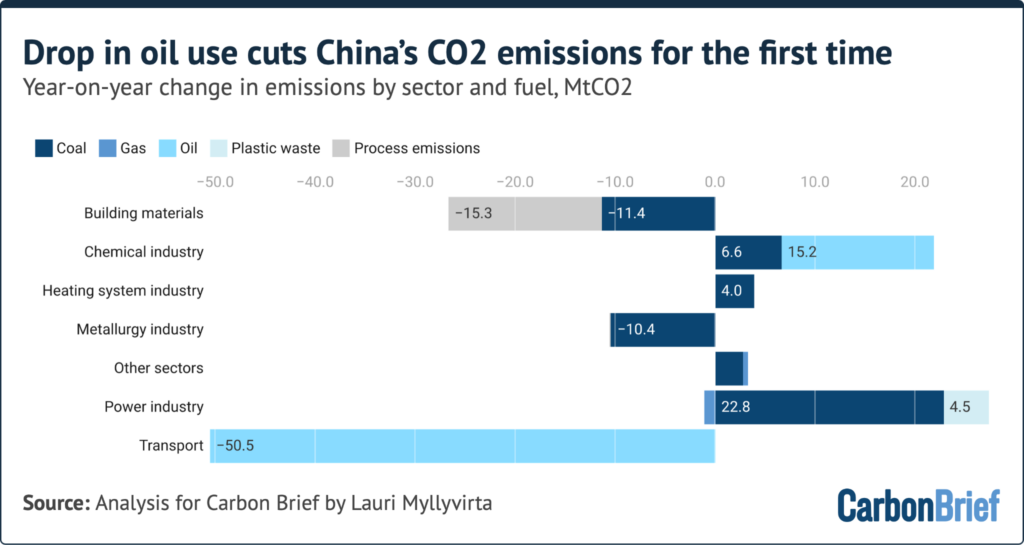
Plummeting oil use led to a 1% drop in China’s overall carbon emissions in the second quarter of 2026, according to new analysis by CREA for Carbon Brief.
Spotlight
Climate change made China’s 2024 heatwave 500 times more likely
In September 2024, an intense heatwave swept across large parts of China, forcing many schools to delay the start of term to protect staff and students.
In this issue, Carbon Brief unpacks new research which finds that the heatwave was made more intense and more likely as a result of human-driven climate change.
After the hot summer months, September usually brings lower temperatures to China. It also marks the start of the academic year, when children across many countries, including China, go back to school.
However, September 2024 saw a severe heatwave sweep across China’s Yangtze River basin. More than two-thirds of the region recorded its warmest early September since 1959, when records began, with temperatures reaching 40C in the provinces of Hunan, Zhejiang and Sichuan.
‘Extraordinary’ heat
Human-caused climate change is making heatwaves more intense, frequent and long-lasting. Scientists regularly use a field of research called “attribution science” to identify the impact of climate change on a period of extreme heat.
A new attribution study found that climate change made the September 2024 heatwave 2.1C warmer – and 514 times more likely – than it would have been in a pre-industrial world.
As the planet continues to warm, periods of extreme heat will become more severe. The authors calculated that even if global emissions are cut dramatically in order to keep global temperatures below 2C, then a “2024-like” heatwave would be another 5.2 times more likely by 2090. It would also be 0.9C hotter, they found.
By contrast, if emissions continue broadly as expected under current policies and temperatures rise around 2.7C by 2100, then such heatwaves would be another 17.8 times more likely and 2.6C hotter.
Impacts on children
Extreme heat is already inhibiting children’s ability to learn. According to the new study, reduced cognitive function and academic performance caused by heat exposure could “potentially [lead] to losses of up to 1.5 years of education per child” globally.
High temperatures can also be dangerous. During periods of extreme heat, people are more likely to suffer from health conditions, including heat stroke and exhaustion.
Dr Qian Cheng is a researcher at China’s Institute of Atmospheric Physics and author on the study. He told Carbon Brief that children are particularly vulnerable to extreme heat, as they have less ability to regulate their body temperature, higher metabolism and “lower cardiac output”.
He added that “beyond acute heat-related illnesses, heatwave exposure also endangers children’s neurodevelopment and mental health”.
Qian told Carbon Brief that the “extraordinary” heat in 2024 disrupted the start of term. He added:
“Some cities decided to suspend classes after one day’s reopening, or suspend the reopening, to protect the children. But, timely action was not universally implemented and there were still reports of students suffering from heat strokes.”
As the climate continues to warm, many of these impacts will become more severe. Qian stressed that schools must prepare for worsening heat through adaptation measures.
This, he told Carbon Brief, could include “delaying school openings based on heat forecasts, installing air conditioning in classrooms, shifting to online learning during heatwaves or adjusting academic calendars”.
All of this would “minimise children’s exposure risk”, he said.
The study notes that the September 2024 heatwave was “dry”. However, the authors explain that “extreme humid heatwave events can cause more serious harm to human health, especially that of children”.
They suggest it would be helpful to use a combined measure of temperature and humidity – rather than heat alone – in future research assessing the impacts of warming on children.
This spotlight was written by Ayesha Tandon, science correspondent at Carbon Brief.
Watch, read, listen
GREEN GROWTH: An International Monetary Fund working paper found that China’s energy transition “raises GDP in the long run and strengthens energy security”.
‘CLIMATE PARADOX’: The Prof G Pod explored the “China climate paradox” of a country being simultaneously a leading provider of cleantech and a major emitter.
ENERGY SECURITY: Researchers at the China Institutes of Contemporary International Relations wrote in Qiushi that the Iran war will see countries that lead on clean-energy “technologies, finance and regulations” gaining “greater influence”.
LESSONS LEARNED: The Center for Strategic and International Studies hosted a webinar examining the lessons China has drawn from the Hormuz energy crisis.
774
In terawatt-hours, the amount of power that China’s data centres could be using in 2030, according to research by Wood Mackenzie covered by Bloomberg. This is more power than South Korea currently uses, it added, but represents only 6% of China’s overall projected power demand.
New science
- Methane emissions from gas consumption in China’s Yangtze River delta are “vastly underestimated or entirely omitted” in current counts due to “supply-chain leakage” | Nature Cities
- Institutional reform of environmental regulators is the only factor that is associated with both a reduction in “non-green” innovation by Chinese companies and a “redirection” towards “green innovation” | Energy Economics
- Storage and transportation account for 20-50% of hydrogen delivery costs across China | Communications Earth & Environment
Recently published on WeChat
China Briefing is written by Lekai Liu and Anika Patel. It is edited by Anika Patel and Simon Evans.
Please send tips and feedback to [email protected]