
Guest post: Combining renewables with direct air capture for ‘net negative’ emissions

Renewables rise
We have witnessed a considerable expansion of renewable power generation over the past two decades. Along with increased deployment, costs have come down substantially. As of today, onshore wind energy is the cheapest source of electricity in many places – including in large parts of Europe. Photovoltaics also has seen massive price drops which have not been anticipated in the modelling community. The variability of renewable electricity generation becomes increasingly important as renewables evolve from a niche player to the dominant contributor. This variability leads to additional challenges and integration costs on a system level, such as for congestion management, transmission line expansion and storage. Fortunately, solutions exist that can successfully integrate large shares of renewables into energy systems, including storage, continental-scale transmission line infrastructure, and sector coupling (the interconnection of sectors, such as transport, industry or housing, with the energy sector, allowing renewable electricity to be converted to heat or another fuel as needed).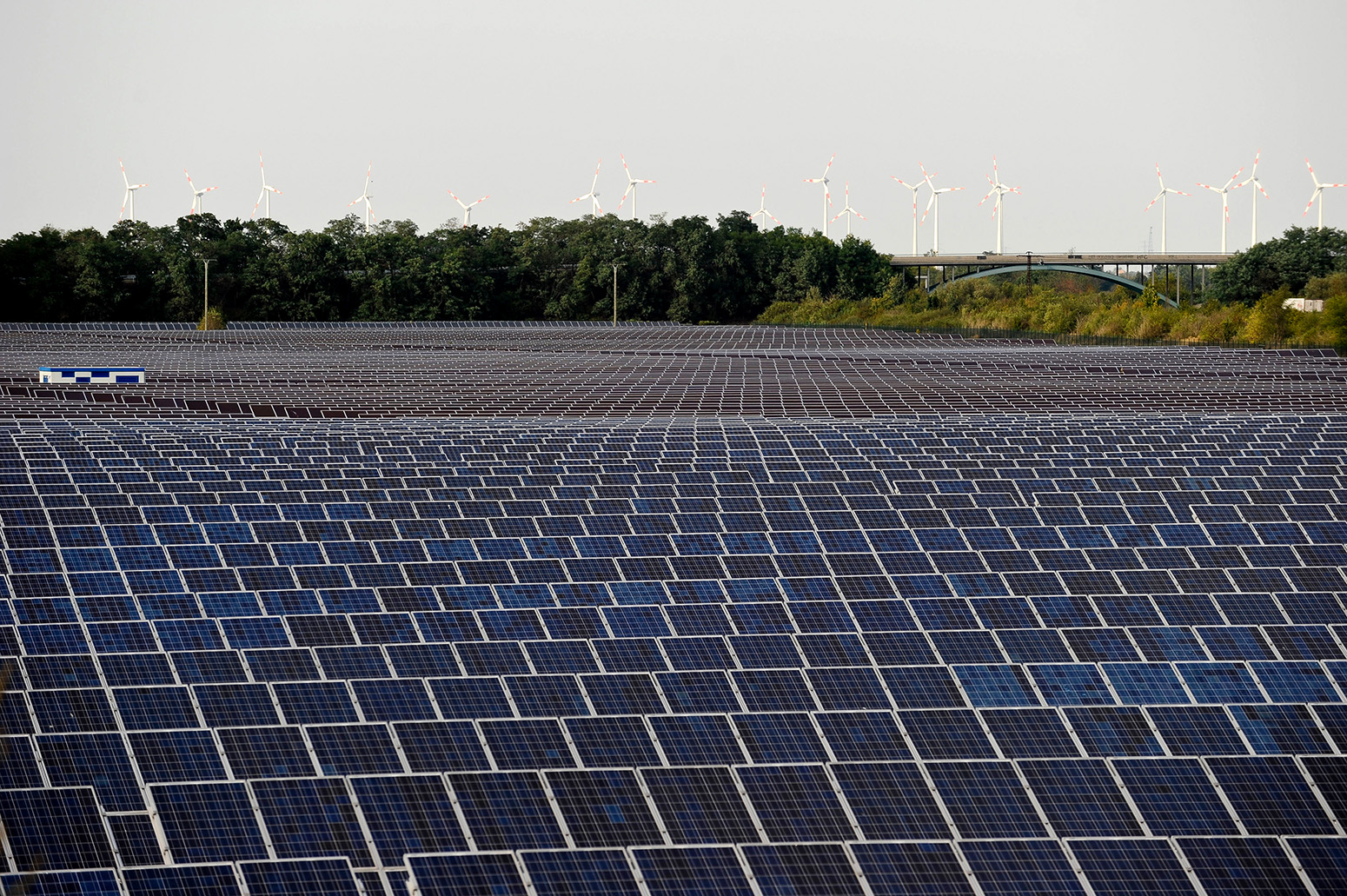
Net neutral
To investigate the carbon removal potential of such an approach, we modelled a simplified European power system (based on data from the European Network of Transmission System Operators for Electricity, known as “ENTSO-E”). We assume that the more direct solutions to mitigate renewable generation variability have been implemented – such as unlimited electricity transmission across Europe and different levels of storage – but deploy conservative assumptions related to the energy efficiency of DAC. Also, our model still includes fossil gas power plants that can be fired up on demand. For different levels of renewable contributions, we assessed the negative emission potential of DAC and the total emissions of the whole electricity system. We find that “net neutral” European power systems – where any CO2 emitted is balanced by CO2 taken out of the atmosphere – are achievable with a renewable penetration of just above 100% and at least 30 gigawatts (GW) of DAC. Here, “penetration” means the ratio of renewable power generation to electricity consumption (excluding DAC). If it exceeds 100%, this means that some renewable generation has to be curtailed and/or is used for DAC. We also find that storage technologies and DAC are not competing, but complementary. Increases in storage size allow for reductions of remaining carbon emissions and enable more efficient use of DAC. You can see this in the charts below, which show the average annual CO2 emissions for Europe (y-axis), according to the penetration of renewables (x-axis), and the amount of DAC – from 30 GW (left-hand chart) to 300GW (right-hand). This would be equivalent to DAC matching approximately 3-30% of current generation capacity in Europe. The charts reveal that at a low take-up of renewables, net emissions are positive (red bars), no matter how much DAC is used. However, as renewables approach 100% penetration, DAC can be used to take net emissions negative (blue bars).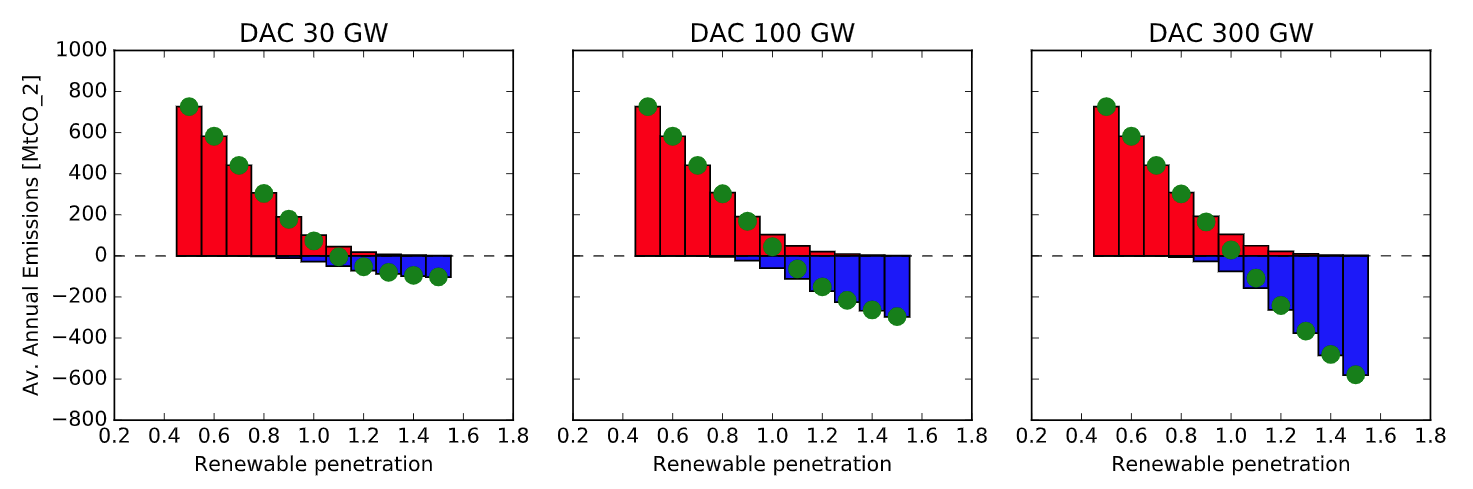
A closer look
There are still many uncertainties to consider, perhaps most importantly, whether or not the approach we have laid out is economically practicable. For example, in order to be viable even when not running around the clock, DAC’s future capital costs would need to be lowered substantially and/or carbon prices would have to increase, each by at least 10-fold. It is possible both conditions could be met as the technology is scaled up and global efforts to mitigate climate change become more tangible. On the other hand, imperfections in real-world electricity grid and energy system design – that can lead to excess electricity and negative electricity prices even today – may enhance DACs attractiveness. An increase in the efficiency of DAC – for example, by also making use of heat from other sources, such as industrial waste or renewable heat – would strongly increase its negative emission potential. However, it is also worth noting that other options to use excess renewables in a “sector coupled” approach exist that would be in direct competition with DAC. These might include electric vehicles that can be charged within a particular timespan, district heating with large reservoirs that store electricity, or converting electricity to hydrogen for transport and industry. While DAC is, thus, clearly not a silver bullet for carbon dioxide removal, it does come with system friendly features. And given the need for negative emissions, the concerns about land-based options, and the rapid technological and cost evolution of renewables, our first results indicate that it might be worth a closer look.Article information
Wohland, J. et al. (2018) Negative Emission Potential of Direct Air Capture Powered by Renewable Excess Electricity in Europe, Earth’s Future, doi:10.1029/2018EF000954