
Cropped 29 July 2026: Nairobi nature talks | Europe’s wildfires | Seabed mining stalemate
This is an online version of Carbon Brief’s fortnightly Cropped email newsletter.
We handpick and explain the most important stories at the intersection of climate, land, food and nature over the past fortnight.
Sign up below.
Key developments
Nature talks in Nairobi
MIDPOINT TALKS: Representatives of parties to the UN Convention on Biological Diversity (CBD) gathered in Nairobi this week to begin two weeks of talks ahead of October’s Conference of the Parties, which will be held in Yerevan, Armenia. This year marks the “midpoint between the adoption of the Kunming-Montreal Global Biodiversity Framework (GBF) in 2022 and its 2030 target date”, noted Earth Negotiations Bulletin, adding that it is also the world’s “first opportunity to take stock of collective progress towards achieving the Framework’s goals and targets”.
REPORT CARD: In Nairobi, delegates discussed a recently released draft of the CBD’s global report on progress towards the GBF targets. Carbon Brief reported that “countries are making overall positive progress on just one of the 23 targets”, noting that a final copy of the report will be formally published later this year. The report highlighted gaps in both the ambition set by countries and the action taken by them, added Carbon Brief.
SUBSIDISING HARM: Separately, Carbon Brief found that 84% of countries missed a deadline to “identify ‘nature-harming’ subsidies by 2025”. The new analysis was based on 134 national report submissions to the CBD, which revealed that countries have identified around $270bn in incentives that may have negative impacts on biodiversity. The primary sectors identified by countries were fossil fuels and agriculture. Under the GBF, countries are expected to collectively phase out $500bn in harmful subsidies by 2030.
Europe’s wildfire woes continue
DRAGON BREATH: “Pyrocumulonimbus” – the “fire-breathing dragon of clouds” – are helping drive wildfires across France, reported BBC News. These fire-driven thunderstorms are generated when severe wildfires form their own weather systems, the outlet said. A separate BBC News article said that French president Emmanuel Macron has called a “crisis” cabinet meeting, with hundreds of thousands evacuated as wildfires encroach upon Bordeaux. Meanwhile, El País reported that the Ávila wildfire burning near Madrid is the “largest in Spanish history”.
HABITATS UNDER THREAT: Wildfires across Wales and Scotland pose increasing threats to habitats, said ENDS Report, with fires near Bangor Mountain risking “internationally important upland habitats and species”, according to the Welsh environment regulator. The Irish Times quoted ecologist Pádraic Fogarty, who said Ireland’s “ecosystems are completely degraded” and argued in favour of restoring natural forests for wildfire protection. Le Monde covered how France could strengthen climate resilience when replanting the Landes de Gascogne forests, which are currently being ravaged by wildfires.
RIVERS RUNNING DRY: Volunteers in France are rescuing fish from rivers drying up due to heatwaves, reported the Guardian. France’s ecological-transition ministry said that during the latest heatwave almost one-third of river-monitoring stations had recorded their lowest levels in 20 years. Meanwhile, Le Monde stated that the Seine is “on life support” following extreme drought. A separate Le Monde piece said that in Morocco, four heatwaves across the past three months and temperatures reaching 50C have caused drought, threatening populations, industry and agriculture.
HEATWAVE, PART II: As firefighters rush to contain the flames, another heatwave due to hit this week will complicate wildfire control in Europe, reported the Guardian. The New York Times quoted the European Forest Fire Information System, which warned that Europe’s fourth heatwave since May means parts of France and Spain will remain under “very extreme fire conditions”.
News and views
- MISSING REEFS: Scientists have rediscovered a coral reef off the coast of Benin that had been presumed dead when first detected in the 1960s, reported Scientific American. The outlet said the rediscovery “shows the resilience of coral reefs against climate change” in west Africa’s Gulf of Guinea.
- SUIT UP: The “world’s largest meat company” JBS is facing a “landmark challenge” from Greenpeace in Dutch courts over its $6bn expansion, reported the Guardian. “This is the biggest agriculture investment that I have heard of in Nigeria’s history, but there have been few details and no consultation for civil society,” said Elujulo Opeyemi, spokesperson for Youth in Agroecology and Restoration Network.
- SLOW BURN: Just 3.1m hectares of the Brazilian Amazon was burned in 2025 – the lowest area in 41 years, following a record 15.8m hectares in 2024, said Valor International. The numbers show that it is “possible to reduce the burned area in the country”, Vera Arruda, co-ordinator of the deforestation-monitoring group MapBiomas, told BBC News.
- TAKING ATOLL: Droughts and heatwaves pushed 2.7 million people in small island developing states “into moderate to severe food insecurity” in 2023, according to a Lancet report covered by Down to Earth. At the same time, “global hunger declined for a third consecutive year in 2025, demonstrating that progress is possible”, said the UN Food and Agriculture Organization.
- ALL-IUM IS LOST: “Global warming has caused China’s rain belt to shift”, disrupting the country’s garlic crop – which accounts for more than 70% of global production, said Sixth One. Meanwhile, several spells of record-breaking heat in France “decimated” onion and other vegetable crops, reported the Daily Telegraph. June’s heatwave in particular “wiped more than €2bn from the value of [the EU’s] grain crop”, said the Financial Times.
- CHICKEN AND EGG: The Guardian covered a new study that suggested organic eggs “are twice as bad for the climate” as those from caged hens. However, it “did not take into account other environmental impacts”, such as pesticide use, the outlet said. Other experts quoted by the UK Science Media Centre criticised the study on environmental, methodological and welfare grounds.
Spotlight
ISA vs the US
This week, Carbon Brief examines the friction between the UN International Seabed Authority (ISA) and US-backed efforts to mine the seabed for minerals, as deep-sea mining talks approach a close this week.
As negotiations over a “mining code” for deep-sea mining enter their third decade, the seafloor has emerged as not only a new frontier for resource extraction, but also a legal battleground for the global commons.
In 1994, the UN Convention on the Law of the Sea (UNCLOS) established the International Seabed Authority (ISA), which controls all resource extraction in the deep sea beyond national waters.
By default, all 169 countries and the EU that are party to UNCLOS are members of the ISA. The US is not a party to UNCLOS and, therefore, not a member of the ISA. This means it cannot bid for leases to explore and mine the international seabed.
However, that has not stopped US president Donald Trump’s administration, which is keen to secure its own supplies in the global race for critical minerals.
In April 2025, Trump issued an executive order to “unleash” the country’s offshore critical minerals. The order refers to both the resources in US-controlled parts of the ocean and those in areas beyond national jurisdiction.
Investigation
One section of the order directed the US National Oceanic and Atmospheric Administration (NOAA) to “expedite the process” for issuing seabed mineral permits.
In January this year, NOAA issued its final deep-sea mining rule, updating the 1980 Deep Seabed Hard Mineral Resources Act (DSHRMA), which gave NOAA the authority to issue commercial recovery permits for seabed mineral resources in international waters.
While progress on mining rules in the ISA remains slow – to date, 45 countries have supported a moratorium on deep-sea mining – many of the same companies seeking contracts under the ISA have now also submitted bids to NOAA. To date, there are five applications listed on the NOAA site, but this could be more than 10, according to a US Congress report.
Hedging their bets, however, has not gone down well for these companies.
On 20 July, the world’s top maritime court refused to halt an ISA investigation into whether two subsidiaries of Canadian firm the Metals Company had breached their contracts by seeking US-backed permits, Climate Home News reported.
The firms – Tonga Offshore Mining Ltd (TOML) and Nauru Ocean Resources Inc (NORI) – had sought permits from NOAA to mine the deep seabed in international waters “in an area already covered” by their UN exploration permits.
Last June, both firms sued the ISA for discrimination and targeting them without “good faith” when it launched the inquiry against them. This charge was effectively shut down by the tribunal’s refusal to halt the investigation.
However, at the ongoing deep-sea mining talks in Kingston, Jamaica – home of the ISA secretariat – the ISA Council decided to extend NORI’s exploration contract, even as the investigation against it resumes.
In a statement, policy advisor at the Deep Sea Conservation Coalition (DSCC), Emma Wilson, said:
“The decisions of this week show the ISA once again hindered by its outdated processes to move swiftly on companies breaking international law. By delaying action on unlawful mining, the ISA is undermining confidence in its ability to regulate the industry. If it cannot enforce the rules, it cannot manage exploitation.”
Broader challenge
Besides actions against specific companies, there is a broader challenge currently being discussed by the ISA talks and its member states in the remaining days of the session.
Before them is a draft decision to seek an advisory opinion from the International Tribunal of the Sea on the legal implications of “unilateral” seabed-mining measures, and on whether and how such measures can be challenged.
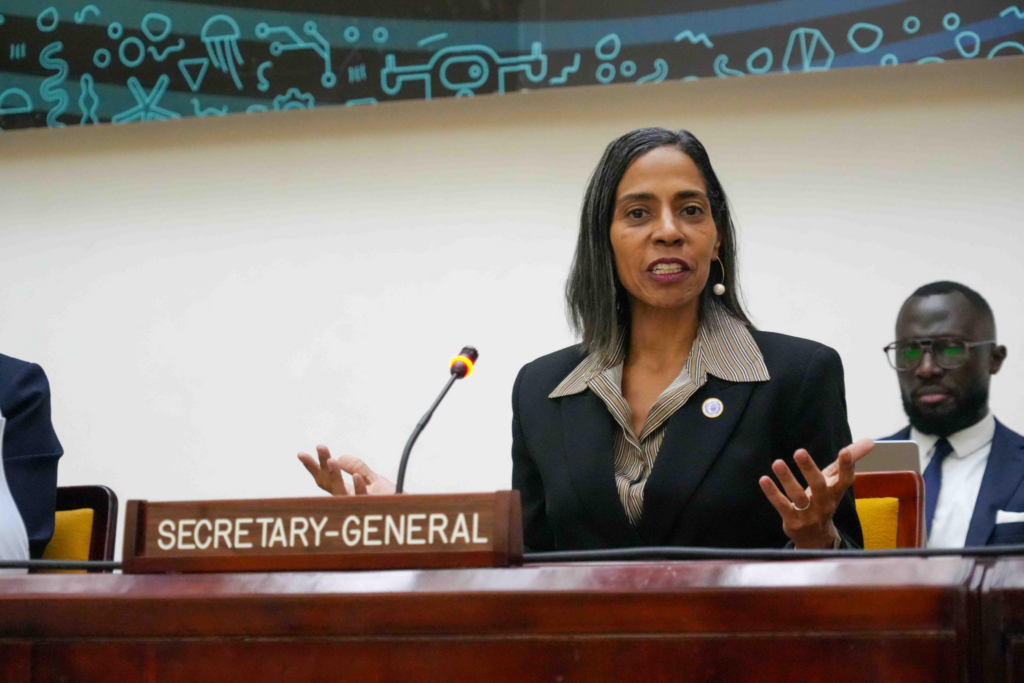
A note attached to the draft decision from the ISA’s secretary general states:
“At present, the principle of the common heritage of humankind as embodied in the Convention is threatened.”
If passed, the decision would “reconfirm the international community’s position” that pursuing mining in international waters outside of the ISA is “inconsistent with international law”, said Julian Jackson, project director of seabed mining at Pew Charitable Trusts, speaking to Carbon Brief.
Duncan Currie, an international environmental lawyer with the DSCC, told Carbon Brief:
“Governments have spoken repeatedly about defending the common heritage of humankind, but words alone will not protect it. States now need to show that they are prepared to stand up to companies seeking to undermine the international system.”
Watch, read, listen
‘FREETOWN THE TREETOWN’: The Continent spoke to Sierra Leone’s Eugenia Kargbo, Africa’s first heat officer, who is pushing an ambitious urban forestry plan to cool Freetown.
CLOSE CALL: Forbes interviewed climate scientist Prof Stefan Rahmstorf about his experience fleeing a “totally surreal” wildfire threatening to engulf Bordeaux, France.
DRY RUN: The Guardian took a closer look at Brazil’s São Francisco River diversion project – meant to “quench the thirst” of 12 million people – finding that those displaced by it “have no water at all”.
SINK TO SOURCE: Deutsche-Welle’s Living Planet podcast travelled to north-eastern Australia’s intact rainforest, where trees are “dying twice as fast” as they used to.
New science
- Climate change is the “dominant threat” to island ecosystems, with islands that are “highly exposed” to climate change hosting the most vulnerable biodiversity | Proceedings of the National Academy of Sciences
- Almond trees in Afghanistan are blooming an average of two weeks earlier than they were in 1980, representing “a clear deviation from historical patterns in response to climate change” | International Journal of Biometeorology
- Since 2009, tidal wetlands have lost more than 6% of the organic carbon stored in their soils globally | Nature Communications
In the diary
- 13-31 July: Meeting of the International Seabed Authority | Kingston, Jamaica
- 27 July-1 August: Meeting of the scientific and technical subsidiary body of the UN Convention on Biological Diversity | Nairobi, Kenya
- 4-12 August: Meeting of the subsidiary body on implementation of the UN Convention on Biological Diversity | Nairobi, Kenya
- 17-28 August: COP17 of the UN Convention to Combat Desertification | Ulaanbaatar, Mongolia
This edition of Cropped was written by Giuliana Viglione, Amy Rushton and Aruna Chandrasekhar,
Cropped is edited by Dr Giuliana Viglione. Please send tips and feedback to [email protected].