
DeBriefed 16 October 2026: Nature plans ‘insufficient’ | How EVs saved ‘$20bn’ | El Niño and UK weather

Welcome to Carbon Brief’s DeBriefed, an essential guide to the week’s key developments relating to climate change.
In this issue…
- Countries’ latest biodiversity plans were deemed “insufficient” to meet nature goals.
- Electric vehicles saved countries $20bn in oil imports since the start of the Iran war.
- Carbon Brief examines how El Niño could affect UK winter weather.
- Key dates for next week and pick of the job vacancies.
This week
COP17 nears
‘INSUFFICIENT’ PROGRESS: The latest round of biodiversity plans submitted by countries is “insufficient” to meet the world’s nature goals for 2030, according to a UN report released ahead of the COP17 biodiversity summit next week. The report will provide the “main basis” for the first global review of progress towards meeting the 2030 goals taking place at the summit in Yerevan, Armenia, over the next two weeks, said Climate Home News.
TARGETS ANALYSED: Carbon Brief took an in-depth look at what the report says about progress on each of the 23 nature targets for 2030. Separately, Carbon Brief has also reported on which countries have met the call to produce new nature pledges, plus published an interactive tracker for all of COP17’s negotiating texts.
Around the world
- THREE-HOUR FIGHT: Politico reported that the first session of talks on how to curb energy prices at an EU leaders’ summit in Brussels yesterday “descended into a three-hour fight” over plans to put a carbon price on road and heating fuel.
- DIESEL DEAL: Trump announced Russia “agreed to supply 300,000 tonnes of diesel to global markets”, with the US temporarily lifting sanctions, according to Reuters. Analysts “doubt” that the deal will ease prices as intended, said CNBC.
- CAR TARGETS: France and Germany want EU emissions targets for new cars to be “water[ed] down” to 90% below 2021 levels by 2035, reported Reuters.
- PUMP CUTS: A Guardian report, citing “sources” saying that heat-pump grants could be “slash[ed]” to fund defence spending, drew an “industry backlash”, said the Financial Times.
- HURRICANES HIT: Hurricane Isaias – the first Atlantic hurricane of 2026 – made landfall in Florida, killing at least six people, reported the Guardian. Hurricanes Simon and Rachel also battered Mexico’s Pacific coast, said Al Jazeera.
$20 billion
The avoided cost of oil imports from electric vehicles (EVs) in the six months since the start of the Iran war, according to analysis by thinktank Ember of EV sales data across 56 countries.
Latest climate research
- The rate of global warming over 2011-25 was twice as fast as during 1971-2025, indicating that the 1.5C warming threshold will be crossed by 2028 – nearly a decade earlier than previously estimated | npj Climate and Atmospheric Science
- Urban heat risk is increasing five times faster in the global south than the global north | Communications Earth & Environment
- Models show the Atlantic Meridional Overturning Circulation weakens as global temperatures increase, but “consistently and promptly recovers” if warming is reversed | Science Advances
(For more, see Carbon Brief’s in-depth daily summaries of the top climate news stories on Monday, Tuesday, Wednesday, Thursday and Friday.)
Captured
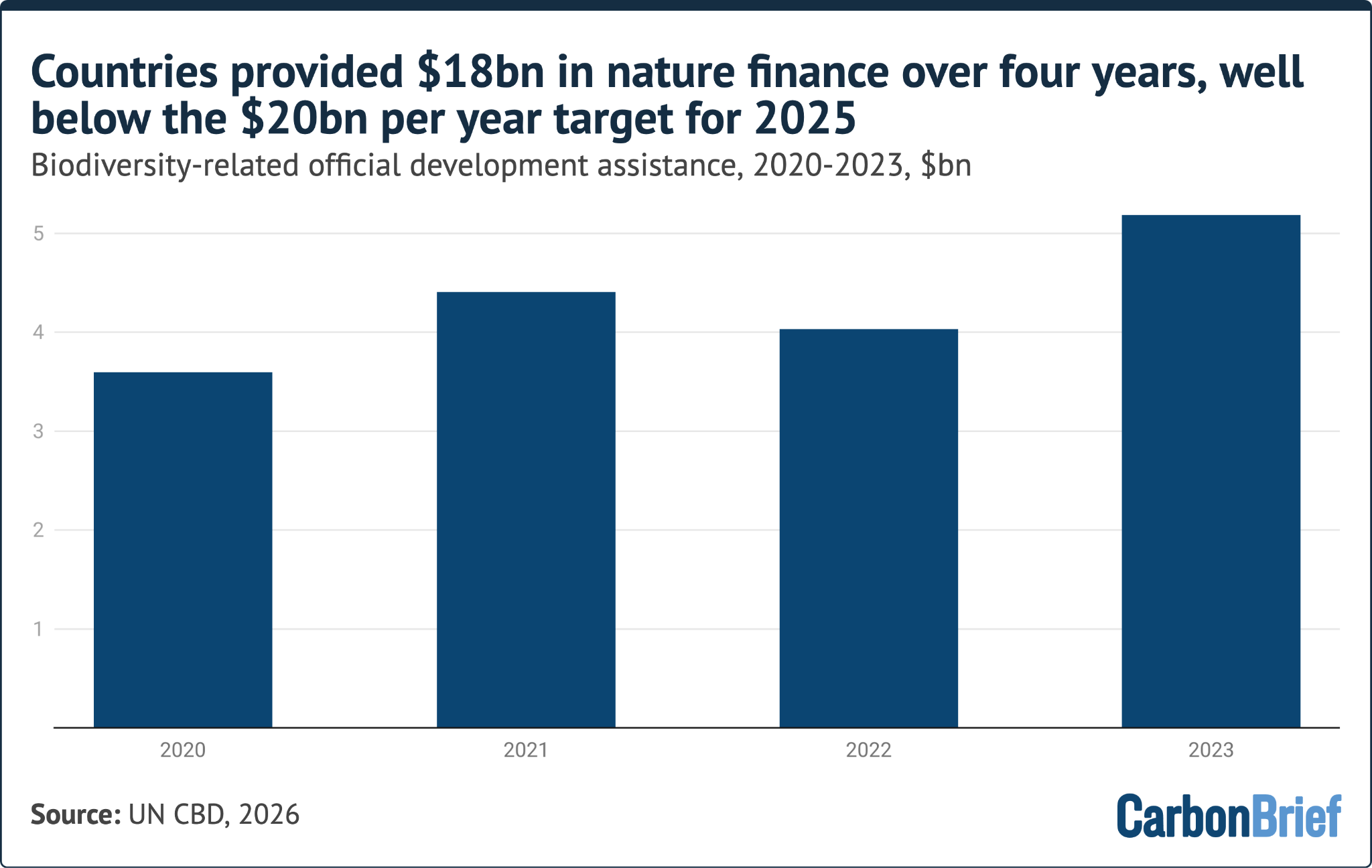
At the COP15 biodiversity summit in 2022, countries agreed to raise $20bn annually in nature finance for developing countries by 2025. Carbon Brief analysis of the UN’s data shows how countries provided just $18bn in nature finance from 2020-23, falling well short of the 2025 target.
Spotlight
How El Niño could affect UK weather
This week, Carbon Brief explores how El Niño could affect UK weather over the coming months and how the country can prepare for future extremes.
Last weekend, the UK government announced a new flood and drought resilience taskforce to “strengthen the nation’s ability to plan for and respond to extreme weather”.
This year began amid one of the UK’s wettest winters on record. But most of the country is now in drought after months of low rainfall, with “severe drought” even being declared in parts of England this week for the first time in history.
Climate change is already bringing warmer, wetter winters to the UK – increasing winter rainfall by around 7% for every 1C of global warming.
The coming winter will also take place amid an “unprecedented” El Niño event.
El Niño weather impacts
While El Niño is known to have a large impact on weather in many parts of the world, its impacts on the UK are generally “less direct” and “less certain”, according to a government briefing on the phenomenon.
However, the briefing adds that “since this may be the largest El Niño to date it could result in unforeseen effects on UK weather”.
The Met Office’s latest seasonal forecast for the UK indicates an “increased likelihood of wet, windy and potentially stormy conditions later this autumn and into early winter”, noting that this is consistent with past El Niño events.
Prof Hayley Fowler, professor of climate change impacts at Newcastle University, told Carbon Brief that warmer sea temperatures associated with El Niño can lead to wetter weather in the UK:
“There’s this warm temperature pathway in sea surface temperatures, which comes from the Pacific all the way through the tropics and follows the track of south-westerly storms towards the UK…pick[ing] up this extra moisture.”
But El Niño is “only one of several climate drivers affecting the UK’s weather”, according to the Met Office.
For example, the current El Niño is expected to temporarily warm the atmosphere by around 0.2C. This is equivalent to five years of human-caused global warming at recent rates, Fowler told Carbon Brief, adding:
“[El Niño] is kind of a wake-up call for us… We need to be more prepared as a society for these types of events every winter, never mind just this winter.”
Preparing for winter
The Environment Agency estimates 6.3m properties are at risk of flood in England.
While heavier rain – especially when running off dry soil – heightens flood risk, it is hard to project exactly where floods are likely to occur, said Fowler.
However, preparing for “cascading failures” from floods and storms – including disruption to electricity and water supplies, telecommunications and transport – should be a priority for the new government taskforce, she added.
Fowler also stressed the importance of building resilience at the community level. One community she visited in Fintry, Scotland – a village often cut off by floods – set up resilience centres to provide food, shelter, electricity and satellite phones.
She welcomed the expanded remit of the taskforce, suggesting a “joined-up approach” to managing flood and drought could help tackle key problems such as water storage, adding:
“We’ve had this big increase in winter rainfall, but we’re not capturing that extra water, and it’s causing significant floods every year now. Yet, we’ve got problems with a lack of water supply in the summer.”
Such shortfalls could reach 5bn litres a day by 2055, according to the Climate Change Committee, which has called for investment in new reservoirs and other water infrastructure.
Watch, read, listen
FUDGING FIGURES: A risk modeller in the insurance industry wrote about commercial pressures to “cut forecasts” for climate-related risks in an anonymous piece for the Guardian.
OBAMA LEGACY: In the New York Times Climate Forward newsletter, David Gelles wrote about the “jarring disconnect” he felt on climate between past and present during a visit to the Obama Presidential Centre in Chicago.
AFGHANISTAN DROUGHT: The Guardian reported on how drought and hunger, fuelled by “climate breakdown”, is forcing girls towards child marriage in Afghanistan.
Coming up
- 19-30 October: COP17 biodiversity summit, Yerevan, Armenia
- 21 October: UN emissions gap report 2026 launch
Pick of the jobs
- Scientists for Global Responsibility, executive director (part-time) | Salary: £42,123 (pro-rata £16,849). Location: UK (remote)
- Wageningen University and Research, PhD researcher in atmospheric sciences – emerging extreme fire weather risks | Salary: €3,204 per month. Location: Wageningen, Netherlands
- University of Bristol, senior research associate in climate science | Salary: £33,906-£50,253. Location: Bristol, UK
DeBriefed is edited by Daisy Dunne. Please send any tips or feedback to [email protected]
This is an online version of Carbon Brief’s weekly DeBriefed email newsletter. Subscribe for free here.