
DeBriefed 21 August 2026: El Niño boosts wildfires | Trump’s ‘unexpected’ renewables boom | Why hurricane season is ‘very quiet’

Welcome to Carbon Brief’s DeBriefed.
An essential guide to the week’s key developments relating to climate change.
Sign up below.
This week
Furious fires
‘DOUBLE THE DAMAGE’: Wildfires burned nearly 95,000 hectares across Indonesia in July, reported Reuters, almost doubling the area of the previous six months. The uptick is being fuelled by the strengthening El Niño event, which brings warm and dry conditions to south-east Asia and Australia. Fire authorities in Australia warned that almost every state and territory is “facing a heightened risk of bushfire”, said the Independent. The UK Met Office said the El Niño is set to be the “strongest in living memory”, reported BBC News.
BELGIAN BLAZE: Hundreds of firefighters tackled Belgium’s largest wildfire in more than a century, reported the Times. Europe’s record temperatures have turned the “usually damp forests into tinderboxes”, the newspaper said. In the US, the western US is having an “extraordinary fire season”, scientists told the Atlantic. But, because the fires are not in California, they have received less media attention, they added.
Renewables rollout
‘CLEANTECH BOOM’: US president Donald Trump is “presiding over an unexpected clean energy boom”, reported the Financial Times. Solar and wind installations will “reach a record high in 2026”, the article said, despite “Trump’s early efforts to kill an energy transition pushed by his predecessor Joe Biden”. In response, a White House spokesperson touted “record-high oil and gas production” under Trump, the FT noted.
FOREST THREAT: Meanwhile, the Trump administration “advanced a plan” to allow logging and road building in “pristine” US national forests, reported the New York Times. The proposal by the US Forest Service would repeal the 2001 “roadless rule” and open up 18m hectares of wilderness, the newspaper said. Experts cast doubt on claims that adding roads and thinning forests would reduce wildfire risks, the article noted.
Around the world
- LEADERSHIP ‘INTENT’: China is considering a bid to host the UN climate summit in 2028, known as COP33, according to Bloomberg.
- HEAT LIMITS: Heat-related deaths across Germany, France, Italy and Spain this summer have passed 25,000, reported Euractiv. Al Jazeera covered new research on the “underestimated” risk to older people from extreme heat.
- ‘CATASTROPHIC HARVESTS’: European farmers warned that multiple heatwaves and ongoing droughts are causing an “unprecedented crisis”, reported the Guardian.
- ‘MORE HOLES THAN SWISS CHEESE’: Carbon Brief factchecked a new report that the opposition Conservative party is using to undermine the UK’s net-zero target.
- GREEN ENERGY: Kenya has “tripled its long-term target” for expanding renewable energy capacity, which would include new nuclear, hydropower and geothermal projects, said the Associated Press.
101.5 million tonnes
The amount of CO2 that the US’s 60 largest planned data centres could produce each year – equivalent to the annual emissions of 27 coal plants, according to analysis by the Financial Times.
Latest climate research
- A recent – and “probably temporary” – slowdown in Antarctic ice sheet loss is linked to warm subtropical ocean temperatures | Nature
- Reforestation was the “dominant contributor” to China’s forest carbon sink over the past three decades | Nature Geoscience
- Interviews with authors and illustrators of children’s climate change books revealed a preference for “narratives that inspire hope through action” | Environmental Communication
(For more, see Carbon Brief’s in-depth daily summaries of the top climate news stories on Monday, Tuesday, Wednesday, Thursday and Friday.)
Captured
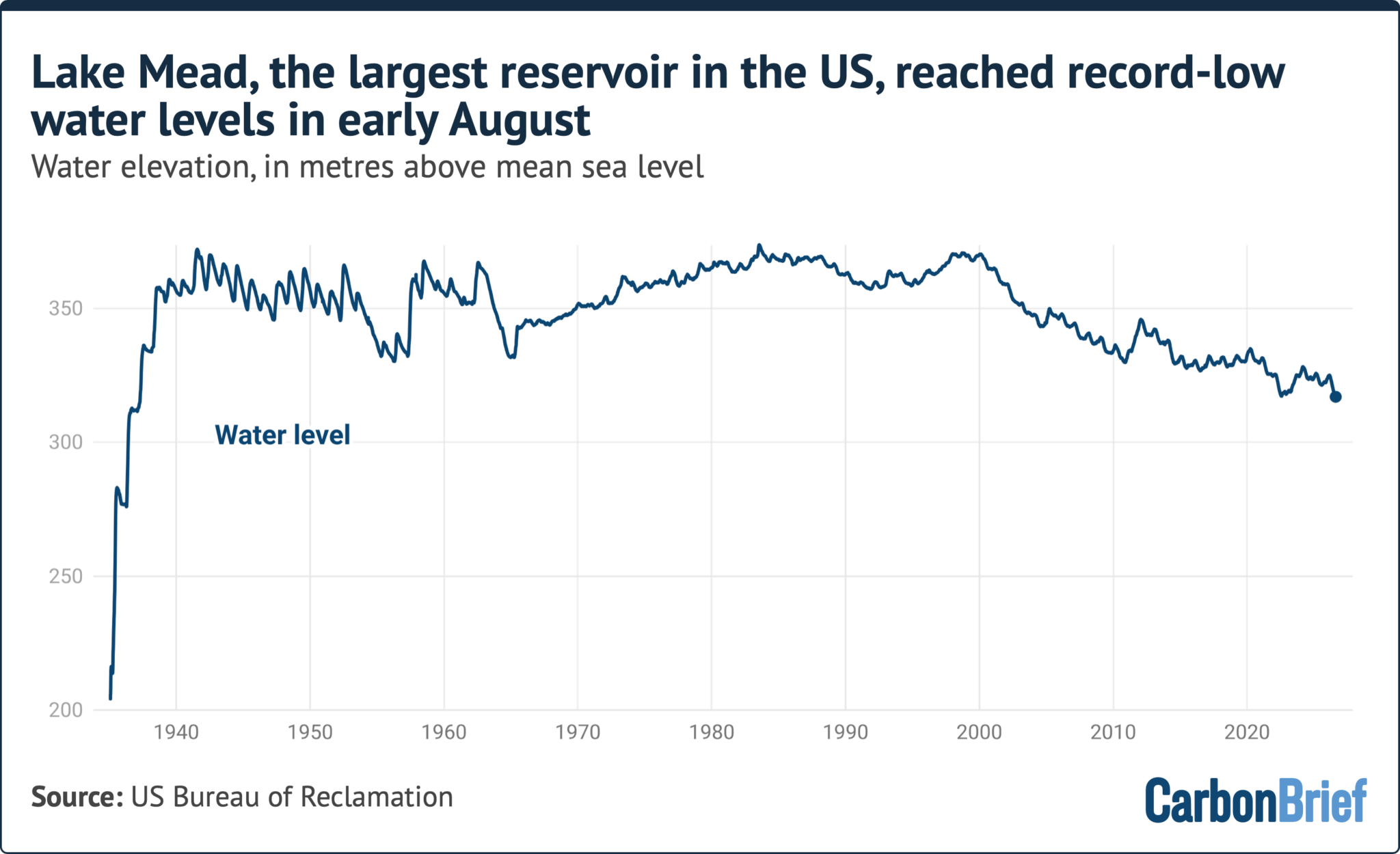
The water level of Lake Mead, the largest reservoir in the US, dropped to a record low in early August, reported Carbon Brief. Lake Powell, the second-largest reservoir, also hit a record low shortly after. The “ultimate cause” of the “present water crisis” is the warming climate, an expert told Carbon Brief. There is also a “proximate cause”, they added – that the “big policy decisions” needed to respond to the crisis “occur painfully slowly”.
Spotlight
The quiet hurricane season of 2026
This week, Carbon Brief reports on how the developing “super El Niño” is leading to a “very quiet” season for hurricanes in the North Atlantic.
While much of the world is facing record heat, floods and fires, there is at least one part of Earth’s system that is experiencing fewer extremes than normal.
The North Atlantic hurricane season – affecting countries in North America and the Caribbean – is heading into what is typically its peak period.
The season runs from 1 June to 30 November, but early September is, on average, the high point for hurricane activity. In previous seasons, early September has brought major hurricanes, such as Irma in 2017, Florence in 2018 and Lee in 2023.
However, this year has been “very quiet” so far, Dr Phil Klotzbach, an expert in hurricane forecasting from Colorado State University, told Carbon Brief.
There have been just three “named storms” in the Atlantic: Arthur, Bertha and Cristobal – and zero hurricanes.
A tropical cyclone is assigned a name once its wind speeds reach at least 39 miles per hour (mph) and it becomes a “tropical storm”. A tropical storm becomes a hurricane once its wind speeds hit 74mph.
A typical hurricane season would “ramp up significantly around 20 August”, said Klotzbach, but there are “no signs” at this point.
One metric that scientists use to track hurricane activity is the “accumulated cyclone energy” (ACE) index. This is calculated by adding up the sustained wind speeds of all named storms during that season. Klotzbach continued:
“By this time during the season, on average, we have had 16 ACE, while this year so far, we have had three [ACE]. As a point of reference, an average season has 123 ACE.”
The three named storms forming this year have been “weak and short-lived”, said Matthew Rosencrans, lead hurricane seasonal forecaster at the US National Oceanic and Atmospheric Administration‘s Climate Prediction Center.
As a result, he told Carbon Brief, total activity is “well-below normal for the year-to-date”.
This is, however, largely in keeping with forecasts earlier this year, noted Rosencrans. Back in May, NOAA predicted that there was a 55% chance of a below-normal season this year. That likelihood has since been raised to 75%.
El Niño impact
The reason for the below-average forecasts is the strong El Niño event developing in the Pacific Ocean.
As Carbon Brief unpacked in a new interactive explainer, this year’s event – dubbed a “super El Niño” – is expected to become the strongest in modern records.
While El Niño events are centred on the Pacific, they have ripple effects for weather around the world. One of these effects is to stifle the development of hurricanes in the North Atlantic, explained Klotzbach:
“El Niño significantly knocks down Atlantic hurricanes due to increases in vertical wind shear – the change in wind speed and direction with height in the atmosphere.”
Over the past month, vertical wind shear in the Atlantic has been “extremely high”, he said, “tearing apart any [storm] systems that have tried to form”.
The quiet forecasts come despite record ocean heat this summer, which would typically provide fuel for storms, added Klotzbach:
“While Atlantic sea surface temperatures are much warmer than normal right now…we anticipate the El Niño-driven shear to be the big story for the season.”
Forecasts suggest vertical wind shear in the Atlantic will remain “elevated well into September – and likely beyond”, said Klotzbach. Yet, there may be some early signs of activity on the horizon.
Meanwhile, an El Niño event does not mean a quiet year for storms in other parts of the world.
El Niño typically shifts the path of tropical cyclones in the Pacific, leaving some countries more at risk of powerful storms than usual.
This month alone has seen Typhoon Dolphin bring torrential rains to China, Japan and the Philippines, and Hurricane Lala cause flash flooding and mudslides in Hawaii.
Watch, read, listen
‘CLIMATE SUPERPOWERS’: Climate scientist Dr Kimberly Nicholas has launched “Climate Actually”, a new podcast to show that “your choices matter” on climate change.
‘FEEDING FRENZIES’: BBC News reported that “hundreds” of humpbacks, minke and fin whales have been filmed feeding in areas off eastern Greenland that were previously covered by sea ice.
CAR CONVERT: In his column for the Times, Giles Coren wrote that the “era of motor macho has passed”, noting that the world’s “motor obsession” is “why it is hotter than 1976 today and will be tomorrow”.
Coming up
- 17-28 August: UN Convention to Combat Desertification COP17 summit, Ulaanbaatar, Mongolia
- 25 August: Launch of UN Environment Programme technical report proposing the Drought Resilience Capacity Index
- 29 August: Kazakhstan parliamentary elections
Pick of the jobs
- The New York Times, correspondent, the economics of a warming world | Salary: $124,979-$160,000. Location: New York
- UK Department for Environment, Food and Rural Affairs, international strategic engagement and multilateral deputy director | Salary: £86,000-£117,800. Location: Bristol, London or York
- Dialogue Earth, Brazil editor | Salary: $250 a day. Location: Brazil (remote)
- City of London Corporation, head of climate action and social value. | Salary: £68,300-£77,400, Location: London