
DeBriefed 27 November 2026: COP31 ‘fails’ | 2C for six days | Trump’s false claims

Welcome to Carbon Brief’s DeBriefed, an essential guide to the week’s key developments relating to climate change.
In this issue…
- COP31 concluded late on Sunday with ‘no major deal’.
- Global temperatures hit 2C above pre-industrial levels for six days.
- Carbon Brief pulls together all the media fallout from COP31.
- Key dates for next week and pick of the job vacancies.
This week
‘Deep divisions’ at COP31
TROUBLED TALKS: COP31 ended late on Sunday with countries “fail[ing] to reach a major new deal to tackle climate change after deep divisions over fossil fuels and money”, reported BBC News. As the summit in Antalya overran – becoming the longest COP in history – a final “cover decision” was rejected by the EU, island nations and others “because it failed to directly mention fossil fuels”, the outlet explained. It added that “many poorer countries objected to the absence of any clear financial commitments from richer nations”.
NOT A ‘COMPLETE FAILURE’: Carbon Brief published its in-depth analysis of all the key outcomes from COP31, from the failed “Antalya pact” to the items that were adopted, such as a new “mechanism” for global “just transitions” and support for countries struck by climate disasters. Another Carbon Brief article summed up outcomes around food, forests, oceans and nature, while CB journalists discussed all the details in a CB Live event.
FINGER-POINTING: The failure to agree a cover decision made many newspaper frontpages, with some outlets attributing COP31’s “collapse” to “oil-rich nations”, while others blamed Europe’s “reluctance” to provide more climate finance. Pope Leo weighed in, describing the outcome as “troubling” and urging “world leaders to step up efforts to combat climate change”, reported Reuters. Carbon Brief summarised the media reaction to the talks (see more below).
MULTILATERAL MESS: In the aftermath of the talks, Euronews reported that the European Commission was “drawing up plans to overhaul” the UN climate summit process, fearing that the “current negotiating system risks becoming ineffective because a single country can block an agreement”. Next Wednesday, Carbon Brief is hosting a live ‘Ask Me Anything’ (AMA) with Joanna MacGregor, the UNFCCC’s chief of strategy and UN affairs. Sign up to CB+ to post your questions.
Around the world
- ‘HOT STREAK’: In a frontpage story, the Guardian reported that, for the first time, global temperatures reached more than 2C above pre-industrial levels for six consecutive days this week.
- RECOVERY EFFORT: India announced a $1.6bn economic assistance package to help Nepal rebuild areas devastated by flash floods in September, reported the Associated Press.
- UNTRUTH SOCIAL: On social media, US president Donald Trump repeated his false claims about a very-high-emissions scenario being “debunked” and “withdrawn” by the Intergovernmental Panel on Climate Change, reported Indian newswire ANI.
- SUMMIT SUCCESS: In a “landmark” package, the EU and UK agreed to link their respective carbon markets and commit to “further talks over UK re-joining EU’s electricity market”, according to BusinessGreen.
- ‘NOT OUT OF REACH’: A government report revealed that Australia is off track for both its 2030 and 2035 climate targets and will “need to more than quadruple the pace of emission cuts”, reported the Australian Associated Press.
- ‘INTERNAL DIVISIONS’: The Guardian reported on its frontpage that nearly 100 Labour MPs, “including at least four frontbenchers”, have written to the UK prime minister to oppose the Rosebank oilfield.
5,258
The number of heat-related deaths in England this summer, exceeding the previous record high of 2,985 in 2022, according to UK Health Security Agency data reported by BBC News.
Latest climate research
- During the “record-warm period” of 2023-24, there was a “global-scale synchronised decline” of water levels in rivers and lakes – the “largest reduction since 1991” | Science
- The CO2 emissions from global peatland drainage have had a “profound and persistent impact on Earth’s climate” | Nature
- A 16-year study of two Great Barrier Reef coral species suggested that “coral gene pools are changing” and “measurable evolution can happen over sub-decadal timescales” | Science Advances
(For more, see Carbon Brief’s in-depth daily summaries of the top climate news stories on Monday, Tuesday, Wednesday, Thursday and Friday.)
Captured
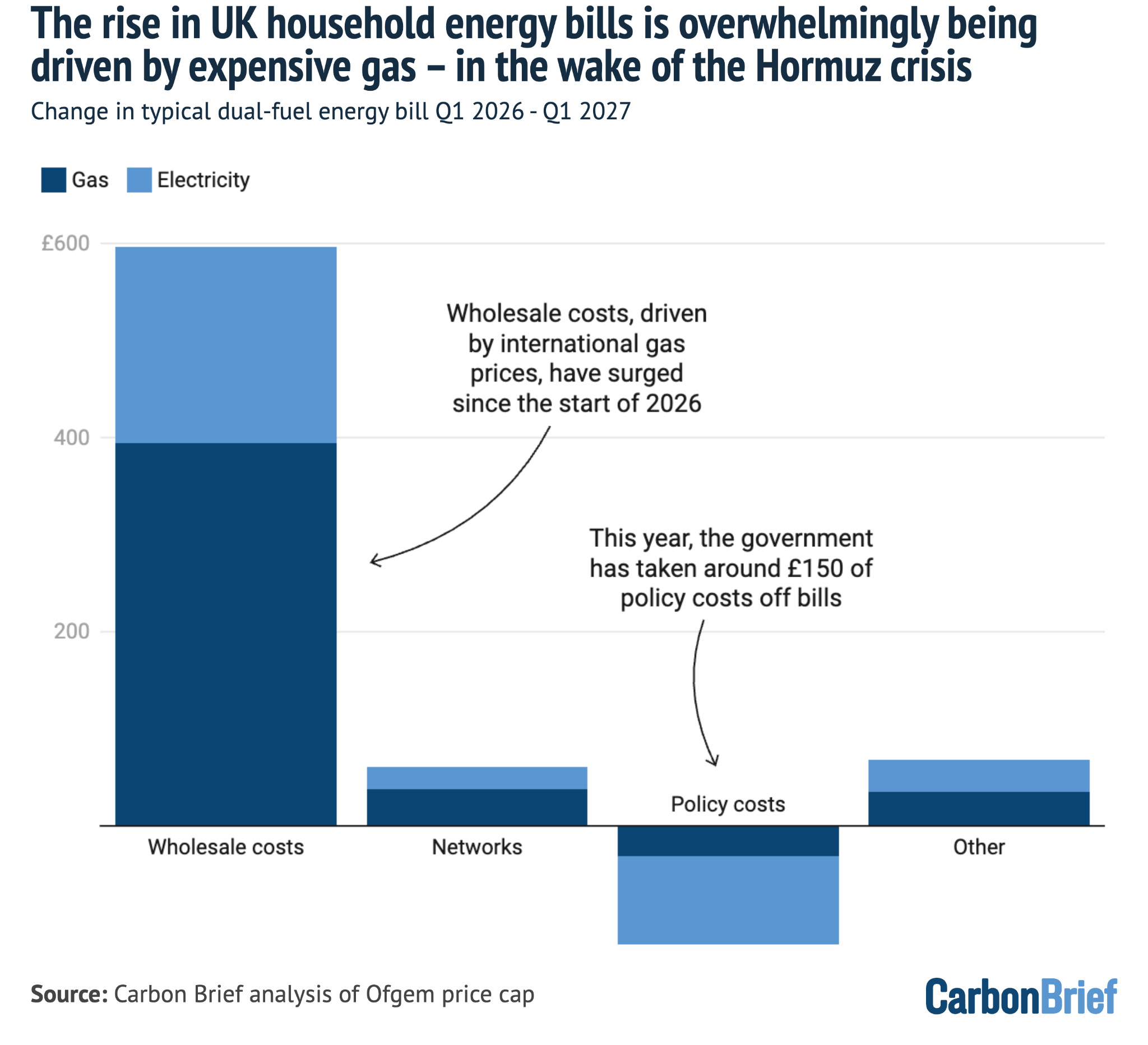
This week, the UK energy regulator Ofgem announced that typical household energy bills will rise by 26% (£443 per year) from 1 January 2027. On CB Connect, Carbon Brief’s Dr Simon Evans explained that the “reality is very simple” on the causes of the rise: “Expensive gas is driving up bills in the wake of the Hormuz crisis.”
Spotlight
Who is to blame for COP31’s ‘failure’
This week, Carbon Brief draws together media reactions from around the world to show the diversity of responses to the COP31 outcome.
The tense final moments at COP31 and lack of a much-anticipated “Antalya pact” have sparked extensive media commentary globally.
Among the reaction, some commentators critiqued decisions made by the co-presidents. An editorial in the Hindu noted that, “usually, cover texts evolve as a final synthesis of deliberations”, but said the COP31 leadership “thought it fit to push for a cover text early in the proceedings”.

Australian “president of negotiations” Chris Bowen also faced criticism over how he managed competing interests at the summit. An editorial in the climate-sceptic Australian said:
“One thing is clear: Chris Bowen, who presided over Australia’s $150m investment in the conference, has some explaining to do. International reporting has raised questions about Australia and Turkey, the two nations that co-hosted the summit. Some negotiators have criticised their handling of the talks.”
Much of the media blame for the perceived failure of COP31 has been placed on oil-producing nations – particularly with the final cover decision draft containing no mention of fossil fuels.
This omission came “amid pressure from Russia, Saudi Arabia and other fossil-fuel producers”, said a Bloomberg editorial. A Times editorial described oil-rich nations, “led by Saudi Arabia”, as the “culprits” for the lack of an agreement.
Going further, David Shukman, a former BBC News science editor, described a “deception” at the “heart” of the COP process. In the i newspaper, he wrote:
“This pattern of lobbying by oil-rich nations has become increasingly blatant and aggressive over more than three decades.”
Nick O’Malley, national environment and climate editor for the Sydney Morning Herald, noted:
“The tension between the action the world knows it must take on climate change and that which a handful of oil-rich nations will allow it to take has been growing for years.”
Blocking
Much of the commentary about the role of developed countries at COP31 focused on the EU and the UK blocking the final deal due to its lack of language about fossil fuels.
However, European countries also drew criticism. For example, a Guardian editorial said they were “wrong to rule out fresh EU funding for developing countries’ climate action”.
An editorial in the Hindu in India stressed:
“It stands to reason that developed countries, which have committed to providing climate finance in recognition of their historical emissions, make good on past promises to shoulder the cost of the carbon emissions that are responsible for warming.”
Climate finance – as well as equity and historical responsibility for climate change – was portrayed at the centre of developing countries’ positions at COP31.
For example, the Star in Kenya said the country had “drawn a firm line” at COP31 and would not “back down until an acceptable deal is secured on climate finance”.
A comment in the Hindu said that “India’s insistence on historical responsibility, climate finance and adaptation belongs at the centre of any credible plan to cut emissions”.
Chinese negotiators maintained a “relatively low profile” at COP31, said Bloomberg. An editorial in China’s Global Times responded to criticism that the nation was “unwilling to take the lead”. It said:
“With its own climate governance arrears unpaid, how can western media expect China to ‘pick up the tab’?”
An editorial in the Mexican newspaper La Jornada called the failure to reach consensus at COP31 “suicidal”, adding the lack of agreement was “far more complex than a mere opposition between the global north and south, or between hydrocarbon producers and consumers|”.
Inter Press Service, a global south-focused news agency, noted that the “deadlock” at the talks leaves COP32 host Ethiopia “to pick up the pieces”.
Read more of the media reaction in Carbon Brief’s full summary.
Watch, read, listen
SOLAR ‘SLOWING’: On Bloomberg‘s “Zero” podcast, chief climate correspondent Akshat Rathi interviewed Jenny Chase, lead clean power analyst at BloombergNEF, about the future of solar.
POWER DEMAND: A Financial Times special report on the “business of energy” looked at the issues facing the nuclear, oil and gas, solar and wind industries, as well as electricity grids.
‘UNPRECEDENTED FAILURE’: Writing for Inside Story, economist Prof Michael Jacobs asks whether COP31 was the “failure the world needed?”
Coming up
- 29 November: Spain general election
- 30 November-3 December: Continuation of the IMO Marine Environment Protection Committee 85th session, London
- 1-3 December: Resumed session of the 65th session of the IPCC, online
- 3 December: Chatham House webinar: “The geopolitics of climate: Where next for climate progress after COP31?”, online
- 7-11 December: American Geophysical Union annual meeting, San Francisco
Pick of the jobs
- World Resources Institute, clean energy associate | Salary: $84,000-100,000. Location: Washington DC (hybrid)
- The Palestinian Initiative for Climate Strategy, head of research | Salary: Unknown. Location: Remote (part-time)
- National Grid, environmental and sustainability manager | Salary: £65,000-75,000. Location: UK (hybrid)
- Good Energy, senior content writer | Salary: £38,000-42,000. Location: Chippenham, UK (hybrid)
- Twinings, climate change and carbon analyst | Salary: Unknown. Location: Andover, UK or Poland
DeBriefed is edited by Daisy Dunne. Please send any tips or feedback to [email protected]
This is an online version of Carbon Brief’s weekly DeBriefed email newsletter. Subscribe for free here.