
DeBriefed 3 July 2026: US faces scorching Independence Day | Record ocean temperatures | Vietnam’s EV surge

Welcome to Carbon Brief’s DeBriefed.
An essential guide to the week’s key developments relating to climate change.
This week
Heating up
NOT FREE FROM HEAT: “Dangerous, record-breaking” heat altered plans for 4 July celebrations across the US this weekend, reported the Associated Press. New York and Boston hit 100F (37.8C) on Thursday, said the newswire. CNBC reported that temperatures of up to 105F (40.5C) are forecast in central and eastern parts of the country, with “daily, monthly and all-time records possible”.
TEMPERATURES SOAR: Heat that hit western Europe last week spread east to “scorch” Germany, Hungary, Romania, Poland and others, said Bloomberg. Red warnings for extreme heat were issued in a number of nations, noted the outlet, adding that the heat “underscores how climate change is transforming summers in the world’s fastest-warming continent”. The Independent said last month was confirmed to be England’s hottest June on record.
HEAT DEATHS: June’s extreme temperatures caused more than 2,000 excess deaths in Spain and France, reported the Guardian. The countries are bracing for further heat that “could bring temperatures of 44C (111F) over the coming days”, said the newspaper. Deaths in France rose almost 30% at the heatwave “peak” on the week of 22 June, according to Le Monde. Last week’s conditions also led to around 480 excess deaths in the Netherlands, reported Reuters.
BOILING: Global ocean temperatures reached record levels for this time of year, reported NBC News, “fuelling fears of more dangerous heatwaves this summer and fanning concerns over the escalating global climate crisis”. Scientists told the Financial Times that this could lead the world towards “uncharted territory”. The newspaper said global average sea surface temperatures reached 20.96C on 21 June, exceeding June records for 2023 and 2024.
Around the world
- GOAL DROPPED: The World Bank will “abandon” its goal to devote 45% of annual lending resources to climate-related projects, reported Reuters. Carbon Brief explored what it could mean for global climate action.
- FIVE-YEAR PLAN: China plans to invest more than 20tn yuan ($2.9tn) in “key energy projects and new business models” over the next five years, according to International Energy Net.
- DRILLING: The Guardian said UK Labour politicians “urged” the likely next prime minister Andy Burnham to ignore “deluded” calls to develop the Rosebank oil field located in the Atlantic north of Scotland.
- PLASTIC TALKS: Countries and activists feared key issues could be sidelined at “critical” talks on a global treaty to curb plastic pollution in Kenya, said Climate Home News. A treaty could have “important implications” for climate change, reported Carbon Brief in 2024.
- CANADA PIPELINE: Canadian prime minister Mark Carney announced plans to build an oil pipeline to supply Asia with up to 1m barrels per day, reported the Financial Times. Earlier this week, Carney called the previous government’s climate plans “expensive” and “divisive”, said CBC News.
63
The number of UK newspaper editorials calling for more oil and gas extraction in the North Sea so far in 2026, according to Carbon Brief analysis.
Latest climate research
- Including emissions from permafrost thaw raises the likelihood of the Arctic becoming a net-carbon source by more than 50% at 2C of warming | Earth System Dynamics
- Net-zero scenarios relying less on carbon dioxide removals lead to fewer residual emissions, which offers greater health improvements for “non-white and low-income groups” in particular | Nature Climate Change
- Agricultural plots of land in sub-Saharan Africa owned by women face heat impacts 2-2.5 times higher than those owned by men | Nature Sustainability
(For more, see Carbon Brief’s in-depth daily summaries of the top climate news stories on Monday, Tuesday, Wednesday, Thursday and Friday.)
Captured
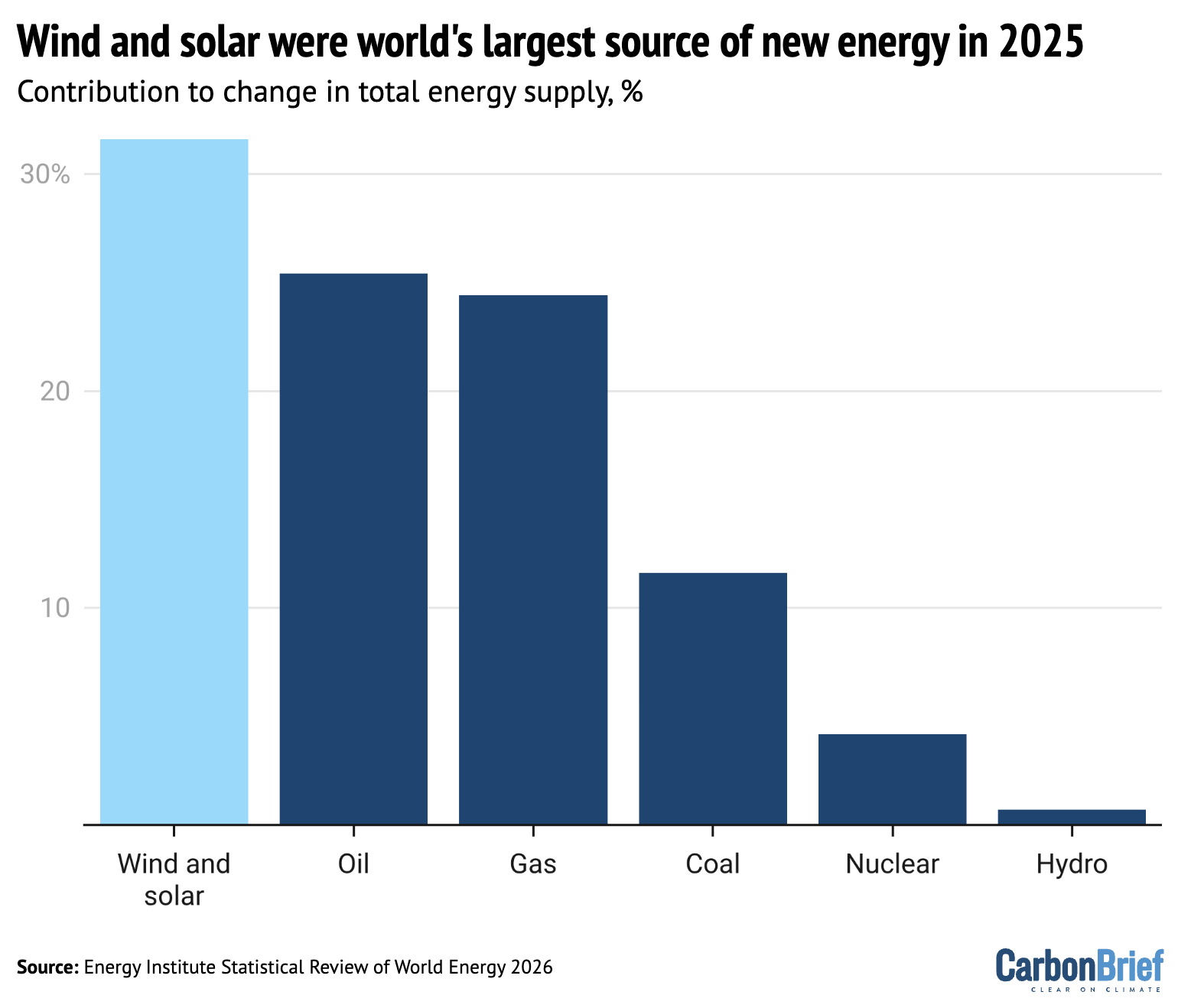
Wind and solar were the world’s largest source of new energy in 2025, according to Carbon Brief analysis of the latest Energy Institute statistical review of world energy. Wind and solar also saw the fastest growth, up by 18% in 2025. Nevertheless, every source of energy – including coal, oil, gas, nuclear and hydro – also reached global all-time highs last year.
Spotlight
Vietnam’s EV surge
Carbon Brief explores the reasons behind soaring electric-vehicle sales in Vietnam.
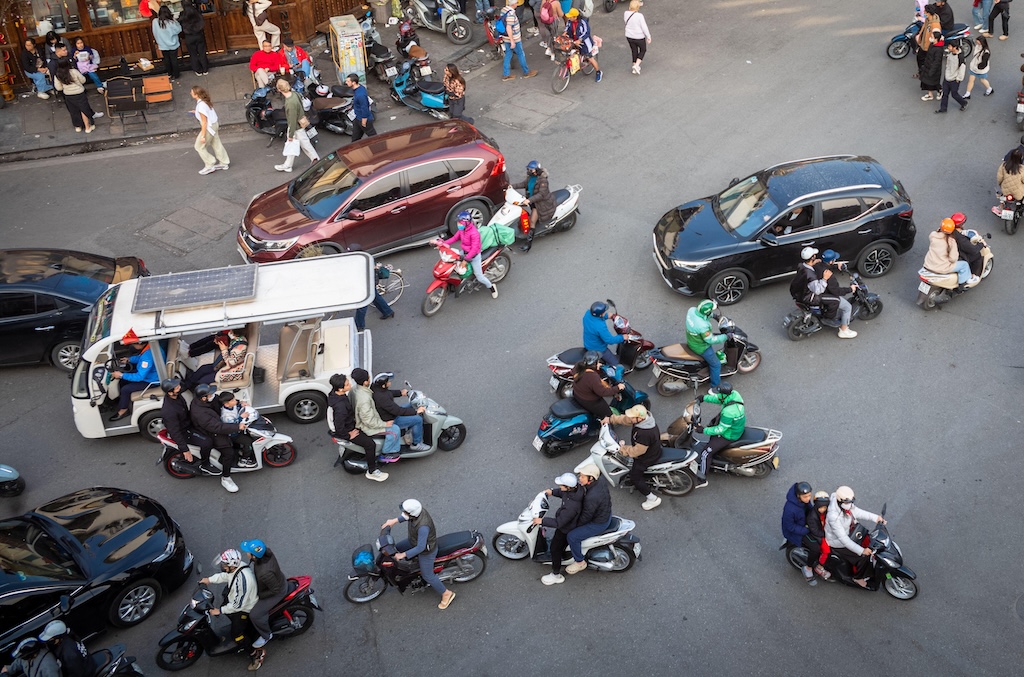
Motorbikes are a constant fixture on streets across Vietnam. They pollute the air in cities and make crossing the road a feat of endurance.
But, increasingly, people are moving away from petrol-powered vehicles to save money and reduce air pollution.
Sales of electric motorbikes, scooters and mopeds more than doubled in Vietnam last year, according to a recent report from the International Energy Agency (IEA).
This identified that Vietnam has the largest electric vehicle (EV) market in south-east Asia.
Nearly one-in-five of the two-wheeled vehicles sold last year were electric, it noted, in a nation with 102 million people and 77m motorbikes.
This is “particularly impactful” given they are the main mode of transport in Vietnam, said Lam Pham, Asia energy analyst at thinktank Ember. He told Carbon Brief:
“Electrifying road transport is essential for Vietnam to achieve its net-zero target by 2050. Road transport accounted for around 86% of transport-sector emissions in 2022.”
The nation has just 6.8m cars, but this number is also climbing, partly due to EVs, with nearly 40% of new car sales being electric.
This is “above levels seen in most European countries”, noted the IEA. (The UK’s figure is around 30%.)
EV incentives
Fuel costs surged in south-east Asian countries earlier this year after the energy crisis caused by the US-Israel war on Iran.
This “accelerated” discussions from “why use EVs” to “why keep paying more for fuel”, said Dr Tham Nguyen, a lecturer at the Ho Chi Minh City campus of Australia’s Royal Melbourne Institute of Technology (RMIT) University, who has researched Vietnamese public attitudes to EVs.
But the surge is “not driven by fuel prices alone”, noted Pham.
Increased EV sales can also be attributed to a “convergence of affordability, convenience and sustainability”, Nguyen said:
“Vietnamese consumers buy EVs because they see real value with immediate personal benefits, such as cost savings and energy security, alongside long-term environmental gains.”
Government policies have also incentivised sales through registration fee exemptions and tax cuts for EVs.
Another factor is affordable EVs sold by Chinese companies and Vinfast, a Vietnamese manufacturer. The IEA report noted that Vietnam is the only country in south-east Asia with “sizeable” domestic production of accessible EVs.
Vinfast reported a 219% year-on-year increase in orders for electric motorbikes and e-bikes in the first quarter of 2026, but the company has yet to turn a profit.
Pham noted that “growing public awareness of air pollution” has also “dramatically strengthened” public support for EVs.
Future plans
Vietnam’s major cities also have plans to get drivers to go electric or turn to public transport.
The capital city Hanoi announced that it would ban fossil-fuel-powered motorbikes from a central zone this month, but this has been postponed until 2028.
Ho Chi Minh City, the nation’s largest city with more than 9.5 million people, intends to introduce low-emission zones and swap 400,000 petrol-powered motorbikes to electric by 2028.
The city’s green transport plans focus on metro lines, electric buses and e-bikes, explained RMIT associate professor Catherine Earl. She noted that walking and cycling are currently “not popular, accessible or safe for many residents in Ho Chi Minh City’s hot and humid climate”.
Looking ahead, Pham said Vietnam could focus on “purchase subsidies, financing schemes and adequate charging or battery-swapping infrastructure, to ensure lower-income riders, including delivery and ride-hailing drivers, are not negatively affected”.
Watch, read, listen
‘JUST 1%’ OF EMISSIONS: The Guardian debunked arguments that climate actions from smaller countries are “insignificant”.
DRILLING RISKS: Mongabay reported on the possible impacts oil drilling in the Amazon could have on a “little-known reef”.
HEATING UP: The BBC Climate Question podcast discussed the weather pattern El Niño and its links to climate change.
Coming up
- 7-10 July: AI for good global summit, Geneva, Switzerland
- 7-15 July: UN high-level political forum on sustainable development, New York
- 8-10 July: Ninth meeting of the board of the fund for responding to loss and damage, Manila, Philippines
Pick of the jobs
- Green Alliance, senior partnerships officer | Salary: £42,748-£47,346. Location: London
- World Vision, environment and climate action senior adviser | Salary: Unknown. Location: Kenya
- Nature Energy, interim associate or senior editor | Salary: Unknown. Location: London or Milan
- Climate Analytics, senior communications manager – climate policy (maternity cover) | Salary €60,605-€66,880. Location: Berlin
- Carbon Exchange, researcher | Salary: Unknown. Location: Hong Kong
DeBriefed is edited by Daisy Dunne. Please send any tips or feedback to [email protected].
This is an online version of Carbon Brief’s weekly DeBriefed email newsletter. Subscribe for free here.