
DeBriefed 6 November 2026: COP31 countdown | Fossil-fuel and forest ‘roadmaps’ | ‘Staggering shortfall’ in adaptation funds

Welcome to Carbon Brief’s DeBriefed, an essential guide to the week’s key developments relating to climate change.
In this issue…
- Roadmaps on deforestation and fossil fuels were published ahead of COP31.
- It is “virtually certain” that 2026 will be the warmest or second-warmest year.
- Carbon Brief unpacks the 2026 UN “adaptation gap” report.
- Key dates for next week and pick of the job vacancies.
This week
COP31 countdown
‘CLIMATE COMEBACK’: The COP31 climate summit is set to kick off in Antalya, Turkey, on Monday amid a backdrop of “accelerating” global warming, continued fossil-fuel reliance and war, said the Associated Press. Dr Fatih Birol, the head of the International Energy Agency, told the Financial Times he expects to see a “climate action comeback” at COP31, adding: “I have rarely seen the energy security policy objectives and the climate objectives so closely aligned.”
ROADMAPS: COP30 host Brazil has published two voluntary global roadmaps ahead of COP31. The first roadmap says that transitioning away from fossil fuels is “urgent and inevitable” and offers “practical” steps for countries to start the process, explained Carbon Brief. The second roadmap focuses on how countries can reverse deforestation by 2030, according to a separate Carbon Brief Q&A.
NEGOTIATION PRIORITIES: Chinese news agency Xinhua reported that China’s vice-president Han Zheng will attend the leaders’ summit at COP31 as president Xi Jinping’s special representative. UK climate minister Katie White told Carbon Brief that COP31 must respond to “really scary” science. Carbon Brief has produced an in-depth table of who wants what from the negotiations. Separately, Carbon Brief also has an interactive tracker of negotiating texts.
Around the world
- RENEWABLES RALLY: The “Democratic sweep” at the US midterm elections has driven up shares in renewable energy, while those in AI data centres have fallen, according to Reuters.
- NATURE COP: Countries have completed the first “global review” of their progress towards reversing nature loss by 2030 at the COP17 biodiversity talks in Armenia, reported Carbon Brief.
- COAL BOOST: India’s coal, power and railways ministries have together set a goal to triple their coal stockpiles to avoid blackouts this summer, reported Bloomberg.
- AID SLASHED: The UK government cut overseas aid to Commonwealth countries, “with funding for nature projects especially hard hit even as [the] climate crisis intensifies global need”, reported the Guardian. Separately, the Independent said UK prime minister Andy Burnham has pledged £40m for “green energy schemes” in the Caribbean.
3.1%
The drop in China’s emissions in the third quarter of the year, marking the largest fall since Covid, according to analysis by Lauri Myllyvirta for Carbon Brief.
Latest climate research
- In China, 1.6 million pregnant women suffered distress symptoms from particulate matter pollution and heatwave exposure in a 13-year period | Nature Cities
- Since 1950, sea level rise has more than trebled the coastal land area affected by the storm surges that accompany tropical cyclones | Environmental Research Letters
- Cloud forests facing “sustained regional warming” maintain “remarkably stable” near-surface relative humidity, which helps to buffer them from atmospheric drying | Communications Earth & Environment
(For more, see Carbon Brief’s in-depth daily summaries of the top climate news stories on Monday, Tuesday, Wednesday, Thursday and Friday.)
Captured
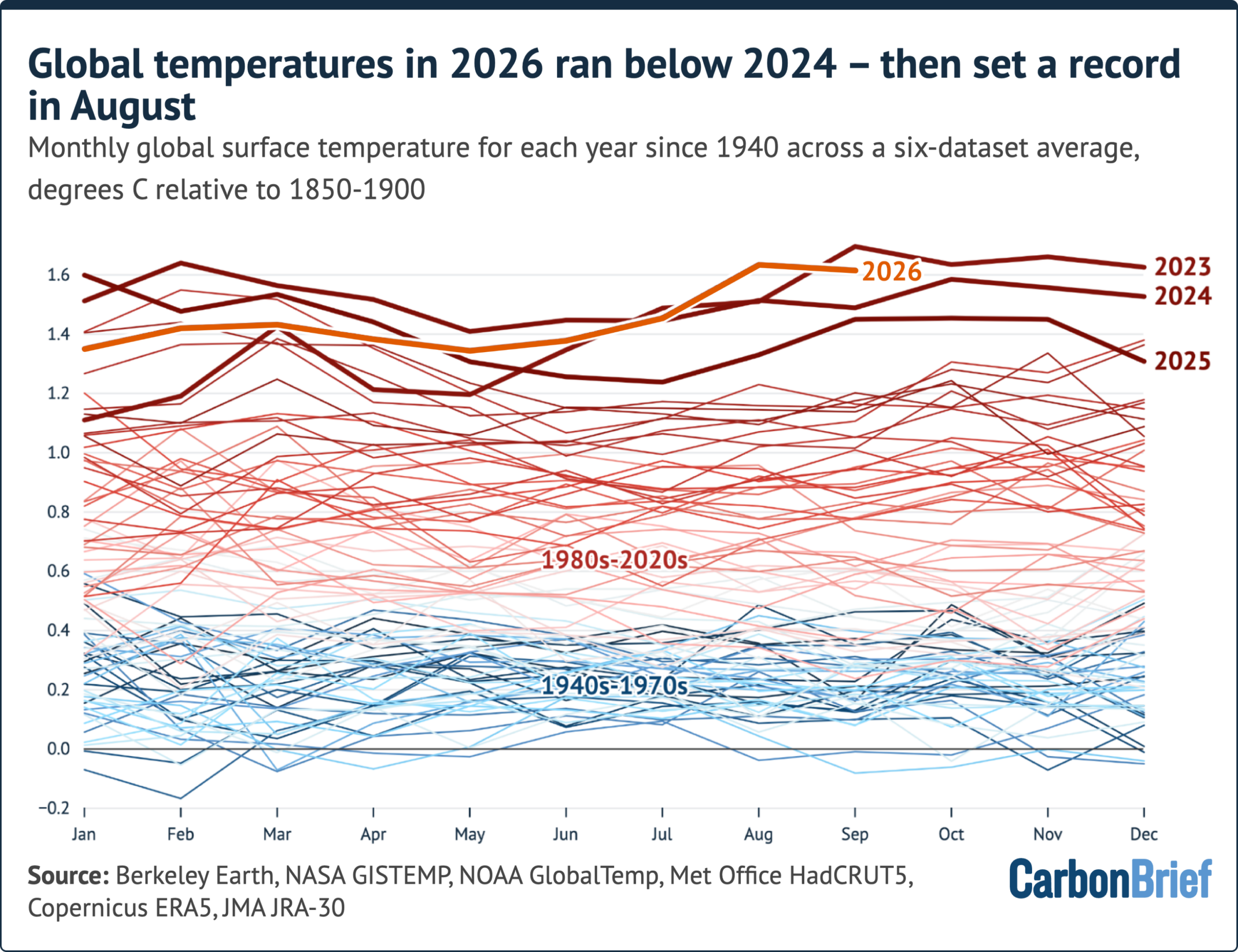
Carbon Brief’s latest state of the climate update found that, “with three-quarters of the year now past, it is virtually certain that 2026 will be the warmest or second-warmest year on record”. Dr Zeke Hausfather added that a “rapidly strengthening El Niño, alongside human-caused global warming, made this year’s August the warmest on record and September the second-warmest”.
Spotlight
‘Staggering’ adaptation finance shortfall
Carbon Brief unpacks the latest “adaptation gap” report from the UN Environment Programme (UNEP).
Communities around the world are already living with the impacts of climate change. Faced with record-breaking heatwaves, storms and floods, many have been forced to adapt to a new reality.
Adaptation can take many forms, such as a farmer growing drought-resistant crops, a community erecting a sea wall, or a vulnerable family moving to a safer location away from floods.
Climate finance is a key source of funding for these actions – especially in low-income countries that are vulnerable to climate impacts.
The 11th annual UNEP report on adaptation finance, launched on Wednesday, analysed the status of global adaptation finance and assesses global efforts to address loss and damage from climate change.
The report estimated that developing countries will, together, need $305bn every year by 2035 to meet their adaptation needs.
However, the flow of adaptation finance from developed to developing countries is slowing down. The report found that this stream of funding reached $28.2bn in 2024, marking just a $1bn increase on 2023 levels.
Off track
If this trend continues, developed nations will miss the goal set at COP30, which calls for efforts to triple adaptation finance by 2035, warned the report.
Furthermore, even if the goal is met, the money will only meet 20-29% of developing countries’ adaptation finance needs.
Meanwhile, funding channelled through development banks and between developing countries more than doubled, from $3.8bn in 2019 to $9.6bn in 2024, according to the report.
In a message issued as the report was launched, UN secretary general António Guterres warned that the numbers expose a “staggering shortfall” in adaptation finance.
He said that the gap in adaptation finance is “not measured in money alone”, but also in “lives, livelihoods and lost futures”. He called on developed countries to deliver “fast, simple, accessible support” to “the most vulnerable”, adding:
“We know who is most at risk. We know what works. What is missing is the money and the political will. The choice is simple – invest in adaptation today or pay for catastrophe tomorrow.”
The report also discussed the state of finance for “loss and damage” – a term used to describe how climate change is already causing serious and, in many cases, irreversible impacts around the world.
More than 100 developing countries have already made applications to the UN fund for responding to loss and damage, requesting $2.8bn in total to help recover from a variety of damaging events, such as drought, floods and storms. This “far outstrips” the $342m that was made available in its initial funding round in July 2026, said the report.
The Nepali government alone requested – and was granted – $20m in the aftermath of the devastating floods that hit the country earlier this year. Carbon Brief analysis shows that this covers just 0.7% of the estimated damages from the disaster.
UNEP executive director Inger Andersen told a press briefing that the report showed that “the world is not ready to adapt to current climatic conditions – never mind what overshoot of 1.5C will bring”.
Watch, read, listen
LAB-GROWN MEAT: A Guardian long read unpacked why lab-grown meat has not been adopted as a “panacea for the climate crisis”.
ELECTRIC IDEAS: Financial Times associate editor Pilita Clark explained why the “energy transition is not as impossible as we’ve been led to think”.
OZ INTERVIEW: The Bloomberg Zero podcast interviewed Chris Bowen, Australia’s climate minister and incoming COP31 president of negotiations.
Coming up
- 9-20 November: UN climate summit COP31, Antalya, Turkey
- 10 November 2026: Launch of the 2026 global carbon budget report
- 11-12 November 2026: COP31 world leaders’ summit, Antalya, Turkey
Pick of the jobs
- Oxford Climate Policy Hub, University of Oxford, postdoctoral research fellow in climate policy and regulation | Salary: £40,178-£48,700. Location: Oxford, UK
- UN Environment Programme, climate mitigation modelling consultant | Salary: Unknown, Location: Paris, France
- UK Met Office, marine data specialist | Salary: £49,448. Location: Scotland
- UK Foreign Commonwealth and Development Office, climate programme, policy & partnership manager | Salary: RWF 2,911,559 per month. Location: Kigali, Rwanda
DeBriefed is edited by Daisy Dunne. Please send any tips or feedback to [email protected]
This is an online version of Carbon Brief’s weekly DeBriefed email newsletter. Subscribe for free here.