
Great Barrier Reef at ‘unprecedented’ risk of collapse after major bleaching event
Turning white
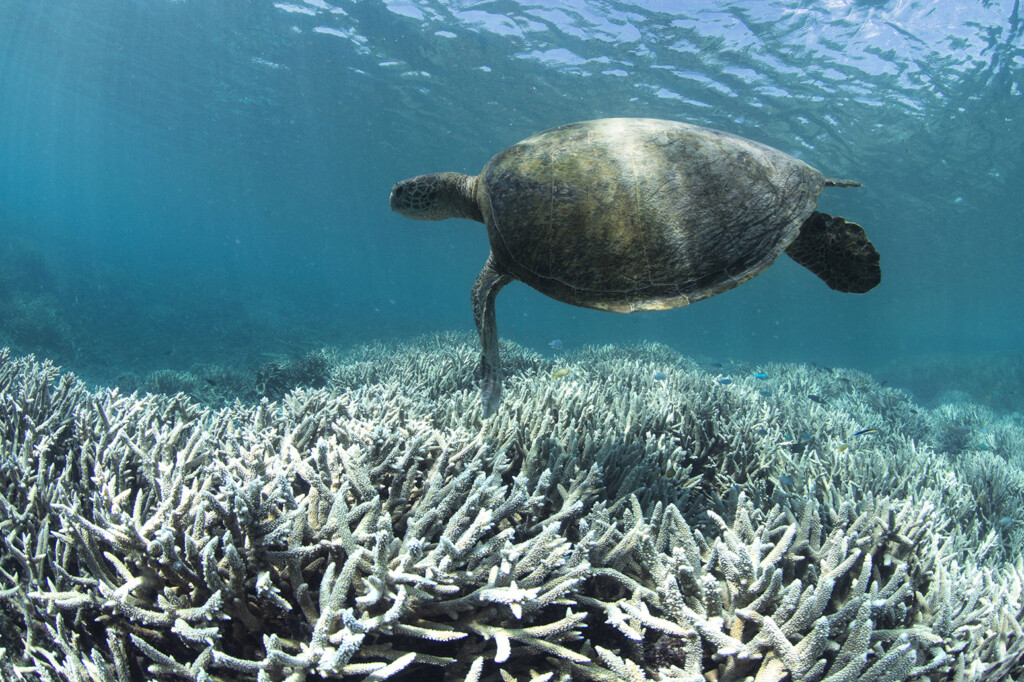
The Great Barrier Reef is the world’s largest coral reef, stretching 2,300km from Papua New Guinea to the coast of Queensland, Australia. Over the past two decades, the Great Barrier Reef has seen four mass bleaching events, most recently in 2016 and 2017. Coral bleaching is primarily caused by prolonged exposure to high sea temperatures. Under continued heat stress, the corals expel the tiny colourful algae living in their tissues – known as zooxanthellae – leaving behind a stark white skeleton. The algae provide the corals with energy through photosynthesis. Without them, the corals can slowly starve. Healthy corals can live from two to several hundred years. The mass bleaching event of 2016, which took place in the summer months of February, March and April, was the most devastating on record, affecting 94% of reefs surveyed. The new study estimates how heat exposure during this event affected the survival of coral and the make-up of species across the reef in the months that followed. It finds that, after the event, many temperature-sensitive corals died suddenly as a result of heat stress, while others slowly starved over the course of several months. The paper concludes:“The die-off of corals drove a radical shift in the composition and functional traits of swaths of the Great Barrier Reef from mature and diverse assemblages to highly altered, degraded systems.”
Coral carnage
To assess immediate coral death following the 2016 heatwave, the researchers used a combination of aerial and underwater surveys spanning the full length of the reef. They then revisited the survey sites eight months later to gather data on long-term coral mortality. The researchers next compared information on coral mortality over the eight-month period to heat exposure data, which was calculated using records of sea surface temperatures. The charts below show changes in coral cover over the study period (left) – with red showing high amounts of coral loss and green showing small amounts of gain – and local heat exposure (right), with red showing high exposure and blue showing low exposure.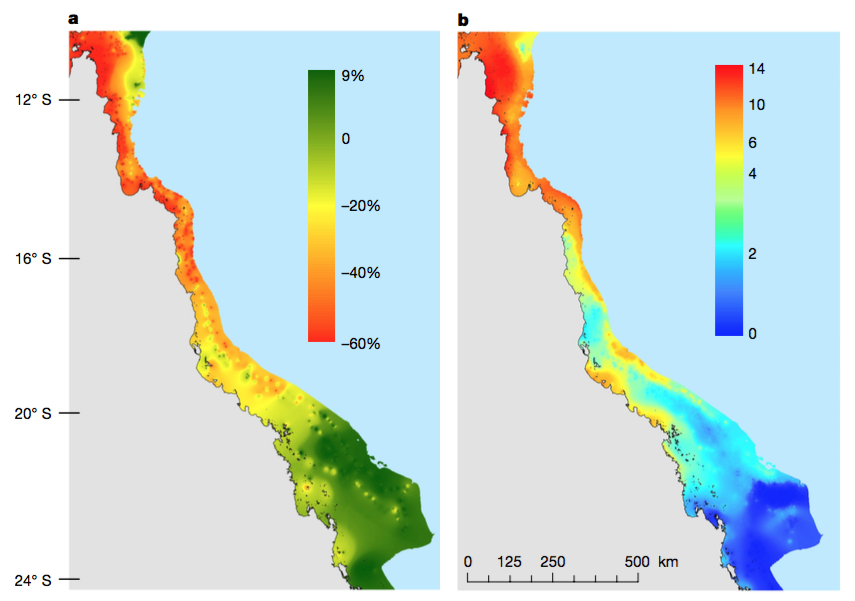
Lasting damage
As well as measuring coral mortality, the researchers also studied how the make-up of coral species changed over the eight-month period.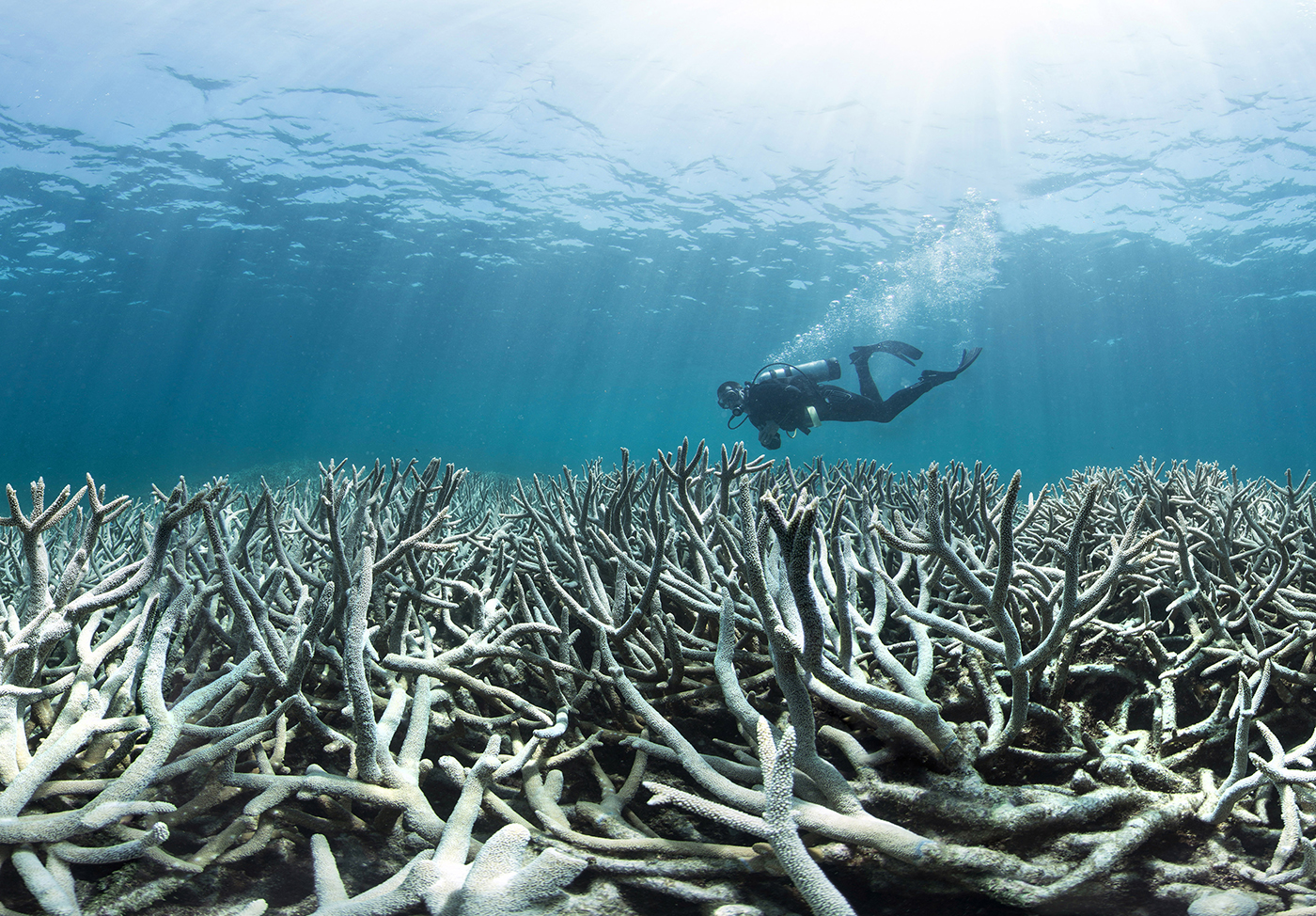
“What you are seeing here is ecological homogenisation or flattening. It is a reduction in the diversity of corals that makeup the community. The problem with this is that one of the aspects that makes coral reefs important is their high biological diversity — the large number of species that live on them. Less diversity of corals means less diversity of the fish, crabs, shrimp, clams, worms and other organisms that live on the reefs.”
A typical coral reef can take 10-15 years to recover from a single bleaching event, Eakin says. However, climate change is causing the frequency of mass bleaching events to dramatically increase, he adds:“The Great Barrier Reef lost approximately 29% of its corals in 2016 and another 22% in 2017. The second consecutive year of bleaching damaged many of the hardier corals that had survived the first bleaching event.
“Even worse, our paper in Science earlier this year showed that severe coral bleaching around the world happened about once every 30 years in the 1980s, but once every 6 years in the 2010s. This doesn’t give corals enough time to recover.”
Place for Paris
However, limiting global warming to 1.5C, which is the aspirational target of the Paris Agreement, could offer the Great Barrier Reef a better chance of survival, says lead author Prof Terry Hughes, director of the Australian Research Council Centre of Excellence for Coral Reef Studies. He tells Carbon Brief:“We now have an international mechanisms, the Paris Agreement, to limit climate change. If we can achieve the 1.5-2C target, we can still have a healthy Great Barrier Reef.
“But it’s clear now that the future mix of coral species will be very different from just two years ago, before the unprecedented back-to-back bleaching in 2016 and 2017. Our study shows that this transition to a new, highly altered system is already underway – faster than any of us anticipated.”
https://twitter.com/ProfTerryHughes/status/722512223067721728 The study “paints a bleak picture of the sheer extent of coral loss on the Great Barrier Reef” following the 2016 mass coral bleaching event, says Prof Nick Graham, chair in marine ecology at Lancaster University, who was not involved in the new research. He tells Carbon Brief:“Huge losses of coral also occurred in many other countries across the Indian and Pacific Oceans in 2016. A future with coral reefs, their rich diversity, and the livelihoods they provide to millions of people, is quite simple. It will only be possible if carbon emissions are rapidly reduced and we limit warming to 1.5-2C.”
Article information
Hughes, T. P. et al. (2018) Global warming transforms coral reef assemblages, Nature, doi:10.1038/s41586-018-0041-2