
Guest post: Why climate scenarios need to better incorporate ‘adaptive capacity’
Adaptive capacity as a way to model adaptation
One of the reasons for underrepresentation of adaptation in modelling strategies might be that it is extremely complex to quantify. Adaptation can occur autonomously, as a response to changing climatic conditions, or it can be planned and implemented as an anticipatory measure (pdf). It can be private or public, or interlinked. It can be sector-specific – and those sectors, such as water and agriculture, sometimes can overlap. Even when adaptation is identifiable, its effectiveness is difficult to measure, rendering the development of comparable indicators of adaptation challenging. One way to capture the intricacies of individual adaptation options and the local context is to analyse is the general conditions that enable or constrain adaptation in the first place. This is where the concept of “adaptive capacity” comes in as particularly useful. This can be summarised as the ability of people, institutions and systems to respond to consequences of climate change. The IPCC’s fifth assessment report (AR5) identified a set of constraints to adaptation that range from financial and economic, to human capacity, governance and socio-cultural factors. Removing these constraints is crucial for unlocking adaptive capacity. The figure below shows how these constraints can be combined with the data available in the SSPs. Integrating these “dimensions” can represent a way forward for a representation of adaptive capacity.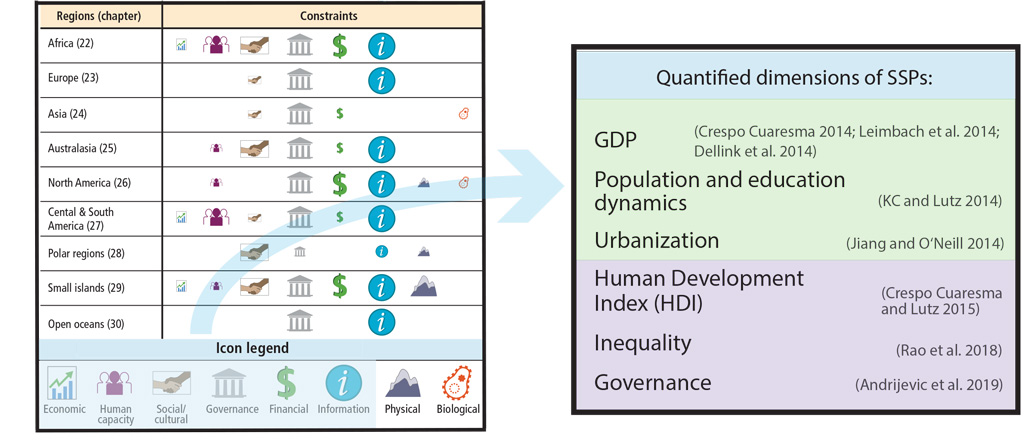
“Parties hereby establish the global goal on adaptation of enhancing adaptive capacity, strengthening resilience and reducing vulnerability to climate change, with a view to contributing to sustainable development and ensuring an adequate adaptation response in the context of the temperature goal referred to in Article 2.”
Governance is among the most pertinent constraints for adaptation, across both regions and sectors. There are numerous interventions that may enable or hinder adaptation – such as prioritising policies, mobilising resources, coordination of efforts, and decision making – are dependent on effective institutions. Inept governance can hinder a country’s ability to realise adaptation goals and targets set according to the country’s level of vulnerability. Corruption is particularly corrosive for governance since it damages public trust, diverts funds from budgets and even hinders the formation of human capital. It is no surprise that countries with better governance are more likely to receive adaptation aid from donors as it is assumed that the funding will be used more effectively.An indicator for adaptive capacity over the 21st century
Understanding current and future evolution of governance is necessary for assessments of adaptive capacity and, thereby, the impacts of future climate change. In our study, we aim to quantify the constraints to adaptation by creating a new indicator of governance from the data provided by the SSPs. The SSPs provide a set of five baseline scenarios that assess challenges to adaptation and mitigation based on the interplay of socioeconomic factors, such as income, population, education, urbanisation and inequality. Our indicator is based on the well-established Worldwide Governance Indicators (WGI) that provide a composite index for governance with six subcategories: Voice and accountability, political stability, government effectiveness, regulatory quality, rule of law, and control of corruption. To estimate and project our governance indicator, we developed an econometric model that quantifies the governance index using data provided in the SSPs. We draw on research that shows, for example, that economic and educational development are central determinants of improvements in the rule of law. Likewise, there is ample empirical evidence of a causal relationship between female representation in government and reduced levels of corruption, as well as a strong connection between gender empowerment and democracy. The map below shows how we project governance to change over the 21st century. The main map shows how things stand in the present day. The governance indicator is normalised, so it ranges from a score of zero to one, with the higher score (shown by yellow and light green shading) indicating better governance. The charts overlying the map show projections for selected countries out to 2100. The small maps then show our projections for governance under three of the SSPs out to 2050: – SSP1 (“Sustainability – Taking the Green Road”): A rapid shift to sustainable development, increases in education and health investments, declining inequality both within and between countries and deep emphasis on economic growth and reduction of resource intensity in favour of improving environmental conditions. – SSP2 (“Middle of the Road”): Characterised by uneven and sluggish economic growth and development with slower progress towards achieving the Sustainable Development Goals (SDGs). – SSP3 (“Regional Rivalry – A Rocky Road”): An expectation of regional and global conflicts to result from international fragmentation and intercountry rivalry. Countries are preoccupied with national goals, which weakens international cooperation.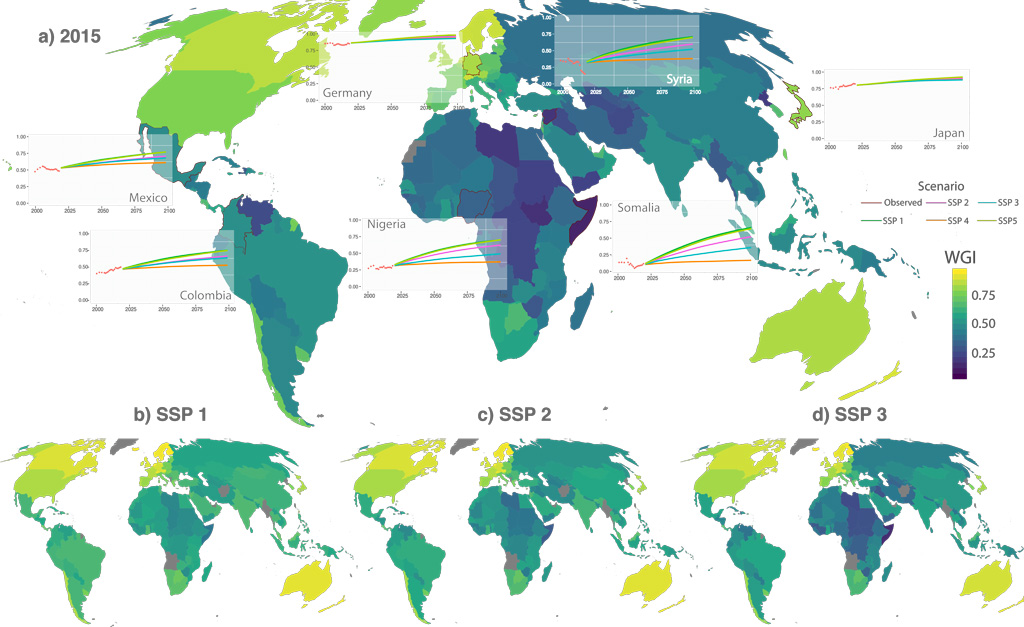
The evolution of adaptive capacity and its relevance for loss and damage
The recent IPCC special report on global warming of 1.5C underscored the substantial differences in climate impacts between 1.5C and 2C that could materialise even before the middle of the century. While vulnerable countries will be striving for sustainable development and improving their adaptive capacity, climate impacts will continue to intensify. As our results show, improvements of governance will take on average at least three decades even under scenarios of rapid and sustainable development. This indicates that limits to improvements in adaptive capacity may persist during the 21st century, leading to elevated risks and impacts of climate change in countries with low socioeconomic development. Such a perspective on limits to adaptive capacity links to the discussion on “loss and damage” – the economic and non-economic adverse effects of climate change that go beyond what can be prevented by adaptation. Our study establishes that there is a time-dependent upper limit to what can be expected for countries in terms of increasing their adaptive capacity to climate change. Since adverse impacts of climate change will further impede the pace of sustainable development and the strengthening of adaptive capacity, adequate responses and support schemes for loss and damage will be crucial policy instruments to help vulnerable countries to cope with the impacts of climate change. Similar to how it is taken for granted that big emitters cannot fully decarbonise overnight, increasing the adaptive capacity of the most vulnerable will equally take decades. And over that period, support will be needed to help the vulnerable countries cope with the residual risks and impacts of climate change – a strong argument for advancing the discussions on tangible responses to loss and damage.Article information
Andrijevic, M. et al. (2019) Governance in socioeconomic pathways and its role for future adaptive capacity, Nature Sustainability, doi:10.1038/s41893-019-0405-0