
World can limit global warming to 1.5C ‘without BECCS’

Stringent goals
The Paris Agreement, adopted by almost every country in 2015, says warming should be limited to “well below” 2C above pre-industrial levels, with efforts to keep it below 1.5C. To meet these goals, global greenhouse gas emissions must stay within a rapidly shrinking carbon budget. Scientists have developed a range of scenarios to explore how this could be done. To date, 1.5C pathways have relied on negative emissions from BECCS to suck excess CO2 out of the atmosphere later this century. In part, this reflects the assumption that inertia in the global energy system makes it hard to peak and then eliminate CO2. The chart below shows the starting point for today’s research: a pathway to 1.5C consistent with a likely chance (66%) of keeping the temperature in 2100 to below 1.5C. (Like most others, this is an “overshoot” scenario, where temperatures breach 1.5C in the second half of the century before falling back below that level by 2100. No-overshoot pathways to 1.5C are only possible, even theoretically, if the remaining carbon budget is at the top end of current estimates.)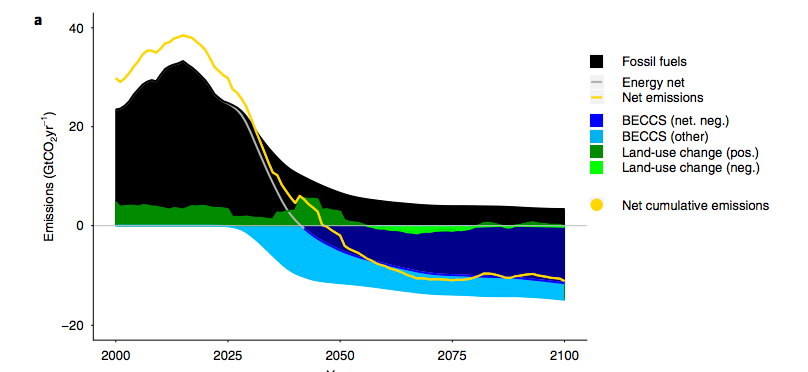
“There are major concerns about the sustainability of large-scale deployment of CO2 removal (CDR) technologies, especially in relation to BECCS, but also for large-scale afforestation.”
The new work on alternative pathways to 1.5C is, therefore, of “great importance”, Popp says.Scenario artefact

“As IAMs select technologies on the basis of relative costs, they normally concentrate on reduction measures for which reasonable estimates of future performance and costs can be made. This implies that some possible response strategies receive less attention, as their future performance is more speculative or their introduction would be based on drivers other than cost, such as lifestyle change or more rapid electrification.
“Moreover, existing studies hardly look into more aggressive implementation of options, such as rapid implementation of the best available technologies or deep reduction of non-CO2 GHGs [greenhouse gases]. Technology development could also be more rapid than typically assumed in IAM model runs.”
This goes some way to explain why BECCS has become so dominant in the 1.5C scenarios, even though its widespread deployment faces daunting sociopolitical barriers. In contrast, alternative solutions have often been ignored because it is hard to estimate their performance or cost. Dr Glen Peters, research director at Norwegian climate institute Cicero, who was not part of the study, tells Carbon Brief:“[This] is a good paper and a step forward. Hopefully, it will be a challenge to others to look at alternative mitigation strategies to those that are solely based on cost…I think it is worth having a discussion on what costs actually are and how they should be interpreted, particularly when things are not so easily ‘costed’ (such as reduced meat consumption).”
Alternative routes
The study looks at a range of “aggressive” alternative scenarios to meet the 1.5C goal, reducing reliance on BECCS. Deployment of each mitigation option is designed to be “ambitious but not unrealistic”, the paper says. These alternatives are:- Renewable electrification: All energy end-use sectors are rapidly electrified, including heat. The technical constraints to integrating variable renewables on the grid are overcome. Some fossil-fuelled power stations retire early and, by 2030, all new cars are electric.
- High efficiency: The best available technologies are quickly adopted for all energy and material uses, including cement and steel. From 2025 onwards, only highly efficient new cars and aeroplanes are sold and only the most efficient home appliances allowed.
- Agricultural intensification: Optimistic assumptions for crop yield improvements are combined with 80% worldwide adoption of the most efficient livestock systems, including improved feed digestibility and “genetic improvements”.
- Low non-CO2: Non-CO2 greenhouse gases are reduced using the best-available technologies and further technological progress. For example, by 2050, fugitive emissions of methane are cut by 100% in the oil-and-gas sector and by 90% for coal mining. Methane emissions from livestock are cut significantly and, by 2050, 80% of meat and eggs are replaced by cultured protein, including lab-grown meat.
- Population: Improved access to education accelerates the trend towards reduced fertility, so that global population rises from 7 billion people today to 8.4 billion in 2050, before falling to 6.9 billion in 2100. This is broadly in line with the UN’s lowest scenario for population, whereas the high end of UN projections reaches 13.2 billion people in 2100.
- Lifestyle change: The majority of the world population adopts sustainable lifestyles, including, by 2050, 100% adoption of healthy diets with lower levels of meat consumption. There is less private car use and more walking or cycling, while air travel is reduced.
Minimal BECCS
The small carbon budget for 1.5C means that existing scenarios lean more heavily on BECCS than for a 2C limit. This can be seen in the chart, below left, where the level of BECCS nearly doubles between a 2C pathway (purple line, “Def_2.6”) and one for 1.5C (blue line, “Def_1.9”). Increased use of BECCS also raises the need for agricultural land to grow bioenergy crops, as shown in the chart, below right (blue line, “Def_1.9”).
“We show there are options available to significantly reduce BECCS, but it is really, really difficult to go to zero BECCS (or negative emissions)…Negative emissions are not necessarily bad, but it means that one does accept certain risks. If you don’t want to take these, or, for instance, find other options more attractive for other reasons – for example, synergies with other SDGs [sustainable development goals], ease of implementation, societal support – [then] I think [our new] paper allows for a much better consideration of pros and cons…I do believe getting rid of negative emission totally is not possible – but minimizing them might be attractive.”
Van Vuuren was a key figure in the early use of BECCS within climate models, as shown in Carbon Brief’s interactive timeline of the technology published in 2015. It is “unfortunate” that work to date on meeting 1.5C has been so dominated by BECCS, he adds.Wider debate
Like all pathways to meeting the goals of the Paris Agreement, these new alternatives are highly ambitious. They also do not change the bigger picture for policymakers. Dr Joeri Rogelj, research scholar at the International Institute for Applied Systems Analysis (IIASA), who was not part of this work, tells Carbon Brief:“The core of the mitigation challenge remains the same: global CO2 emissions need to be reduced to zero. What policymakers should take from this entire body of research on 1.5C scenarios is that there is a variety of avenues one can pursue to limit CO2 emissions and that these different avenues or strategies allow to limit the contribution of potentially undesirable technologies like BECCS.”
Importantly, the barriers to adoption of the various alternative strategies go beyond the cost metric prioritised by previous research, spanning politics, societal acceptance and technical feasibility. Bert Metz, former co-chair of the Intergovernmental Panel on Climate Change (IPCC) working group on mitigation and now senior adviser to the European Climate Foundation (ECF*), tells Carbon Brief:“It is highly unlikely that the investigated options can indeed all be applied simultaneously to the extent assumed in the paper and that the full impacts of each of the options can be delivered in practice, as the assumptions are very ambitious.”
“Each of these options deserves close examination and appropriate action by policymakers, if they want to take the Paris objectives seriously and avoid gambling on the large-scale availability of CDR [CO2 removal] and particularly BECCS.”
A study published last week explores the limits of plausibility for avoiding the use of negative emissions. It shows they are only avoidable if the carbon budget for 1.5C is at the high end of current estimates and if there is radical adoption of low-carbon technologies and lifestyles, along with unprecedented efforts to limit energy needs, so that demand in 2100 falls to half of today’s levels. A low-end carbon budget would make the 1.5C goal unachievable – even with BECCS. Dr Stephan Singer, senior adviser on global energy policies to the NGO umbrella group Climate Action Network, tells Carbon Brief:“it is extremely useful for the academic community to assess alternatives to large-scale BECCS, in particular [because] that is likely to impact significantly on food security and land use…The stronger, earlier and deeper that politics embarks on ‘conventional’ mitigation policies and measures, the less the world needs negative emissions like large-scale BECCS to meet the Paris goals.”
Singer adds: “Lifestyle changes for the globally high-consuming and emitting rich…are [a] fundamental part of the equation…This is not limited to individual dietary changes…[it] also includes significant transport and travel behavioural change, institutionalised longer durability of products, higher reusability of components, new materials and, overall, a circular economy.” Whether or not the Paris targets can be met, today’s research suggests policymakers should debate a wider set of options for tackling climate change, in addition to BECCS and negative emissions, which have come to be seen as a default “backstop”. Peters says:“IAMs have a limited set of tools [to cut emissions] and, in reality, there are many more tools in the toolbox. This is a good sign, as the more tools we have, the more options we have to getting to 2C or 1.5C. We need more studies broadening the toolbox, instead of using big-hitting backstop technologies like BECCS or direct air capture.”
It is worth adding that today’s research is far from an exhaustive exploration of that “toolbox”. Indeed, it concludes by mentioning a range of other options for cutting emissions, which have also generally been excluded from previous work. These include soil carbon management and “rapid forced closure of fossil-fuelled power plants”. Finally, none of the current scenarios consider a world without economic growth, considered by some researchers as the only path to a sustainable future. *Carbon Brief is funded by the European Climate Foundation.Article information
Van Vuuren, D. et al. (2018) Alternative pathways to the 1.5C target reduce the need for negative emission technologies, Nature Climate Change, doi:10.1038/s41558-018-0119-8