
Guest post: Why BECCS might not produce ‘negative’ emissions after all
Forests compared to BECCS
Most people know that forests have many benefits, ranging from high biodiversity to improved soil and water quality compared to agricultural land. Tree-planting programmes, where carbon in new trees is tracked and sold for carbon credits, are already providing additional income for farmers. Afforestation (growing new forests) and reforestation (restoring existing forests), combined with a variety of land management and conservation practices, could remove around 1-2bn tonnes of carbon from the atmosphere per year. It is also important to note, though, the potential warming effect of forests as well – in high-latitude areas, adding trees can warm the climate since their albedo is lower than snowy ground or agricultural land. In comparison, bioenergy crops, when grown sustainably, could also provide multiple benefits. Some studies have found increased biodiversity and soil carbon when growing the biofuel miscanthus. And they have the potential to remove large amounts of carbon each year, particularly compared to forests since their carbon uptake capacity saturates as trees reach maturity. In Intergovernmental Panel on Climate Change (IPCC) scenarios that are consistent with 2C warming, BECCS is assumed to remove an average of 3.3bn tonnes of carbon per year by 2100. But what if, overall, BECCS does not actually remove as much CO2 from the atmosphere as it emits?Land for food
Before answering that question, it is worth mentioning that a constraint on using land for climate mitigation is our need to grow food. In our study, we examine scenarios produced by the IMAGE integrated assessment model of different ways society could meet the 1.5C and 2C limits. You can see how these scenarios are projected to pan out over the course of the 21st century in the charts and maps below.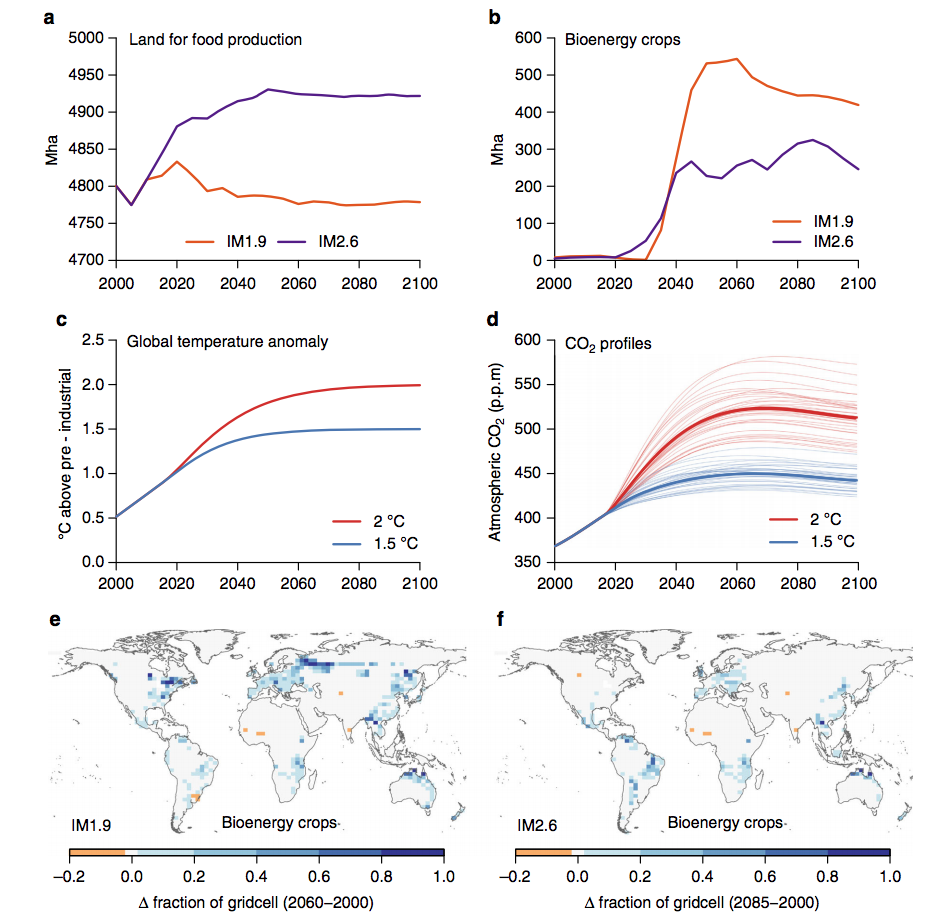

Glossary
Integrated Assessment Models: IAMs are computer models that analyse a broad range of data – e.g. physical, economic and social – to produce information that can be used to help decision-making. For climate research, specifically,… Read More
The importance of land-use change emissions
Removing trees to plant biofuels as a way of mitigating climate change clearly seems counterintuitive. So we looked more closely at the effectiveness of the land-use patterns in the two scenarios. We used a land-surface computer model that calculates the carbon stored in plants and soils, taking into account changes in climate, land use (natural vs agricultural) and the amount of CO2 in the atmosphere. We ran the model with several climate change scenarios that reach either 1.5C or 2C warming by 2100. This is illustrated in the middle two charts in the earlier figure, which show how global temperature and levels of CO2 in the atmosphere change in our idealised scenarios to meet the 1.5C (blue line) or 2C (red) limits. We then calculated the mitigation potential of BECCS by adding up the annual biomass harvested from bioenergy crops and assuming some carbon is lost during the BECCS life cycle (from field all the way through to injection of CO2 underground). And finally, we compared this to the carbon stored naturally in forests and soils that would have been replaced by biofuels. Overall, we found that in a majority of the areas where forests would be replaced, more carbon was stored by keeping the forests than with employing BECCS. That was a surprising finding, since the IMAGE model that created the scenarios clearly found it worthwhile to put bioenergy crops in those places.
Ambition
These findings underscore the importance of things that scientists and policymakers might take for granted. To meet the ambitions of the Paris Agreement we need innovations for producing more food and biomass on our limited land, for using land more efficiently and sustainably (reducing waste, changing diet, integrated management), and to assess fully the value of protecting the naturally stored carbon we already have in the world’s forests and soils. There is work for the individual, too, as lifestyle changes, such as less CO2 intensive transport and a diet less reliant on meat and dairy, could decrease the need for negative emissions by three or four times. And, of course, fossil fuel emissions will need to be reduced dramatically to zero by mid-century in most scenarios consistent with 1.5C.Article information
Harper, A. B. et al. (2018) Land-use emissions play a critical role in land-based mitigation for Paris climate targets, Nature Communications, doi:10.1038/s41467-018-05340-z