
Rising CO2 levels could push ‘hundreds of millions’ into malnutrition by 2050
Growing problems
Climate change is known to threaten food security by increasing the chances of extreme weather events such as heatwaves and drought – which can cause crop failures. However, climate change could also threaten food security by worsening malnutrition. Across the world, humans get the majority of the key nutrients they need from plants. Crops, including cereals, grains and beans, provide humans with 63% of their protein, which is needed to build new body tissue. Plants also provide humans with 81% of their iron, a nutrient that facilitates the flow of blood around the body, and 63% of their zinc, a nutrient that helps fight off disease. (Other sources of these nutrients include meat and dairy.) However, recent experiments show that, when food crops are exposed to high levels of CO2, they tend to produce lower amounts of these three key nutrients. The reason why this happens is still not well understood, says Dr Matthew Smith, a researcher in environmental health from Harvard University and lead author of the new study published in Nature Climate Change. He tells Carbon Brief:“The prevailing theory for many years has been that higher CO2 causes a faster growth rate [in crops] – which favours carbohydrates rather than other nutrients important for human health that cannot be taken up quickly enough by the roots.”
However, there is also evidence that suggests not all nutrients decrease under higher CO2, notes Smith, meaning the extent of the impact is still an “open question”.Under pressure
For the new study, the researchers estimated how global levels of malnutrition would be affected when the average concentration of CO2 in the atmosphere reaches 550 parts per million (ppm). Earlier experiments by the research group have shown that, at this concentration, the iron, protein and zinc content of food crops such as rice, wheat and maize can fall by 3-17%. Levels of CO2 are currently around 409ppm – and are expected to reach 550ppm in the next 30 to 80 years, depending on how quickly greenhouse gases are – or are not – curbed. The charts below show the expected carbon emissions (left) and point at which 550ppm is reached (right) for a range of future socioeconomic scenarios known as the “Representative Concentration Pathways” (RCPs). Historical data is also shown in black.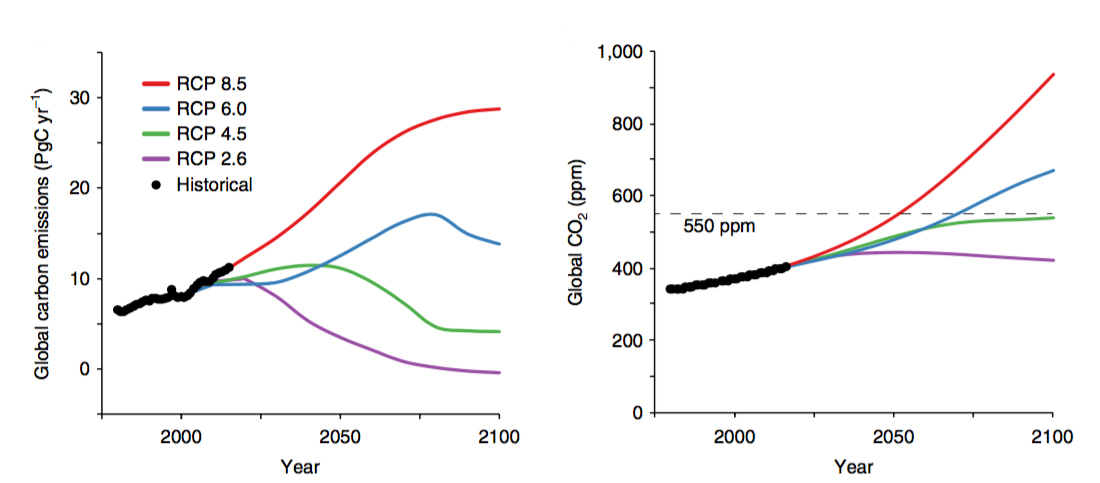

Diet distributions
To explore how malnutrition is likely to be distributed across the world, the researchers gave each country a ranking of between one and three for each nutrient – with one indicating a small increase in deficiency and three indicating a large increase. They then added the results together to give each country a score out of nine. The results are shown on the map below, where dark blue indicates a low score (zero) and dark red indicates a high score (nine).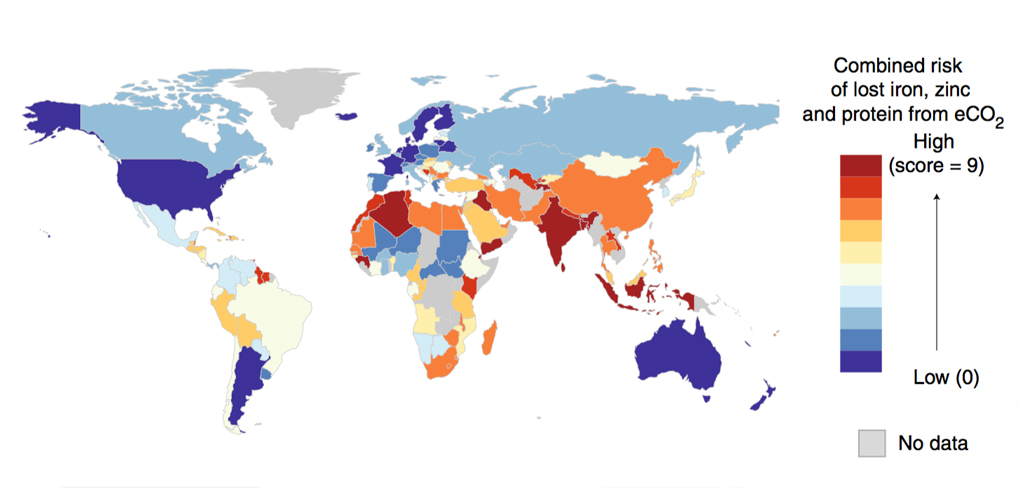
“Hundreds of millions of people could become newly deficient in these nutrients – primarily in Africa, southeast Asia, India and the Middle East – potentially contributing to a range of health effects: anemia, wasting, stunting, susceptibility to infectious disease, and complications for mothers and newborns.”
Curbing CO2
Despite the stark findings, there are “many steps that can be taken” to reduce the impact of rising CO2 levels on malnutrition, Smith says:“Breeding crops for CO2-tolerance or higher nutritional content, increasing [iron] fortification or supplementation programmes, encouraging dietary diversity to include more nutrient dense foods or those less sensitive to CO2 effects, for example. And of course, renewing our global effort to curb CO2 emissions would be the most direct way to help avert potential harm.”
One caveat of the new research is the assumption that current patterns of global food consumption are likely to stay the same until 2050, Smith says:“We definitely agree that it is highly unlikely that diets will stay static, but we make this assumption simply because we are unsure of which direction diets will go. Dietary forecasting is very uncertain, and it relies primarily on economic projections to determine how diets will change.”
Previous research suggests that low- to middle-income countries are likely to consume more meat and dairy products in the coming decades. If this were to occur, the impact of rising CO2 levels on crops – and thus malnutrition – could be smaller, Smith concedes. The findings add to previous research showing “the potential health consequences” of rising CO2 levels, says Prof Kristie Ebi, a researcher in public health and climate change from the University of Washington, who was not involved in the study. She tells Carbon Brief:“The growing body of literature on the impacts of rising CO2 concentrations on the nutritional quality of our food indicates the health consequences could be significant, particularly for poorer populations in Africa and Asia – although everyone could be affected.”
Article information
Smith, M. R. and Myers, S. S. (2018) Impact of anthropogenic CO2 emissions on global human nutrition, Nature Climate Change, doi:10.1038/s41558-018-0253-3