
Rise in insect pests under climate change to hit crop yields, study says
Soaring swarms
At present, around 10-16% of global crop production is lost to pests – including insects, fungi and bacteria. Thousands of insect species are known to threaten food production. One of the most well-known pests, the desert locust, feeds on a wide range of crops – including rice, maize and sugarcane – and can swarm and strip a crop field within an hour. Other insects, such as the western corn rootworm, target specific crops. The rootworm, for example, feeds on maize during both its larval and adult beetle life stages and currently costs US farmers around $1bn a year in lost revenue. The new study, published in Science, explores how climate change could alter the activity of 38 of the world’s most-studied insect crop pests. Climate change could increase the activity of insect pests in two ways, according to the research team, which was led by Prof Curtis Deutsch, an ecologist from the University of Washington. First, rising temperatures boost the rate at which insects can digest food – causing them to demolish crops at a faster rate. Second, in temperate regions, warming temperatures could cause insects – which are ectothermic, or “cold-blooded” – to become more active and, thus, more able to reproduce.Crop countdown
For the study, the researchers made of use of existing data on how temperature is known to affect the population growth rate, food consumption rate and overall survival of insect pests under laboratory conditions. The researchers used this information to inform a set of models projecting yield losses from insect pests for wheat, rice and maize under different levels of temperature rise. The projections assumed that total global crop yields will remain the same as today. The charts below show the expected crop yield loss in megatonnes per year as a result of increased insect food consumption – or “metabolic activity” – (purple triangles) and population growth (orange circles and green asterisks) for wheat (A), rice (B) and maize (C) under various levels of global temperature rise. A dashed line is used to indicate the current loss as a result of insect pests.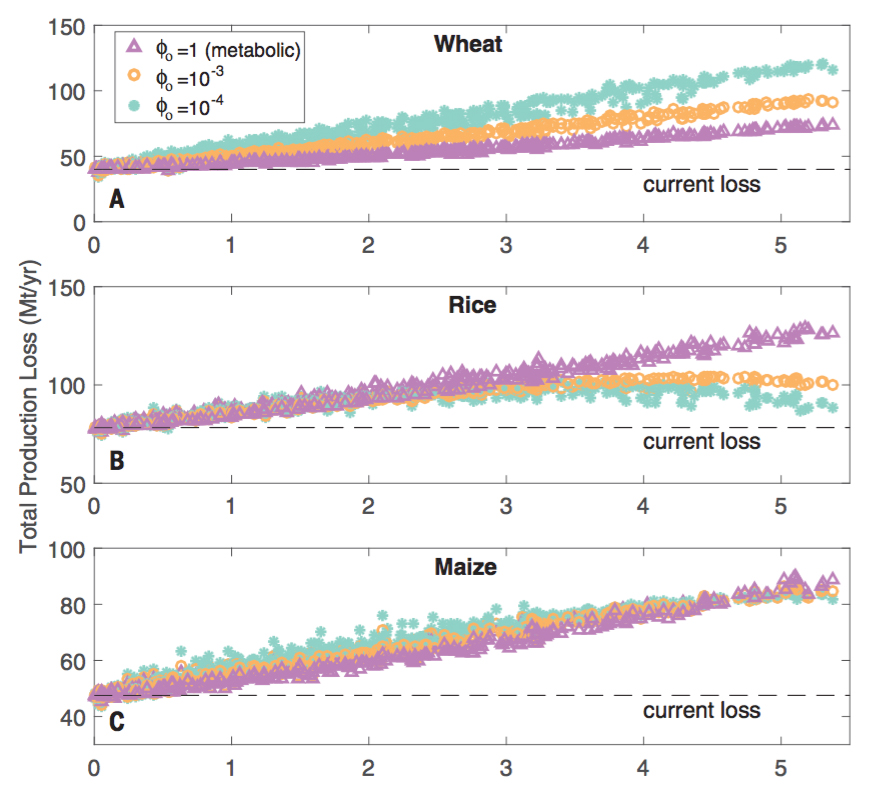
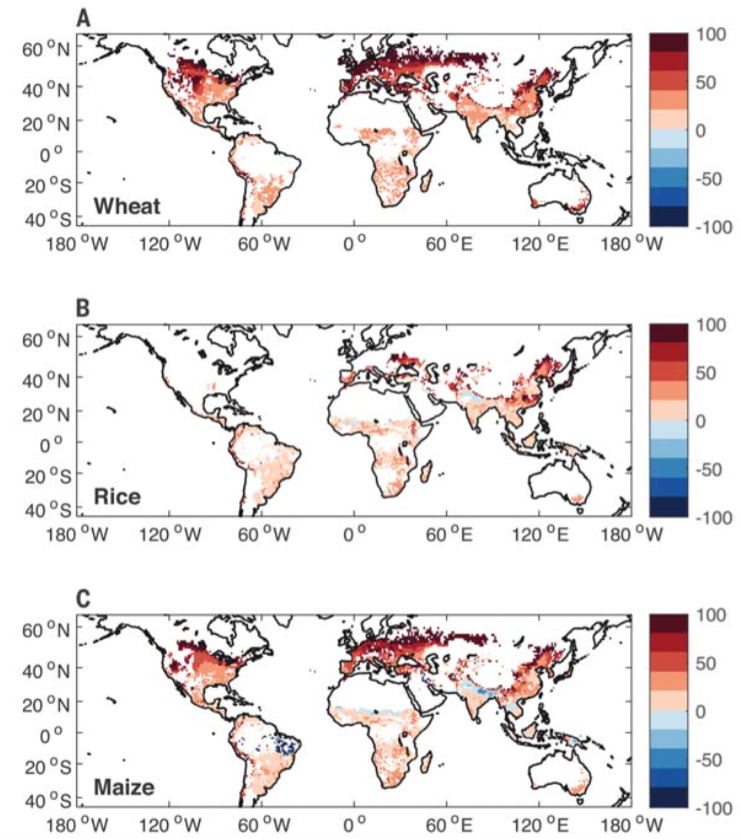
“Poor grain consumers and farming households, who account for a large share of the world’s 800 million people living in chronic hunger, will suffer most.”
Knowing the enemy
The findings should serve a “call for action on climate change mitigation and adaptation”, Prof Markus Riegler, an insect biologist from Western Sydney University, writes in an accompanying perspectives article. He says:“Everyone must be involved in change: farmers, industries, policymakers, and the wider society. There is also an increased need to focus on plant protection, particularly given that many insecticides are being banned over human and environmental health concerns.”
The research offers “a global perspective” of how climate change could impact the damages caused by pests, says Prof Christer Björkman, an insect ecologist from the Swedish University of Agricultural Sciences, who was not involved in the study. However, the study does have a few shortcomings, he tells Carbon Brief:“One is that the authors only model the pests themselves. This is a great simplification because we know their host plants and their natural enemies are affected by the same temperature changes.”
Research shows that climate change could impact many of these enemies – including birds, mammals and parasites. Björkman says:“In other words, the study ignores many key ecological interactions of potentially great importance. Another [unconsidered factor is] the nutritional value of plants may change.”
Research covered by Carbon Brief earlier this week found that the nutritional value of key crops including rice, wheat and maize is likely to fall as CO2 levels rise. If crops become less nutritious, insects will have to consume more plant matter to get the nutrients they need, Björkman says, potentially raising yield losses further.Article information
Deutsch, C. A. et al. (2018) Increase in crop losses to insect pests in a warming climate, Science, doi/10.1126/science.aat3466